
The extremely hot temperatures felt in northeast Georgia, USA recently has caused me to think about water sources for bees. I am not talking about sugar water either. They need plain old fashioned water.
Many people do not realize they should provide water sources for bees. They just set up their hives and let the bees fend for themselves. But like every other living creature, they indeed need water too. Just as we provide fresh clean water for our pets we should provide water for our bees.
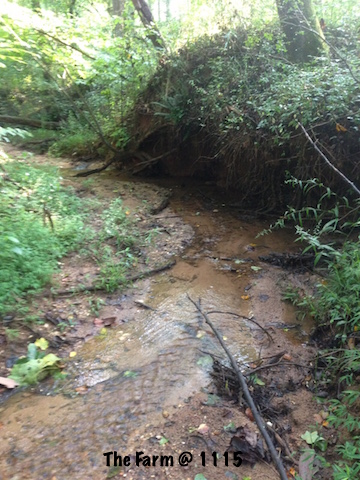
Water source on the backside of 1115.
Why do bees need water?
- water helps cool the hive
- they use water to raise the humidity in the hive
- they use water to dilute or de-crystalize honey to feed larva
- water is used to keep brood moist
- They especially need water during strong brood rearing times such as early spring.
There are numerous ways to provide water for your bees. Remember bees do not swim very well so provide them a landing pad of some kind! You can use sticks, rocks, cork, styrofoam, etc.
- bird baths
- small water feature with plants
- leave a faucet dripping on a board
- chicken waterers
- a dog or cat feeder/waterer
- drips around irrigation hoses
Waterering Hole
It is recommended to try setting up a “watering hole” for your bees at the earliest stage of your beekeeping adventures. If the bees find a different “watering hole” first or one they like better (such as a neighbors swimming pool or still wet fresh washed laundry!) it may be impossible or very difficult to break them from visiting there.
Where I am located my bees have a variety of opportunities for water sources. We are blessed to have a creek on the backside of our property and a bigger creek less than half a mile down the road. They have plenty of space so I only see a handful at a time at their watering holes.
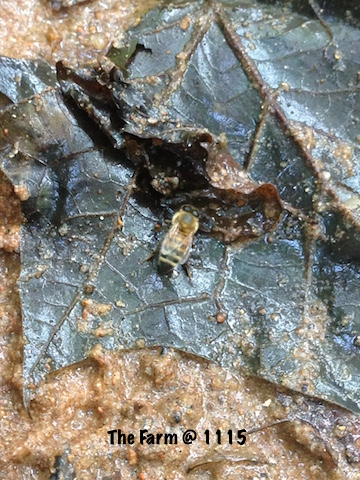
Don’t be surprised if you discover your bees are going to disgusting water holes they find out and about! For example, The Maximus Hound likes to come around to the front of the house every morning to water the ornamentals. It can be quite disgusting at times but that is where a lot of bees are visiting. I have geese and they get their swimming pool water nasty in a hurry but I find bees right there. I have waterers in the chicken coop and the bees are found visiting in there.
We keep our bees in man made boxes. We are responsible for helping them survive. This includes providing water sources.
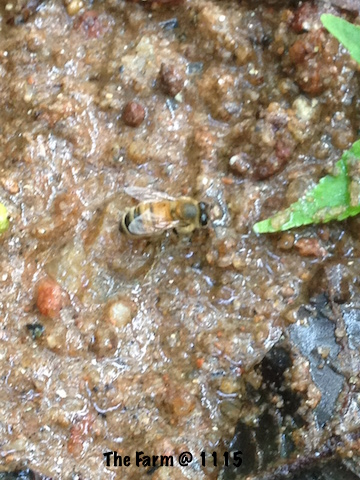
Bees need water.






19 Comments
Slovenian beehive article was interesting. I’m second generation Russian and had a similar idea for keeping bees. (Must have inherited the idea). This idea and a little of what I thought about might make keeping bees a lot easier. I’ll keep you posted.
I have an old swimming pool that I raise fish in and it is covered in duckweed. The bees love to land on the duckweed and drink water from between the plants, so I set up some smaller containers near the hives with duckweed. Never a problem with drowning bees.
Help! Every time we set up a new watering hole for our bees, the yellow jackets swoop in and take it over! This morning I found two yellow jackets eating honeybees that were still alive and kicking. Ugh! I havent found the yellow jacket nest yet, and I have several yellow jacket traps around that are just about full, but still, there seem to be more and more yellow jackets. What do I do?
Yellow Jackets can-be real Pests. They ARE “Ground-dwellers” so Look-Around for their “Hole”. Trust me, you WILL “Find it”!
good idea, never thought of bees and water and today I found them in the green house in the waterers. The board and dripping water sound like the best method.
A fountain — two tiered — allows bees to get a lot of water. Rocks had to be placed in it, though, so the bees would not drown. A great place to observe these bees — on the patio — and the honeybees love it. …and no they won’t hurt you, just move slowly around them and you’ll be just fine
Brenda
Very usefull artical.thanks u
we have many different water sources available, but because their are so many bees they find different areas they like better. One favorite seems to be a flower pot that broke in have vertically. it has collected some debris such as dirt, leaves etc and the slant allows them a landing pad. We basically let nature take its own path.
Most People MUST “REALIZE” that ANY “LIFE” NEEDS WATER! BEES, however, well the BEST REASON to “Provide-your-own” might-“Bee” convenience! After all, bees ARE “Great”, BUT “Neighbors” MIGHT-PREFER” a FEW less around THEIR “Pools, etc.”! Most Keeps I’ve known make-sure to “Keep-Watering-Holes” nearby & ON “Their” Property.
I started my first bee hive in Spring of 2016. It is located close to our pond. Is there a safe way to chemically treat our pond for duckweed that will not harm the bees? The duckweed has taken over and we are losing our fish.
[…] need regular access to water, especially in rising summer temperatures. Provide some kind of small source of water close to the hive: a small pond, bird bath, pet waterer, or even a dripping faucet will do. Include […]
[…] Bees need a water source. If you don’t have one nearby, they will go and find one. We happen to have a fountain in the middle of our yard, which is handy for them. However, if you don’t have an existing water source, you’ll need to provide one for them. This can be anything, from a bird bath to a bucket. Try to provide them with an edge or a place to land, as they like to have a safe place without risk of drowning. If you don’t provide them with a water source, they may find a favorite location (such as a neighbor’s yard) that can be hard to break them from. Oops. Sorry neighbor! […]
So, I have a pool. My neighbor, 2 doors down has bees. The bees are using my pool and have been for a couple months. She has plenty of water for them placed around in bowls and water slowly on the cement for them. Is there a way to break them of their habit to visit my pool daily? I literally can only dip in the shallow end. No diving or swimming or splashing about or they swarm around. Suggestions?
I use the unpopular hive front feeding jars. While not good for feeding ( due to robbers), they work great as a water source close to the hive.
I have question. One of my hives constantly bearding. Even when not hot.
4 deeps, one honey super.
I have question. One of my hives constantly bearding. Even when not hot.
4 deeps, one honey super.
You advise I’ve asked this already. Did not receive reply.
Four deeps is a lot! Are they all filled with brood or are you using deeps for collection of honey for harvest? If all these are filled, this is a BIG hive. As the hive ripens honey, they need to evaporate moisture. Hot bee bodies inhibit this activity. By hanging out outside, it creates space in the hive. But, in a way, everything is related to or because of the queen. The bees do nearly everything bc of genetic predisposition or environmental impacts. It is the result of the queen that you have a big colony. It may be genetically programmed that when humidity and temp is a certain level, the field bees will shun the hive cluster. Do not worry about bearding. I’d camp out at night, too. Becky
– Ol’ Bee Gal
How do bees get water in winter freezing temperatures? Do bees need water in cold temperatures?
I have a question. We have baby bees dying in one of our hives. We are finding them at the front of the hive. Do you have any idea what is going on? Any help is greatly appreciated!