
 by Jennifer Sartell of Iron Oak Farm
 Last fall we harvested our first frames of honey! It was a very exciting moment for us, cut short by a rapid moving storm that came up on us so fast that we hardly had time to get the roof back on the super boxes before the downpour was on us. We were sent running for the house with only four honey frames in tow. But I can’t believe the honey that we got from just four full frames!
It was our second year bee keeping. The year we set up our hives in early spring and let the bees keep all the honey that they produced. We hoped that this extra boost of honey would help them become a strong hive. It seemed to have worked! We also supplemented their honey stores with sugar water in the beginning and a homemade bee candy that we put out for them in the later part of this past spring. (You can read more about our bee candy recipe in my Grit Post, Feeding The Bees.) This extra food supply after winter but before the flowers bloomed, was a nice source of energy for the bees that got them through that last hard stretch.
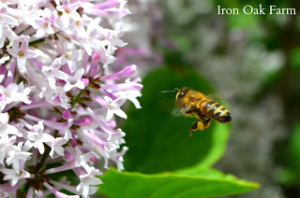 This year, the bees have been super active. I see them everywhere. The flowers have been prolific with all the rain and the early spring weather and the pollinators are taking advantage of this abundance.
This increase in bee sightings and activity prompted us to check the hives and we were pleasantly surprised!
We choose a cooler day, got our bee equipment together and headed out on the walking paths that I mow regularly through the tall grasses back to the hive.
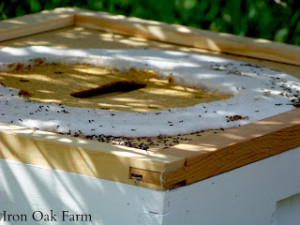 When we opened the hive we found that a colony of ants was taking advantage of the remaining candy that we put out for the bees last spring.
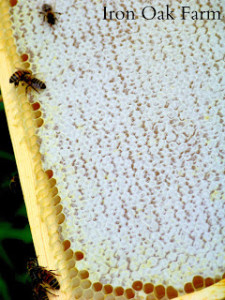 But below this layer, the frames were capped and full of beautiful honey.
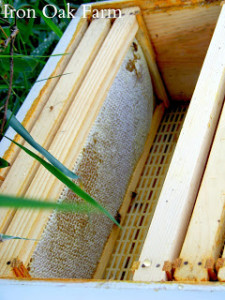 In the time it took us to walk out to the hive, open the box and remove only 4 frames, a storm moved in on us and we quickly sealed up the hive and carried our small but heavy harvest back to the house, shielding the frames from the rain as best we could.
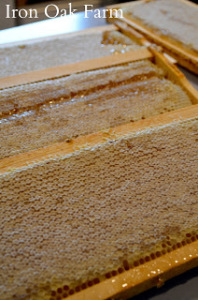 We don’t have an extractor to remove the honey from the comb. So we were forced to improvise.
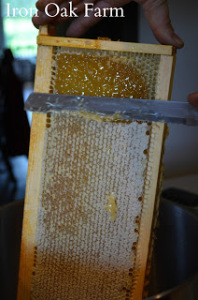 At first, we really wanted to preserve the wax comb that the bees had built so we could return the frames to the bees with the comb still in tact. This would save the bees the extra work of having to re-create this wax comb. We tried cutting just the caped section of the honey and attempted to suspend the frames horizontally so the honey could drain out. This didn’t really work that great. The honey pretty much stayed in place, in a sort of vacuum inside the cells. I now understand why the centrifugal force is required in an extractor to whip the honey out.
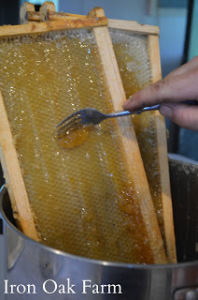 We decided that scraping the frames of wax and honey and letting it strain through a strainer was our best option, and that maybe because we were working with only 4 frames, that it wouldn’t be too much of a strain on the bees to build that comb back up. In our northern climate and shortened warm season, it is more difficult for bees to make wax. At this point in our bee keeping experience we’re sort of “babying” our bees, especially considering the devastating threats they face nationwide. Anything we can do to eliminate stress on our colony is something we try first.
So much to our chagrin, we scraped the frames…wax, honey and all and let it strain through a strainer into a bowl.
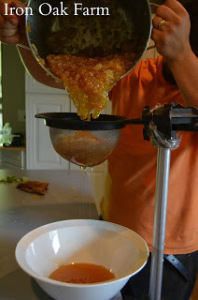 We suspended the strainer clamped in one of my camera tripods and taped with packing tape for good measure.
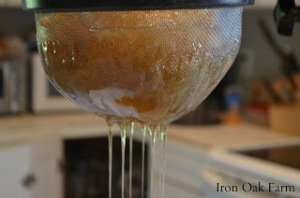 Once it was all strained, we poured it into jars.
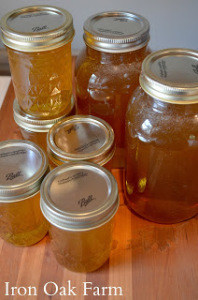 This is what we were left with! 3 1/4 quarts! or 13 cups.
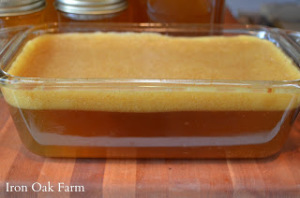 Plus the honey that filled this bread pan in my experiment to separate the wax from the remaining honey.
I melted the honey and wax in a pot and poured it into the bread pan. As it cooled, the wax solidified on the surface and the honey stayed below. We can now use this wax to seal and protect my husband’s blacksmith items or to make candles and homemade beauty products like deodorant and lotions.
After seeing how much honey we got from just 4 frames, I’m tempted to leave the rest for the bees as our first goal right now is to establish a healthy hive so they can produce for us years to come.
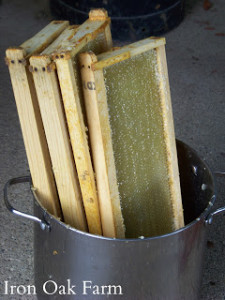 These are the finished scraped frames ready to be returned to the hive. The bees will clean these hives of any out of place honey and rebuild the comb using the plastic “comb sheets” that you see here in the frame as a guide. The plastic sheets have a pressed hexagon pattern similar to what bees naturally build.






56 Comments
Very cool; I have had hives for three years and did something similar the first year. I made cut comb honey, but decided not to do that anymore for the same reason you mentioned: too much work for the girls to rebuild the comb and the turnaround time is too long…less honey production..glad I found your site….it was sent to me by a friend.
there are molds for that
This was our first year of taking honey from our hive also. I used an old potato masher to mash the honey and comb together and drained it the same way. I took all the honey and wax. We got almost 20 lbs of honey out of 8 frames (deep). We left two shallows for the bees for the winter. We live in SC. I am going to try and do what you did with heating the wax to get the rest of the honey out.
Question – How often do you remove the sticky board out of the bottom and replace it?
I live in NY but I don’t think its any different than where you live, we take the shallow frames for ourselves & leave the deeps for the bees unless they can spare some. That is their overwinter stock. You shouldn’t need to change the plastic base unless it becomes brittle or you chose something different like real wax base
The metal strainer you showed may allow tiny bits of wax through which will float to the top of your jars and need to be skimmed off with a spoon before final lids. One thing we have had good luck with is straining through several layers of cheesecloth. It’ll be clean as a whistle……………..
the wax will not hurt you some people like it
I was thinking about the plastic sheets didn’t know anyone who used any. I would like to know how they did the next year. good luck .
i do they are all right
I live in Washington state and I was just wondering if there is anybody here from Washington because I would like to see if I want to do this
Hi, I realize this is a very late reply, but I wanted to say that Washington State is a fine place to raise bees.
i have found that wood frames are all right but wax worms love wood. i went to a non wood for the bees . i am going to try a new way to keep the worms out. i have had bees for a lot of years . mice are a good pest to. put a caller around the lags to keep them put . the navy use them to keep rats off the ship.i hope this helps
Funny, I am just starting out so I don’t have an opinion other than what I have read. Until now I have heard that the wax moths love the plastic frames as there are more spots to hide there eggs but now you mention the worm like the wood…..go figure. I have wood so I will see how it goes. I think they look nicer anyway.
Cheers,
Dave
You do realize that your not supposed to feed your bees while honey supers are on? You end up with honey sauce and not pure honey.
yes that is true you do not need to feed bees they will make honey to feed them
I tried the melting honey and wax and putting in glass pan to separate. Now how do I get the dried wax off of the glass pan?
Got a paint strainer from Ace Hardware; plastic mesh bag which fits over a 5-gal bucket. That worked great for straining and leaves the wax in the bag. You get two in a package for $4.
Immerse the glass bowl in boiling water and let cool. The wax floats and solidifies on the water when it cools.
Put the glass or mesh container in the freezer, the wax will come off very easily, no mess.
let the wax harden then use a knife to get it out
Thanks for the tip, this is our second year. We can’t afford extracting equipment, like we thought, and have been worried. We also left a medium super full for the bee’s winter food, seems only natural.
I’m been doing this type of extracting for years. They make a mesh strainer that fits on a 5 gallon bucket, and you can put a honey gate on the bucket. By the time I take the cappings off, most of the honey is gone, then I let the bees clean them off .
The beauty of this method is that I can do 4 frames each night after work, and then return for them to clean up and fill. I don’t have to figure out how to get a bunch of supers off, and store them, and spend all day extracting.
Uncap and lightly break up the comb and bundle it in fine nylon cloth. Squash it with a weighted lever. The setup depends on your ingenuity but the squashing has to be done near to the lever hinge and the lever length about 10 times longer than the distance from the hinge to the squashing with weights hanging on the end. The weight can be, say, a bucket of water? The lever must be strong enough not to break! How you catch the honey that squeezes out depends on what equipment you have. The bundle can be on a simple slightly sloping board so it drips off the end….. or something more elaborate. Remember, a gallon of water weighs about 10lbs, so a 10 to 1 lever gives about 100lbs squish force so don’t get your fingers in the way!
You could also use an old cider or grape press if you find one on a yard sale. I use an old cheese press but it only holds two frames of comb.
Thanks for the idea of scraping the honey as a means of harvesting it. Like you, I have only one hive, and I just could not justify the expenditure for an extractor for such a small amount. I have had my one hive for a year now, and will be taking some honey in the next month or so, so the information was timely.
http://floridahomesteading.com/extracting-honey-without-an-extractor/
this is how we do it.we find the cheese cloth to do the job.it is basically the same either way.
but,when your done you just put the cheese cloth and wax in a pot and boil it.
I interested in bee keeping at my small ranch. I have considered a bee hive from my local feed store. I have a spot I feel will be good for the hive. The problem I have at hand now is, where, when, how and cost do I find a queen and her herd? Any help out there?
Starting beekeeping really requires advice from local beekeepers. Get books, contact your local extension agent. In our county we have classes and mentors. Also about extracting, we have enough interest to form our own county honey house for small beekeepers. New hive bodies (boxes) can cost $100-200 for a setup. I suggest purchasing the first one before you consider doing the woodworking yourself so you can see how they work up close. You also need to decide if you have frames, like most of us do with Langstrohm hives, or try hanging combs that the bees build up freeform from hanging bars. Anyway, I’m glad you’re interested in starting hives!
Thank you so much for such a simple explanation. We are new beekeepers in Kent, UK. We have had lots of good help from an experienced mentor, but are still often confused by the whole beekeeping parephernalia! You would be surprised how comforting your description has been – and comments from other beekeepers. Thanks, Lynne
Im looking at setting up a hive here in NY (just outside of NYC)
The removal of honey if you didnt want the wax and make the bees job easier to rebuild, would you be able to scrap off the caps on one side then punch the other side out with a small screwdriver/ice pick
Time consuming Im sure but this way you could drop the honey half a frame at a time into a tray and because the comb is broken both sides the honey should come out easier, certainly seems a cleaner way of doing it.
Am I missing something to extracting the honey with no/little damage to the comb/frames?
I have a $159 extractor. Even after removing the caps with a knife and placing 2 frames into their basket and cranking the handle for 15 minutes very little honey was extracted. I then did it by hand with my fingers honey, pollen and wax flowed into my “extractor” . Love your method had remove and. Strain.
Just love your presentation
Thank you so much for sharing! I’m in the same predicament, no extractor. Your experience is very helpful!
I’m a novice beekeeper who just tried the “let it drain” method for my first extraction. You’re right, it’s at best unworkable slow. When my more experienced colleagues scrape off misplaced comb, they leave it in the hive for the bees to re-use. Perhaps doing that with the extracted wax will save the bees the effort of making it again.
[…] http://backyardbees.wpengine.com/extracting-honey-without-extractor/ […]
You need to see how long your writers have been keeping bees. Anyone in their 2nd season should not be writing about beekeeping.
This is exactly what I’ve got to do this evening and just wanted to ask how you heated the wax/honey. Did you use a double boiler? What temp if just a pot?
Thanks!
I AM A NOVICE AT BEES. MY SON DESCOVERED A SWARM IN HIS PLUM TREE, WE MANAGED TO CUT THEM OWN AND PLACE IN A BOTTOM SECTION I HAD BUILT FOR THAT PURPOSE, HE HAS HAD SEVERAL SWARMS. I PUT A QUEEN SCREEN IN AND A 9 INCH FRAME AND A SMALLER ON ON TOP. FOR A TOTAL OF ONE SMALL ON BASE ONE 9 INCH WITH WATER CHAMBER ION NEXT AND A SMALL ONE ON TOP, HOW OFTEN SHOULD I CHECK THE WATER 3 GAL WITH LADDERS?” AND NEED TO KNOW WHEN I SHOULD BE READY TO REMOVE HONEY, AND DO I HAVE ENOUGH ROOM FOR THE HIVE? I AM 81 YEAR YOUNG, NEED ALL THE HELP I CAN GET. SO THANK YOU FOR THE VISUAL HELP, I LEARN BY SEEING AND HANDS ON..
Jennifer, thanks for sharing your experiences of harvesting honey without an extractor. I will be taking part in harvesting with an apairy this week and will see how the large producers work their hives at harvest. Looking forward to learning all I can. I am new at bee keeping this year and hope to at least take a sample of the honey from one of my colonies this year. I also want to leave them more than enough to get through the winter here in mid Missouri.
Thanks again for your article.
Nancy
I would like to extract honey locally bcoz i have only 1 longstrorh bee hive
I just did the 2 bucket extraction process. Worked well as I only have 1 hive, and 3 supers that need extracting. My question is….I extracted one super and then put the super back on the hive with the remains of the honey that didn’t scrape off the frame. Will they rebuild the comb before winter or do I keep checking to see if they clean it off and then get ready to store it for winter.
Wow!! Very informative article!!! Thank you so much!!! This was our first year of taking honey from our hive of bees and we only took 3 frames. At this time, we don’t have an extractor, but we are planning getting one for next year. Thanks again!
I am in Australia, could I use eucalyptus or wattle leaves in the smoker?
Stacey Connell, I Live in WA, I have found Eucalyptus leaves work great in a smoker. Get it going and then pack it tight!
Aloha You are very lucky !! I am a beekeeper who uses only the Top bar beehives The advantage the honeycomb is used only once ,so you are getting superior honey …..the wax collects the pesticide when reused again and again !!!! Certainly You are getting less honey ,it is mostly used by hobby beekeeper and You can use a paint strainer which will give you honey with all the goody’s !!!! I am making a dvd about my I do have the copyright and it will give You some easy instruction how to built it !!!!
Hello my husband loves honey and his birthday coming up and was trying to find a place thats lets us scrap our own honey and put it in a jar for us to take home . If you can help
Second year beekeeping, I also do not have an extractor, and I found my honey did not flow. It remained creamy and thick. Do you need to remove the honey/comb at a certain temperature? It was very frustrating. Thanks
Boiling the honey to extract the wax takes the nutrients out of the honey!
Drawn comb is money in the bank. Invest in an extractor, or rent, or borrow one. You and your bees will be so much farther ahead next year. Honey bees have to consume 6-8 pounds of honey to make 1 pound of wax. If you only have 4 frames to harvest…well, that’s hardly worth the mess.
[…] But back to our first honey harvest. We took two frames, which we extracted without an extractor. If you’re curious how this works, go here: https://www.keepingbackyardbees.com/extracting-honey-without-extractor/. […]
I am New in this field. I retired from Indian army. Please guide me which place is good for keeping the colony (Boxes).
I am so glad that you don’t have to buy an extractor!!! I am going to get bees in the spring, and I don’t want to have to buy an extractor!
Very interesting article. I have wax foundation in my frames. Can I still use the scraping method of extraction? Will it damage the foundation sheets or should I cut the whole lot out and crush it all up and then remake the frames? I like the thought of giving the bees back something to rebuild.
When you take your comb that has been crushed and strained and then heat it up to separate the last of the honey and wax – at what temp to you heat it up to and for how long?
Darrell,
1) I hope that other folks here answer you.
2) We’ll be adding your question to our Bee Questions answered podcast with Becky Tipton that comes out once a month. Look for it on the Mother Earth News and Friends website: https://www.motherearthnews.com/podcast
Is that strainer plastic or stainless steel?
Jennifer
I am a first year beekeeper this year, 3 hives overwintered well. I had a huge ant problem. massive amount of ants in the lids. I tried this and I have had zero ants in my hives. Zero. My hives are sitting on two 4 x 4’s that are sitting on a large concrete block at each end. I took vaseline and wiped a 2″ band around the block. The ants cannot climb through the vaseline and have no other route. Super cheap and easy and 100% effective. Hope the tip helps you or others.
Steve
I read with fascination your article on extracting honey with out an extractor. Just a couple of quick questions. How long did it take for the honey to run through the screened strainer? Did you also run the honey through a cloth strainer a second time to remove any pieces of wax?
I live in columbus, ohio and unfortunately, my bees did not survive the winter (despite feeding them in the fall and over the winter). When i cleaned out the hive, i was amazed at how much “product” was left in the frames. I say product because very little of what i saw looked like the nice white capped honey that you show in your pics. much of mine was uncapped and looked like nectar (or perhaps storage of the sugar water from my feeder) or was dark looking. The frames also had powdery mold on the top. I had built a quilt frame and put it in last fall but believe water got in the hive (we had a very wet spring this year). I worry about disease though. Does this sound like the hive died due to moisture, or disease? The mold is what concerns me the most. I appreciate any advice you might offer. Thanks.
Would heating the honey-and-wax mixture not destroy the biologically active ingredients of the honey? I scrape the wax foundation to release the honey and then put it all in a muslin sheet which I gather around the mass and hang over a receptacle to catch the honey. The wax is later recovered and washed to remove traces of honey. I dry, then melt the wax and filter it through paper towel to retrieve very clean product.