
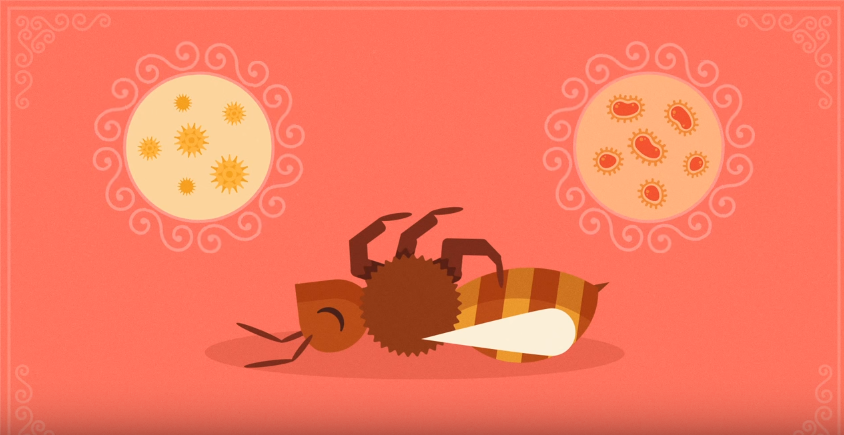
 Did you know that approximately one out of every three meals consumed by humans today is made possible by honeybees? Did you know that the dollar value of plants pollinated by honeybees every year is about $265 billion?
But worldwide, beekeepers have seen a loss of 30-90% of their colonies in what’s been called colony collapse disorder. In the United States alone, hives have decreased from 5 million hives in 1988 to 2.5 in 2015.
While scientists are not entirely certain what’s causing colony collapse for sure, this easy-to-understand animation carefully explains the phenomenon and why we need to help the honeybee if not for their species, at least for ours.






6 Comments
For all we know, this is an intentional plan of global elitists who want to depopulate the earth to just 5% of current population levels. These criminals have openly admitted their goal of eliminating 95% of the human population on the earth which is genocide on a level never before conceived. Time for people to wake up to the fact that global elites are the most hideous criminals that ever existed.
First of all, the claims that if honeybees go, so many plants and crops will die is not true. Productivity may drop considerably but in a few years it will resume when native pollinators multiply to fill the void; as most of those pollinators are NOT plagued by mites, wax moths, hive beetles, or the other diseases associated with honeybees. And it isn’t likely the globalists have planned this, but what is likely is that it is a useful “side effect” of their other evil doings (GMOs, chemtrails, saturating agriculture with pesticides and herbicides, etc). It should be noted that these colonies that are dying out are NOT those of the smaller beekeepers, most of those are lost due to poor management and inexperience, but mostly of the commercial beeks who transport their colonies all over the country. As a local beekeeper, I know ALL of the crops within 3-5 miles of where my hives are placed and I deliberately keep them out of reach of GMO crops and farmers who use commercial herbicides and pesticides. I also aid the native pollinators like bumblebees and mason bees.
One thing the video failed to mention is greedy beekeepers taking all the honey from the bees then feeding them white sugar as a “replacement”. That would be like feeding a human a diet of candy bars–one might live for a while, but wouldn’t be healthy or live for very long…….
Just an observation I have made and I am still not sure where it will take me in the future but I will follow up and see.
I was called to come get a swarm some distance from my home and I carried an empty hive and sat it on a table and gathered the Bees in it and made sure I had the Queen. That night I returned and close the hive and brought the hive home in my Suburban with a very nervous wife beside me. I made a feeder of sugar water and the Bees really began to thrive.
After about a week to ten days I removed the feeder thinking the Bees would continue to do well but to my chagrin the entire hive disappeared overnight. All of which makes me wonder if a short food supply is not a major cause of Colony Collapse rather than some other cataclysmic event. If the Bees die in the hive there should be some sign of it, however if they leave all at the same time only the ones not at the hive will still remain. It is my intent to start new colonies this year (2016) and leave the feeders in place and see what happens. My thoughts, Yours are welcome too!
First only 15% of crops are pollinated by honey bees, second the number of hives in the US and worldwide has been stable for the last 25 years or has slightly increased. No bee-apocalyp, sorry. Third the cause for collony collapse is now shown to be varroa mites passing viruses from bee to bee. The mites eggs are infected, as are the queens eggs if she gets infected. New mites attach to young bees and spread around, sometimes dropping off on flowers to wait for a new ride. Fourthly native bees ARE affected by varroa and the attending viruses, but they seem to be a little less affected, perhaps due to their smaller, shorter hive cycles, bumblebees bees make a new nest each year. There may be some slight stress caused by pesticides, but most pesticides are now applied when bees are not visiting flowers. And many are applied to the seeds and have no measurable affect on bees. Despite several paid for psuedo scientific papers to the contrary, paid for by big organic farming groups.
Your assertion that ” backyard beeks ” are a cause of the demise of bees made me see RED. How dare you. We spend our time, money and energy to keep our bee alive, healthy and happy. COMMERCIAL bee pollinators are the cause of deaths of bees. Do some research.