
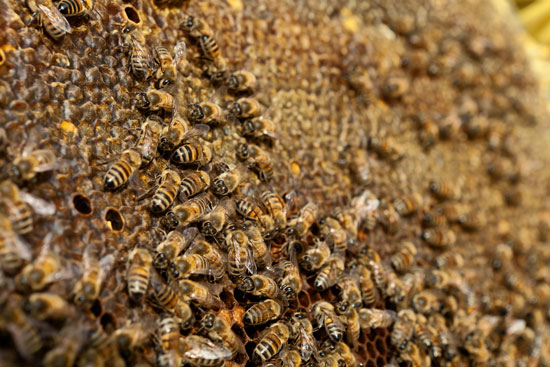
Experienced beekeepers are keenly aware of which flowers provide bees with nectar, when those flowers are in bloom, and whether the right balance of rain and shine has encouraged them to bloom in abundance. In beekeeping jargon, when there is a bounty of nectar for bees to forage, a honey flow is said to be on.
Honey flows are regional to the highest degree, and the only effective way to figure out if you’re having one is local observation. If you’ve made connections with other beekeepers in your area, you can take advantage of their seasoned surveillance. Otherwise, be on the lookout for the following signals of honey flow.
Signs of honey flow
Lots of blooming nectar sources
This isn’t as easy as it sounds. Not every flower is a nectar source, so you need to educate yourself about which ones are destinations for honey bees. Also, bees can travel several miles in foraging expeditions, so it’s not a matter of looking out your window and seeing what’s up in the backyard. Keep an eye out as you travel around your town, noticing where honeybees are gathering.
Lots of nectar in the comb
This is a great indication of a honey flow, but if you’re feeding the bees, you won’t know whether you’re seeing sugar syrup or floral nectar. If the bees stop taking the syrup, however, you know a whopper of a honey flow is on and they are getting all they need from the land. That’s worth celebrating!
Lots of fresh, white wax
For a colony of bees, plentiful nectar and pollen is equivalent to wealth. Flush with resources, they begin a building boom and rapidly expand the comb to make room for more brood and more food.
Lots of foraging
During a honey flow, your hive will bustle with activity. Bees come and go from morning to evening in greater numbers than you can count.
Rapid weight gain
Give your hive a heft test each time you visit it. Heave it up a smidge by the handle of the bottom box. Weight gain is always a good thing, and a rapid increase probably means a honey flow is on.
Strong, sweet scent
If walking by your hive feels like passing through a cloud of ambrosia, there is probably lots of honey ripening inside. Happy day.
A honey flow can last days or weeks, depending on the bloom time of the nectar-rich flowers. If you’ve positively identified that a honey flow is on, pause or slow down the frequency of your inspections so you don’t hamper the colony’s burst in productivity. Your main task at this point is to provide enough space for the bees to store their bounty.
Depending on where you live and what the weather is doing, your first honey flow might be in the spring.
What’s in bloom?
By no means a complete list, here are some nectar sources you might find in your area:
Acacia, Alfalfa, Apple, Aster, Avocado, Basswood, Blackberry, Black locust, Blueberry, Buckwheat, Chestnut, Clover, Cranberry, Eucalyptus, Fireweed, Goldenrod, Huckleberry, Lavender, Linden, Orange, Poplar, Pumpkin, Raspberry, Rosemary, Sage, Saw palmetto, Silkweed, Snowberry, Sunflower, Thyme
A bee sucks nectar from a blossom with a long, tube-like tongue called a proboscis. She stores it in her honey stomach, an internal organ separate from the stomach that digests the food she eats. When she returns to the hive, house bees will suck out the nectar and ripen it into honey.
To collect pollen, a bee scrapes it from a flower with her hind legs, which are covered in tiny hairs. She spits out a bit of nectar so the pollen sticks together, packs it into a pellet, and presses it into a cavity, called a pollen basket, on each hind leg.
Mandibles are for chewing. For example, workers masticate wax they have secreted from a gland in order to form comb.
Guest post by Alethea Morrison of Grit.com





1 Comment
I am a new bee keeper and COVID has placed me and others at a disadvantage. I have read a lot about honey flow but I find it difficult to find an answer to my question. When do I harvest honey? Is there a month during the summer that is best. And, what do I do with the frames, if I choose the crush method?
Thank you