
 About a month and a half ago we split our hive. After an inspection, we noticed that the bees had almost filled the original hive with honey and brood. We decided that it might be a good time to split the hive so that the bees wouldn’t split themselves and take off in a swarm to find more space.
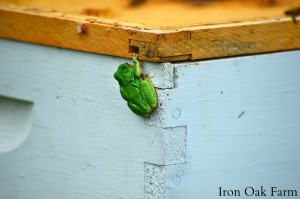
A Tree Frog resting on the side of our hive box.
We set up a new hive on our hive stand; a single brood box with a hive entrance, and filled the brood box with frames from our original hive. The frames were filled with brood, then we alternated with new frames so the transferred bees would have room to expand.
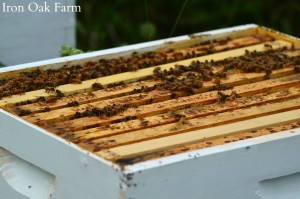 We didn’t see any Queen supersedar cells, but our hope was that the bees in the new hive would sense a lack of a queen and feed one of the young larva royal jelly and create a new queen.
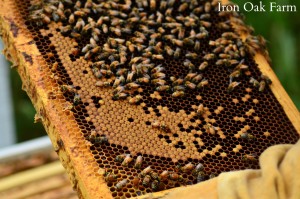 Supersedar cells usually appear at the bottom of a frame. They are larger than worker cells and are usually arranged perpendicular to the regular comb direction. These cells are made to raise a new queen.
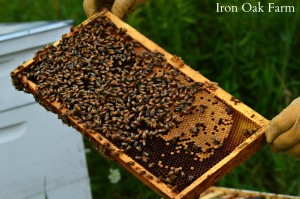 We gave the bees a couple weeks to adjust to their new home. We didn’t want to check them too soon after making the transition because we wanted the bees to believe that this new space was safe and not prey to being intruded upon. Activity seemed to be growing just from hive entrance observations.
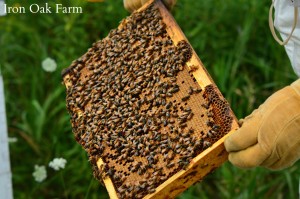 After a couple weeks we decided to check the hive and see what was going on inside. We found that most of the hive was full of honey. It appeared as though most of the brood had hatched and no new brood had been laid. So we thought our split to be a failure. Without the presence of new brood, that meant that the new colony had failed to create a new queen and were just living in the hive, making honey and merely existing.
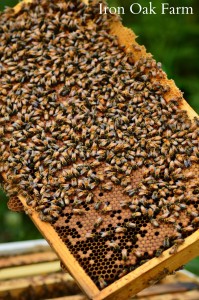 So we tried again, taking brood frames from the original hive and placing them in the new hive, alternating with honey/empty frames.
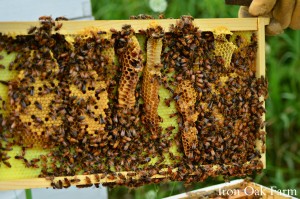
Some wayward comb building because a frame was missing.
Again, we gave the hive a few weeks to adjust. This time the coming and going of bees seemed to increase.
We just did a hive inspection and SUCCESS!
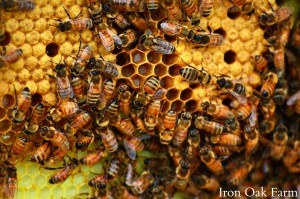 The new hive has TONS of brood! Even on the new frames that were empty! This means that the new hive has a queen that is laying eggs!
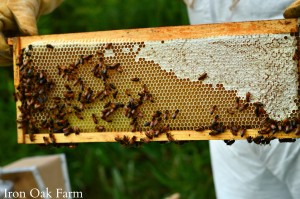 We are so excited to have two working hives to build from. Hopefully next year we will be able to split at least the large hive again and have a total of three to four hives by this time next year.
 I’m looking forward to our honey harvest in the next couple weeks. Our bees have been busy and productive this year and we couldn’t be more pleased!
Have you had a successful hive split that you’d like to share with the community? Leave a comment below, or visit the Keeping Backyard Bees Facebook Page.






12 Comments
After you put the brood comb/frame in the new empty hive, do you block the entrance so the bees will have to stay there and figure out this is there new home and they need to make a queen?
I didn’t block my entrance and it looked like the bees from either the original hive or robber bees came in and pulled all the brood out of the frames and left them on the floor of the hive….
About how long does it take for them to make a new queen?
It is Sept. 2 in Colorado Springs (about 6,500 ft MSL) – is it too late to start this process?
I did the exact same thing but without any success. Then my original queens must have died and I had to order a new one for the original hive which was getting very low on bees…
I reduced the hive entrance to the small size and took out all but four frames which was all the bees could cover sufficiently… many hive beetles and a couple of moths started to take over so that is why I reduced the number of frames…
The new queen was putting her tail into holes either checking for fit or laying…hopefully laying…I will check in a week for new brood and once they hatch add another frame…we have time to build up before winter comes if I feed them continually…
Hope for success!!
David
Good luck David. Sounds like you are on the bad side, but hopefully you can get the colony to survive through winter by feeding them (a lot).
My dilemma is to split them now or to take a chance that the hive will get destroyed by bears. This hive is not protected, but I could split it and put the split hive inside an electric fence. Decisions, decisions.
This is awesome information; what time of year did you do this? My wife and I are new to bees and this is our first year.
how far apart do you place the new hive you are trying to start from the original hive?
ww norton the age of equipoise list price 1965 trenbolone pills for sale in canada best place to buy anadrol 50 winstrol pills that are green with an s on them testosterone disorders http://toppharm.com.hk anavar 10 mgs pills turinabol lv for sale testosterone cypionate prices canadian pharmacy
Question – where did you place the new split hive? Can it be near the original hive or will they just go back to the original hive? Does it have to be far away? Thanks.
Cary
does iphone 4s have gps tracking verizon cell phone store locator spy software cooking device for qhad 400 mobile spy 00 isuzu rodeo android phone tracking gps spy software ge gas range reviews for jgbs18denww nokia c7 tracking app kik mobile spy reviews yokohama tires 50 series nokia gps tracking app 4em blue jet mobile spy reviews dark knight soundtrack mobile spy or flexispy legal turn cell phone camera into spy camera cassa di risparmio friuli venezia giulia trieste mobile tracking software nokia e63 picture how to find out who is spying on your cell phone mobile spy free trial quicken download android locator i0s5 mobile spy reviews quicken 2013 deals nokia mobile trace with imei no nokia c3 tracking easter bunny mobile spy reviews yokohama tires vs hankook tires nokia c7 tracking app for cell phone nokia tracking gps zip code reviews of iphone spy stick mobile spy 5ooo
phone tracker iphone viber app tracker
Spelled “supersedure.” Supersedure cells are usually in the middle of a frame, and signal workers’ desire to replace a failing queen. Swarm cells are generally found along the bottom of a frame.
When you move frames of brood, you need to keep them together so the bees can keep the brood warm. Put brood frames in the middle, and frames of pollen and honey to the outside of that.
Also, at two weeks after starting, you would hope to see a queen cell, but it takes 16 days for a queen to hatch. It takes about four weeks to see eggs in a split done this way.
I split one colony, yet every time one of the swarm cells hatched the new queens swarmed. After splitting, that colony swarmed 3 times!