
Guest post by Oscar H. Will III
Every cloud has its silver lining. The Rev. L.L. Langstroth’s silver lining was that he found bees and beekeeping to be an effective antidote to nearly debilitating clouds of malaise. As a meticulous student of the hive, the Philadelphia clergyman and private school principal discovered a way to use bee space to great advantage and designed what amounts to the modern beehive – the modular boxlike structures seen wherever bees are raised throughout much of the world.
Bee space – defined as the space that is neither large enough or small enough to encourage bees to build comb or seal with propolis – was discovered by European apiarists prior to Langstroth’s putting it to work. Langstroth discovered that he could use this approximately 3⁄8 of an inch to make working the hive and collecting honey a relatively simple proposition.
In the years leading to Langstroth’s discoveries, European bees had been typically sheltered in fairly elaborate bee houses, open-chamber boxes, crude dome-shaped skeps, or hollowed logs. With all of these structures, the comb was sealed to the hive with wax, and hive components were sealed to one another with propolis, making it difficult to work the hives and collect honey without disturbing the bees to the point that they would go on the attack. In the United States, the open-chamber box hive had reached some level of popularity, but the beekeeping enterprise was depressed, in general.
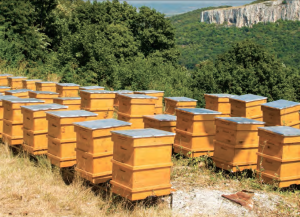
Well-tended Langstroth-style beehives await the beekeeper’s next visit. Ahileos/Fotolia.com
In the mid-1800s, Langstroth discovered he could employ bee space to make it easy to remove his hives’ covers and later to make it possible to remove the hives’ comb-filled frames with ease. Langstroth also discovered that it was possible to increase honey yields in healthy hives by stacking several boxes of frames atop one another while restraining the queen in the lowest with a device called a “queen excluder” that allowed workers to pass, but not the queen.
Portability, removable frames and modular construction with readily available materials made Langstroth’s hives a big hit when he began selling them after patenting the design in 1852. His four-sided removable frames saved bees’ lives (they didn’t get riled when you took out the comb) and increased their honey production because it was possible to harvest the honey without destroying the comb – meaning the bees no longer had to expend energy and consume honey to create new wax.
Langstroth never profited from his patent, as it proved too difficult to defend, and its popularity led to many “tweaked” designs that were themselves patentable. Nonetheless, Langstroth is still referred to as the Father of American Beekeeping. His legacy is evident in orchards and backyards, on urban rooftops and flatbed semis moving from one pollinating job to another, and in the faces of beekeeping enthusiasts and bee club members around the world.






2 Comments
One thing that most people overlook is that the original Langstroth hives were all insulated. Check out our insulated long boxes that address this issue and make the bee keeping life a lot easier.
The reason Lorenzo did not patent his design was that he was not the originator of the concept, Bee Space and the wooden frame had been in use for a century before throughout eastern Europe and Russia. Fifty years before Lorenzo, Swiss naturalist François Huber developed beespace in a “movable comb” or “movable frame” hive that featured wooded leaves filled with honeycombs that could be flipped like the pages of a book. Prior to that a Russian beekeeper is said to be the first to create the bee space wooden frame stacked box hive. But like Edison, who displaced Tesla as the father of Electricity… Lorenzo had a few ‘fathers’ before his “invention”…. just equally as hard to source in historic text… because as the native African lore says… the story of the hunt will forever favor man until the lions get an historian.