
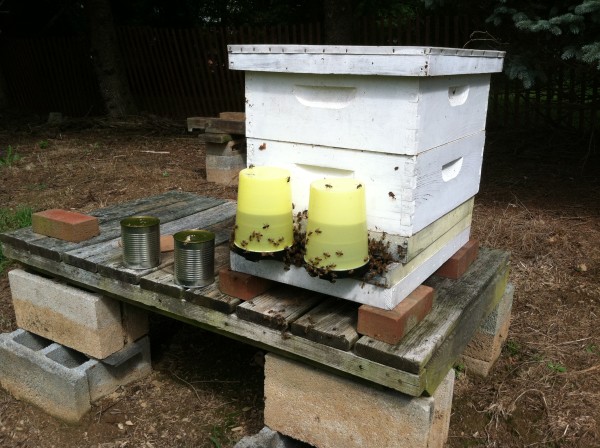
Feeding a newly installed package of bees
When to Feed Bees
Feeding bees is all about stretching the food stores so that bees don’t starve from lack of nectar, especially during the cold winter months. Feeding bees is essential at different stages of keeping bees.Newly installed bee packages also need a boost of sugar water until they get their house in order. As a gardener and a beekeeper, I am careful to plant very early and late boomers to provide much needed foraging for pollen and nectar when very few flowers are blooming. For early nectar sources, go to my post Early Spring Bloomers and for late bloomers, Autumn Super Stars. And don’t forget, when you use a honey jar up, there is always a little bit left which I give to the bees.
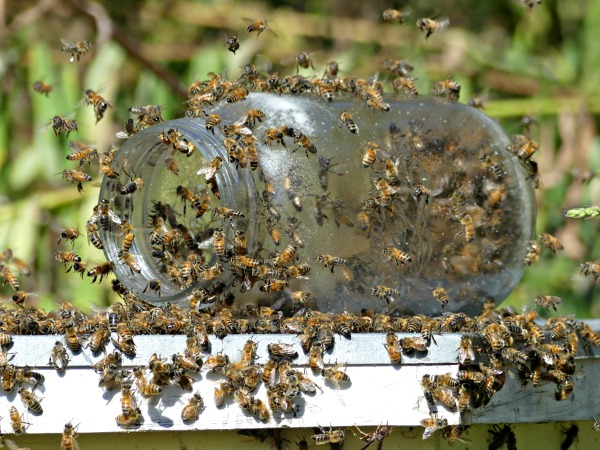
Set your empty honey jars on top of your hives so your bees can extract every bit of honey from them
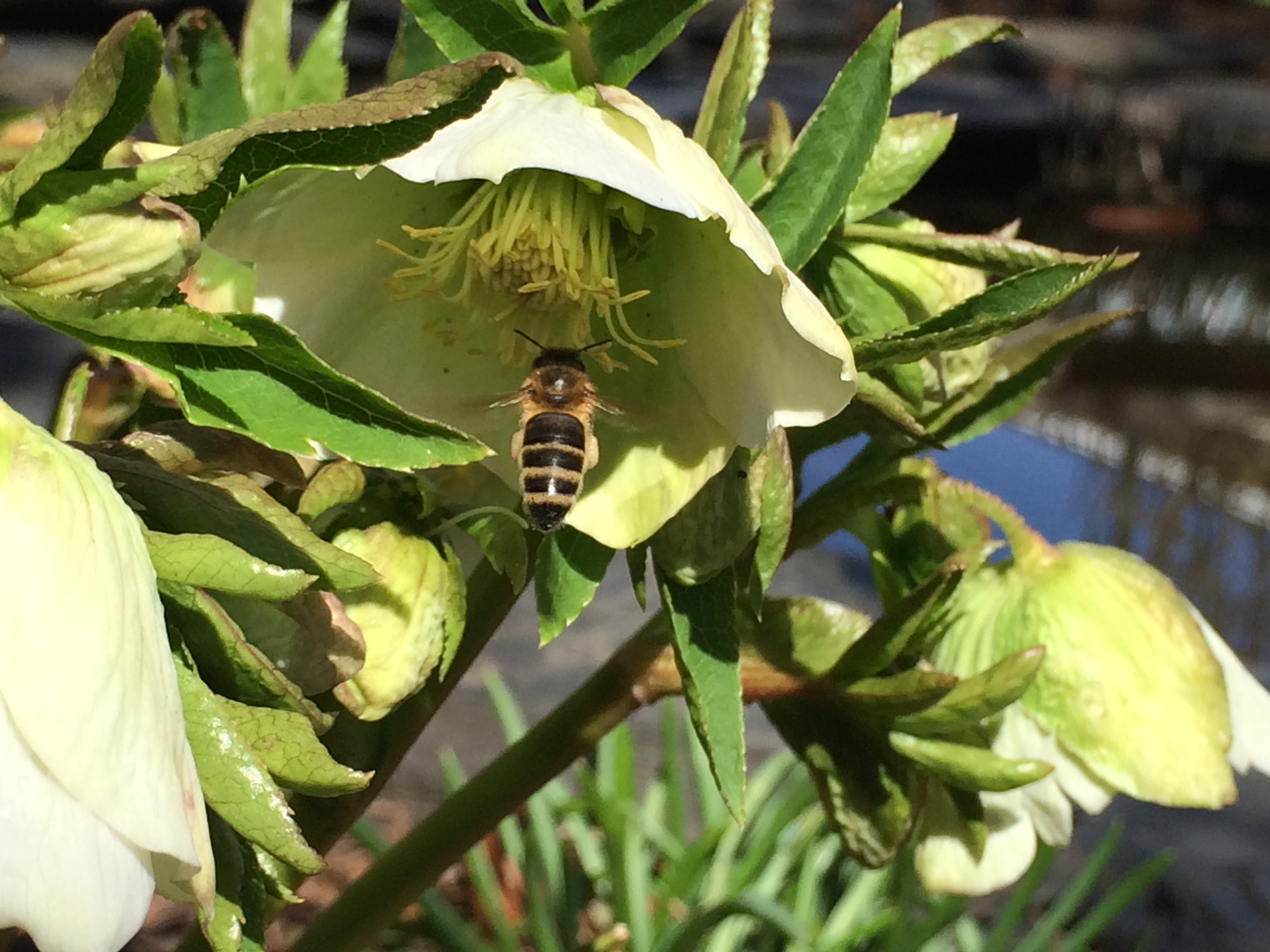
Helleborus or Lenten Rose is one of the first late winter bloomers in my garden
But for times when there is absolutely nothing blooming in my garden, late November to early March here in the mid-Atlantic region, I need to supplement feed, either sugar syrup or fondant. When I have some days in November or December that temperatures rise over 50 degrees Fahrenheit, one of my hives can suck down at least 2 quarts of sugar water.
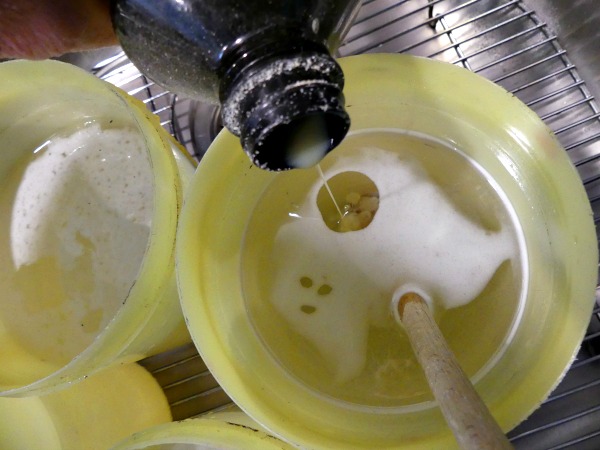
Mixing up 2:1 sugar water solution and adding HoneyBee Healthy, an attractant
Fondant to the Rescue in Winter
But for the really cold days when the bees aren’t flying and are using up winter stores, try making up a fondant as a supplemental food source. Fondant is simply a thick paste made of only sugar and water, with no additives. Commercial fondant that is used for decorating cakes usually has other chemicals added to increase shelf life so I make my own. I have seen many recipes for fondant that require boiling the sugar syrup using a candy thermometer to hard crack stage, then kneading it…..this is way too much work for me! Instead, I have used this home-made no-cook fondant that you can whip up in 10 minutes for years and the bees love it!
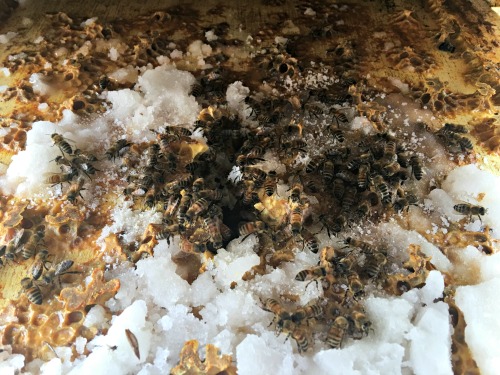
- Home made fondant covered with bees on the inner cover
Fondant Recipe for Feeding Bees
Starting with a full bag (4 pounds) of sugar I dump 2/3 of the contents into an disposable aluminum pan – mine measured 14″ x 10 1/2″.Spread the dry sugar evenly across the bottom of the pan. Mix the rest of the sugar in a measuring cup and add water until the mixture is just wet through. The sugar solution will be very thick, but pourable. Pour the solution into the pan and mix with a wooden spoon until all sugar is saturated and there are no dry sugar crystals left.
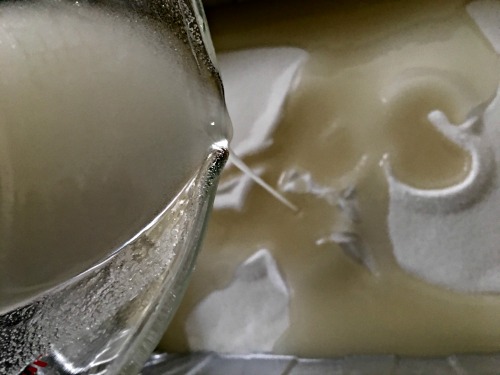
Pouring the super saturated sugar solution into the aluminum pan of dry sugar
Rinse out the measuring cup with a little bit of water and pour the remainder of the sugar solution into the pan to get every bit of sugar. The mixture should be pretty solid as you jiggle the pan. If the mixture is too wet and slurpy, sprinkle some dry sugar on top. The end product should be candy-like in texture, very like fudge.
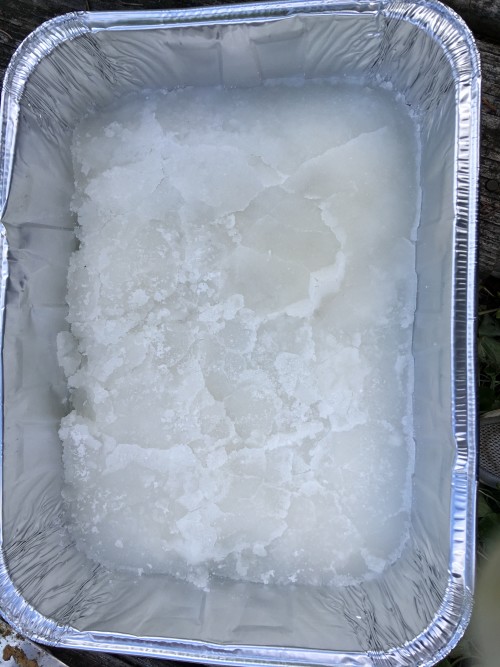
Cracks will appear in the block as it dries
I keep the aluminum pan in the kitchen for about a week drying out and cracks will appear, but that is just a sign that it is drying out with excess water evaporating. When dry, you can break up the chunks and place them on top of the inner cover for the bees to access.
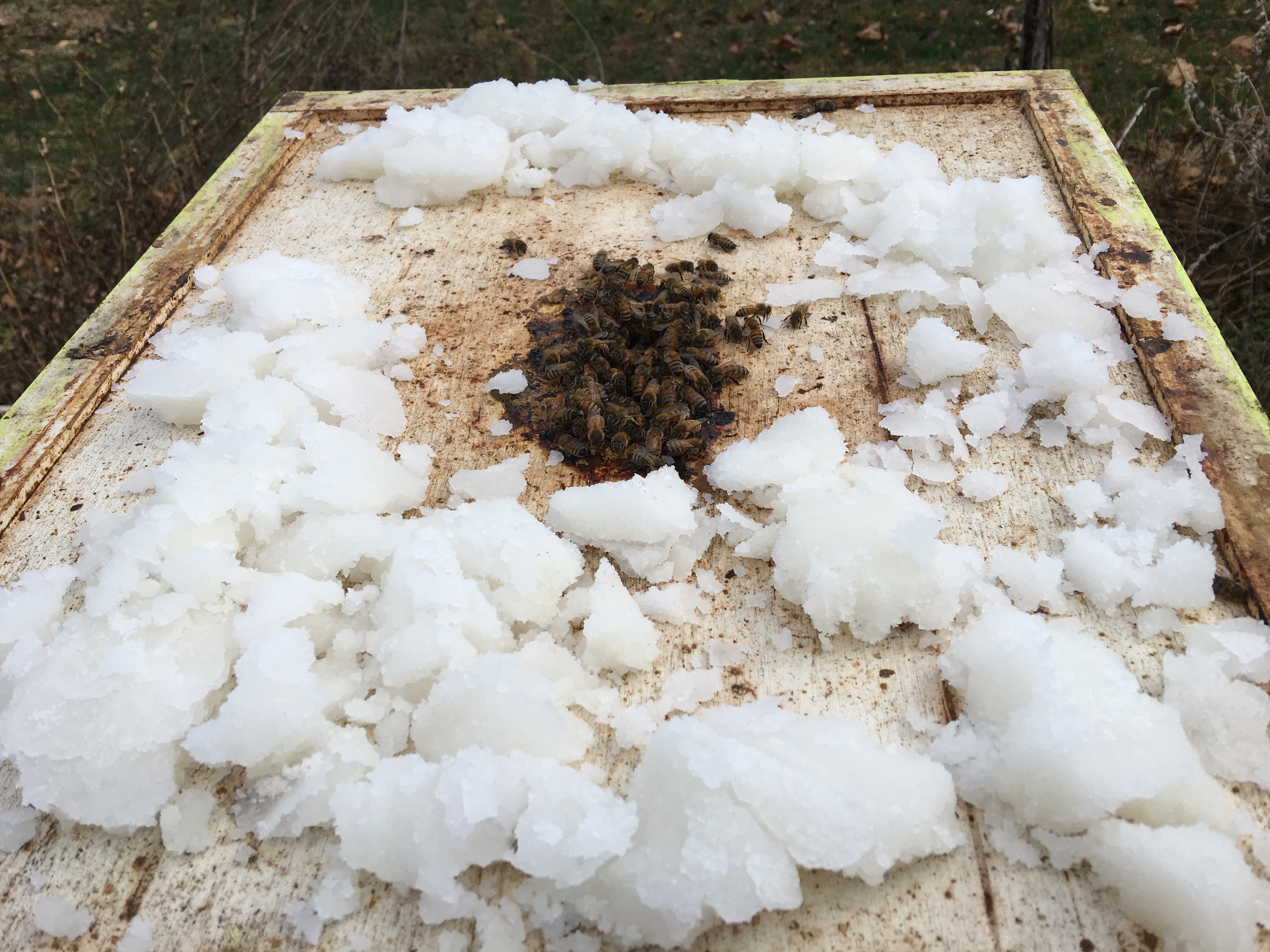
Break up the chunks and place on top of the inner cover-here the bees are starting to emerge from the hole in the inner cover





9 Comments
PLEASE don’t give your bees any honey that is not from your hive. There is a good chance there is foulbrood in store bought honey.
You are correct, even honey from your own hives might have AFB spores in it. I read somewhere that Roger Morse would buy honey from different locations and test them for AFB spores; every single one of them had some spores. My hives had this in 2016 and in NY the law is to burn everything. We burned 11 of our hives. Now I do not open feed anything in my yard, not even extracted frames of honey.
I just leave a full super on top of my my 2 deeps. I’m happy and they are happy. 🙂
I am going through my first winter with my 2 hives. I have not taken anything from them. Just made sure they were good and growing well with honey stored. Is there anything I need to do for them?. They seem to be doing well. I live in the lower mainland in b.c. Canada. Any websites would be much appreciated.
I got bees from a old trailer that was to be moved and they were going to destroy the bees and I said no and went and got them. Then there was another hive that was taken from some other people and they didn’t want the honey because it was not caped. So I got it and it went bad or sour. I was told to make wine, but can it be fed to the bees????????
I have a huge Weeping Willow tree that had a honey bee best for years… Than they left when threatened with ants, wasps they left an I don’t know how to get them back… They have swarmed about 3 times. Help
I live in Virginia and planning to make this Fondant for my 2 hives to help supplement. I’m wondering though about putting on top of the inner cover versus under the inner cover near cluster of bees. I would do this on a warmer day like today it’s in the 50s but thinking since it’s cooler and they are moving slower, it may be good to get it closer to them?
Thanks
Yes, you can even break up the fondant into smaller chunks and let them sink into the hive. I find the closer to the hibernating mass, the better.
Glad I stumbled upon this article Claire. Thanks. Will be making some fondant this week.