
When Good Honey Goes Bad…Not bad, really, just crystallized.
If you have ever wondered about that jar of honey in your cabinet, you aren’t alone. I’ve been asked by many people if the jar they bought years ago is still good. Happily, I have good news. It definitely is!
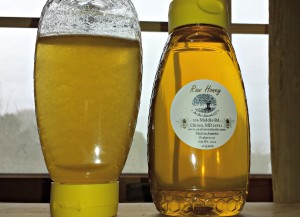
Crystallized Honey on Left
Liquid Honey on Right
Almost all unheated, unfiltered honey crystallizes; some just crystallize sooner than others. Crystallized honey is preferred over liquid honey by many people (me included). You can cook with crystallized honey. It works in tea; in stir-fry; and as an easily spread glaze on fish, meat and fowl. It doesn’t drip off the bread and you can eat it like candy. You know that beautiful creamy spread in the Natural Food store that sits beside the liquid honey? It might be called Whipped Honey, Spun Honey, Churned Honey, Candied Honey, Honey Fondant, Creamed Honey or Set Honey, but whatever name you choose, it originates from crystallized honey.
Once the honey leaves the hive where it’s a balmy 95° to 104° (sounds good right about now in February) it begins to crystallize. When the weather outside the hive is extremely cold, like it is now, honey can crystallize if the bees aren’t directly on it. It’s the natural state of honey.
If you prefer your honey liquid you can re-liquefy it. Gently warm the honey by placing the container in a warm water bath (never over direct heat) or in a warm, sunny windowsill. I don’t recommend doing this in a plastic container even if it’s BPA Free. The most important thing to remember about re-liquefying honey is to never heat it above 104°. That is when you destroy the enzymes, antioxidants, pollen and propolis and then whole point of having raw, natural honey is negated. The problem with re-liquefying your honey is that once it cools it will begin the process of crystallization again. The process of re-liquefying multiple times can cause the honey to lose its consistency and can affect the taste. If you prefer to have liquid honey it’s best to heat up only the amount of honey you want and leave the rest in the container.
But the best way to enjoy your liquid honey without worrying about crystallization is to consume it quickly! As many of my customers say, it never lasts long enough to crystallize!
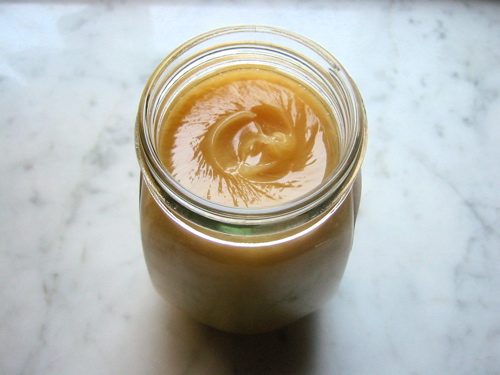
Spreadable Honey
If you prefer your honey a little thicker you can follow these easy directions to make your own creamy honey spread.
First you will need to have some “seed honey”. Much like making yogurt or cheese, the culture replicates. So if you want creamy, smooth honey you’ll want crystals that are small and uniform in size. If you are a chunky fan then larger crystals will make you “crunchy” creamed honey. Our honey (Ann Bee’s Naturals) just happens to crystallize to tiny, spreadable crystals. If yours doesn’t you can by some creamed honey to use as your seed. Then you’ll use your seed honey by introducing at least a Tablespoon into the jar (1lb). Then you’ll stir it well and place into the refrigerator for at least 2 weeks. It’s important to stir the seed all the way to the bottom of the jar or it won’t cream evenly.
Beekeepers, this could be a great addition to your product line. No drip honey is much easier for kids to handle which means less mess for moms to clean. Now that is a great selling point! And if you are making large batches of creamed honey, just use the 1TBSP to 1lb ratio and use a paint stirring drill attachment to mix it up.






18 Comments
love the blog. And I love your products, My whole family does actually.
Thank you, Pam!
Just wondering if I am understanding correctly, Place the “seed” or purchased creamed honey into my crystallized honey and ref for 2 wks?
Hi Sheri,
Well, the seed IS the crystallized honey if you like the texture of it. If not, or if you don’t have crystallized honey you would purchase creamed honey to use as seed. Then you incorporate it into the liquid honey and refrigerate. You can just refrigerate the crystallized honey for a few weeks and then with some vigorous stirring you’ll have creamed honey.
Ann B.
Thanks so much for the response! I was a tad confused but now I understand. I love those little guys and do not want there hard work to go to waste! Thanks again.
Thanks! I have four or five jars of crystallized honey that have been waiting for this post!
Love this site! Now I know I can use crystalized honey. Thanks for the info!
Why didn’t it print the whole thing? I just have it printed to : honey is to never heat it above –
Clearly it should have printed at least a page 2…..
Spot on ! i tend to spoon it out and eat it, since i am a honey hog !!!
i like the other ideas as well
Thanks
Where can I get a case of those plastic jars? Love the combination pattern on the bottom.
I have lots of crystalized honey. Once I heat it do I add the creamed honey to the warm liquified honey…if I let it cool it will crystalize again… But if I add it to warm honey the creamed will melt right?
I’m new at this ! What I want to know if I should take out the queen excluder
Never decrystallize honey in a microwave! It will do the same as heating honey over 104°.
What would be the ratio of using honey instead of sugar in freezer jam?
Please discuss how to store bee equipment overwinter
No drip honey! Splendid marketing idea! I preheat the frames in a room set at 90 degrees F. I just extract my honey into a 5 gallon bucket with a gate on the bottom. I let the honey sit a day or two and then gate it into glass quart jars. I store the jars around 65 degF and by Christmas, the honey crystallizes with a very fine texture. I’ve been frustrated and have wondered how to stop the crystallization process, but I think I just need to market it a bit differently. Thanks for the idea.
This recipe is missing something. Seed honey into jar…. of new honey? That’s never clearly stated
This was an excellent article! Thank u TJ ou.