
Guest post by Leeann Coleman & Jayne Barnes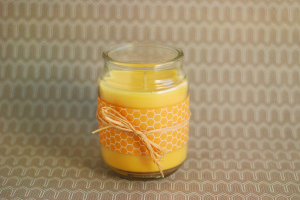
The container candle is the most versatile type of candle, with a long, storied history. If you look around your home, you’re sure to find many glass jars with interesting shapes or attractive designs that you can utilize to make container candles. As your container candle burns and melts, the flame will flicker through the glass, illuminating your walls in delicate firelight.
Glass is the best material for containers. Ceramic or metal will also work, but those materials are opaque so you can’t enjoy the glow as the candle burns down. Never use wood, milk cartons, or any other flammable materials for containers. Glass makes the loveliest kind of container, but be sure it is heavy enough not to crack under the burning candle’s heat.
Container depth is important. Generally speaking, because the wick needs adequate oxygen to burn the candle properly, it’s a good idea to select containers no more than 5 or 6 inches tall. Shorter ones—even very small ones—are ideal as they burn well and can be made in quantity and set around different areas of your rooms to give a candlelit feeling to the entire space. For example, baby food jars or other votive candle– size containers can be utilized this way. Try to pick containers that are either the same diameter at the top and at the bottom, or are wide-mouthed at the top. If your container does narrow at the neck, make sure your candle ends before that point.
Items Needed
- 1 pound beeswax (amount will vary according to the size of your container)
- Double boiler designated for wax melting (preferably stainless steel)
- Wax or candy thermometer
- Pint glass jar or similar size container
- Wicking: Varies by size and type of container (see sidebar)
- Wick holder tab
- Glue
Directions
1. Melt your beeswax using a double boiler—a small saucepan containing the beeswax, sitting inside a larger pan of water. Melting beeswax over direct heat is very dangerous, as hot beeswax is flammable and can ignite. Use a thermometer to monitor the temperature of your wax. Stainless steel pans are recommended because copper, brass, and iron can change the color of the wax, making it look dull.
2. Cut the length of your wick to extend beyond the top of your container.
3. When the beeswax has reached 150–160°F, prime your wick by dipping it in the beeswax until air bubbles stop releasing from the wick. Priming will allow the wick to stand straighter when placed in the container and aid in the initial lighting of the candle. Allow to dry.
4. Thread the wick through a wick holder tab.
5. Secure your wick tab to the bottom of your container using a dot of glue. Allow glue to dry.
6. If your vessel is a clear glass jar, it is recommended that you heat the jar by placing it in a 150°F oven prior to pouring. This will prevent the wax from pulling away from the side of the jar as it cools and shrinks, improving the overall appearance of the candle as seen through the outside of the jar.
7. Pour your candle when the wax has reached 150°F, using a slow, steady pour. Do not pour to the very top.
8. As the wax cools the wax surface will start to solidify. Pull the wick to the center to set it in place.
9. You will notice a sinkhole caused by shrinkage as the wax cools. Pour a second round of beeswax at a temperature of 155°F, just above the level of the original pour. This will cover the shrinkage and create a more even appearance at the top of the candle.
10. Allow the candle to cool and trim the wick to 1/4 inch.
11. To dress up a plain container, consider tying colorful ribbons around the middle of the container, or drawing designs on the sides.
Candle Diameter and Wick
- Less than 1 inch—4/0 wicking
- 1–3 inches—2/0 square braided wick
- Greater than 3 inches—1/0 square braided wick or 60 ply wicking
Candle in an Acorn
Natural materials and vintage containers can be used for container candles as well. Ideas include: a teacup, spice tins, orange peel, hollowed-out pumpkin or gourd shell, acorn caps (for floating in water), or sea shells. Be certain to follow the wicking guidelines from your wick supplier to ensure the proper size wick for the diameter of your candle.
 Excerpted from Honey Crafting: From Delicious Honey Butter to Healing Salves, Projects for Your Home Straight from the Hive written by Leeann Coleman & Jayne Barnes, Copyright © 2013 by F+W Media, Inc. Used by permission of F+W Media, Inc. All rights reserved.





5 Comments
Just wondering: I purchased about 5# of pure raw beeswax from a local bee company. They told me I could NOT use ANY container for my beeswax candles, that I had to use molds….They said that the temp. beeswax burns at would shatter glass, and/or destroy any container used …But you are telling me I CAN use glass containers and burn beeswax candles with no issues?
So I have two ‘experts’ on beeswax candles telling me two different things…..confusing!! ;-}
Would love to win this book . It love making things with beeswax and honey . Honey is so good for you and of course I support the bee keepers as well .
Such good advice! I am glad I found your website because I am just starting my own beeswax candle business. Thank you!
I’m a beginner candle maker , found your site looking for instructions on candle making and wick guide for beeswax candles. I really enjoy your site.
Hi there,
This is Ricky from Changge Huading Wax Industry Co.,Ltd. We are a factory specialized in manufacturing&exporting Beeswax, Honeycomb foundation sheet,and Beekeeping Tools etc.
Here I just want to establish cooperation relationship with you. We can offer high-quality pure beeswax for you to make candles.
Regards.
Ricky