
Bee stings are going to happen. It is just a matter of when, where and how many times.
PAY ATTENTION TO YOUR SYMPTOMS!
Honey bee stings produce different symptoms in different people.
Some people experience a Mild Reaction with symptoms of itching, mild to moderate swelling, redness and warmth at the site of the sting.
Some, like me, experience what is defined as a Large Local Reaction. This kind of reaction produces swelling that extends beyond the sting site as well as pain, itching and redness.
Others suffer Severe Allergic Reactions.
Symptoms of a serious allergic reaction called an anaphylactic reaction and symptoms of anaphylactic shock include:
- Difficulty breathing
- Difficulty swallowing
- Swelling of the face, throat or mouth
- Wheezing or hoarseness
- Rapid pulse
- Dizziness or sharp drop in blood pressure
- Nausea
- Diarrhea
- Stomach cramps
- Loss of consciousness
Please be aware of your symptoms after a honey bee sting. While severe allergic reactions are not that common, they can occur within minutes after a sting. They can lead to shock, cardiac arrest and unconsciousness in ten minutes or less. If you think you may be suffering a severe allergic reaction, please do not hesitate to get emergency medical attention.
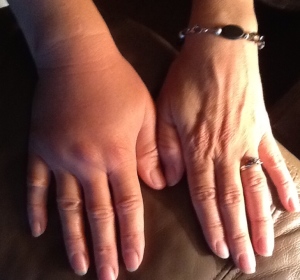
Large Local reaction to bee sting.
WHAT TO DO WHEN YOU GET STUNG…
First and foremost, DO NOT PANIC! I believe the bees know when we are fearful and they react accordingly.
Do not start swatting; you will just irritate them. If you happen to smoosh the offending bee, it will release a pheromone that signals danger to the other bees and result in more stings.
Remove that stinger. DO NOT SQUEEZE IT! Squeezing causes more venom to be released. Use your fingernail, the edge of your license or a dull knife blade or even your hive tool and SCRAPE it off.
Smoke the site of the sting a little and step away for a couple of minutes to let the bees calm down.
Then, grab a bit of plantain weed, chew it up good and put it on the sting. Um, plantain, the banana-like fruit? No, this is a weed. A weed? Yes. A weed.
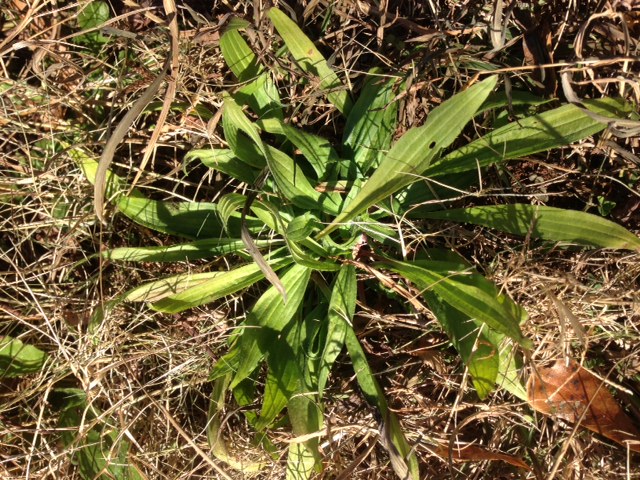
Lance-leaf Plantain
My husband and I took classes from The Fat Bee Man, Don Kuchenmeister, and my first sting came during one of our lessons. Don pointed at a weed and said, “Get some of that plantain, chew it up and put it on there.” I was a skeptic since I didn’t have a clue what he was talking about and was in too much pain to ask. I sort of did what he said. That sort of following directions did not stop the pain or swelling. At home my husband showed me the weed The Fat Bee Man had told me to use and explained what to do.
I got tired of getting stung and swelling up. After being stung many more times on my fingers, I decided to try the plantain weed again. I knew we hadn’t prayed any pesticides on the yard and my dog Max hadn’t passed through, so it was safe for me. I picked a couple of leaves, stuck them in my mouth and chewed. My husband laughed at me. I chewed it enough to get it tore up and mixed with my saliva, and then I put it on the sting. It hurt! It burned! It was worse to me than the sting itself! By the time the leaves were dry and falling off my fingers I realized this wonderful miracle weed had drawn out the venom from the sting. I could barely tell where I had been stung! There was no swelling and very little pain.
Does plantain weed work like this all the time? I have to say, “No.” Why? I think it depends on a couple of things. How long did it take to get that stinger out and the plantain applied? How long did you keep the plantain applied to the sting location? It can be difficult to keep it stuck on your finger when you are inspecting a hive. You could carry some band-aids or tape with you to help it stick.
WHAT DOES PLANTAIN LOOK LIKE?
I know of two varieties of the plantain weed on my yard, and I know where every little patch is located. One is broadleaf and the other is lance-leaf. As with any other weed or plant out there, I am sure there are a dozen different names for it. I remember telling my dad about this fabulous weed, but he did not recognize it from my pronunciation. I showed him the lance-leaf plantain, and he recognized it immediately and shared a story about his granny using it for stings. Then he showed me the broadleaf plantain, which I recognized as a weed that grew at my childhood home.
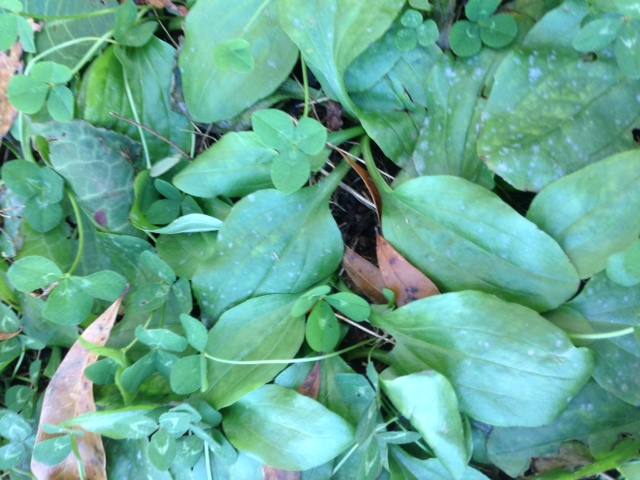
Broadleaf Plantain
If you live in the city or a location that doesn’t sport this awesome weed, you can purchase seed to start your own little patch. Plantain salves are also available. There are many plantain salve recipes out there, so if you happen to have and abundance of the weed, you can make your own salve and even use your own beeswax in the process.





14 Comments
My yard is full of Plantain. I’ve used it more than once for bee stings. My sister makes a homemade salve with Plantain that we call the green stuff. All the kids and grandkids use it also.
This article failed to mention that there are also those people that have NO reaction to a sting, as with me. I have less reaction to a bee sting than a mosquito bite, but of course I get stung 50-100 times a month doing “cut-outs” because I wear no protection other than a veil.
I tell people that are watching me to use a piece of onion or wild onion/garlic held on the sting for a few seconds works fine too.
Put a little Snuff in your palm and mix with saliva. Put paste on sting. Works great.
A little squirt of WD 40 rubbed in also relieves bee stings. It doesn’t work on wasp stings though.
We herbalists call Plantain “the Bandaid Plant” because it is demulcent, cooling and drawing for all manner of stings & scrapes. What you were taught to do was make a spit poultice, but you didn’t get all the instructions. After chewing the leaf and applying it to the wound, take a large whole Plantain leaf and put on top as a covering, then grab one of the stalks and use it to tie the poultice in place. This binding method works great for fingers, not so much for larger sites.
Two other first aid techniques:
1) Apply a thin slice of Irish potato to the sting and bind it in place. As the slice becomes warm, replace it with a new one. The drying starch will draw out the venom.
2) carry a small jar of cosmetic clay (available as green or french clay in most health food stores) in your pocket. When needed put a teaspoon in the palm of your hand, add enough water to make a paste and gently dab a good thickness on the sting. Let it dry and then later rinse it off with warm water. This is perhaps the easiest method of all.
I have also used lavender to cool & diminish the sting. Simply crush fresh lavender flowers with your fingers & hold over sting area. It works quickly!
Homeopathic Apis, made from bee venom, relieves stings immediately.
You are using my copyrighted image of a honey bee sting. It was stolen from my blog at http://ucanr.edu/blogs/blogcore/postdetail.cfm?postnum=7735. Please remove. Thank you.
I always use honey on a bee or wasp sting. The stinger pops out and it stops the swelling immediately.
Crest toothpaste works better and you don’t have to chew it first
I was curious if you could infuse oil with this and just have the oil readily available? Or maybe a tincture would work better?
I am just throwing out some thoughts
Hi Dina,
I actually make a salve from plantain weed and oil. Check out my recipe.
http://lifeatelevenfifteen.blogspot.com/2014/12/plantain-weed-salve-recipe.html
Honey also pulls the venom out. The weed is good for all sorts of things. I try to avoid chewing weeds in my bee yard unless I can rinse them first. Not all my bee yards belong to me, so the owner may have sprayed. Thanks for the tip.
My Grandmother was part Cherokee indian & had this for our sting medication!
Yes it works & with my own Grands now we still apply this precious weed