
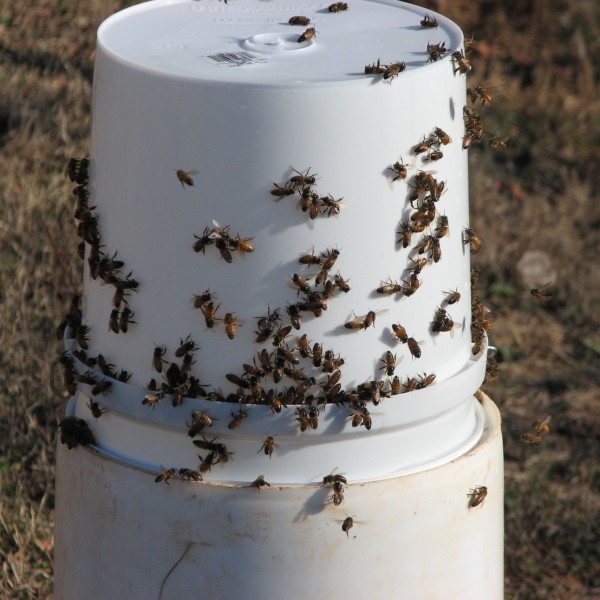
With Spring just around the corner and a new schedule in my life, I am looking at ways to help me feed my bees. I am operating on a tight schedule in the mornings and I don’t have time to fill individual jars or top feeders with sugar water. Therefore, I have decided to set up feeding stations around the bee yard. I would like to share my experience with you.
On the warmer days here in NE Ga, the bees are flying so now is the time to set up the stations.

Lets get started!
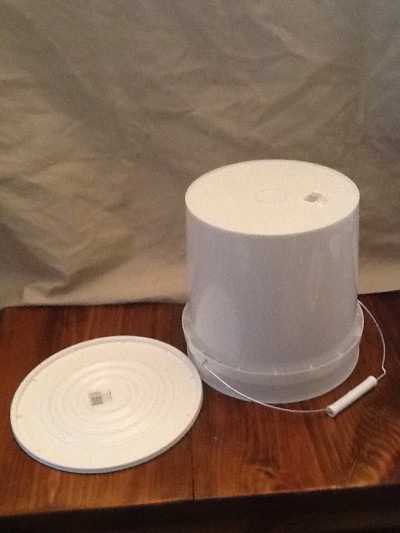
Two-gallon bucket with lid.
My feeding stations are made of plastic 2 gallon food grade buckets with lids.
There is a reinforced area around the rim of the bucket. My husband drilled one hole in each section of the reinforced area using a 1/16 drill bit. He drilled the holes into the side of the bucket. (The buckets will be set up top side down. The sugar water will come out the drilled holes. *Also…there may be some seepage around the lid. The bees will clean it up.)
Now that the buckets are ready, I have decided to locate the stations about 25 yards from the hives. I set the buckets on top of 5 gallon buckets. With rain in the forecast, I will need some kind of roof over it.
Honestly, the first few days I put the buckets out were disappointing. I fully expected the buckets to have breathing room only but the activity was very minimal.
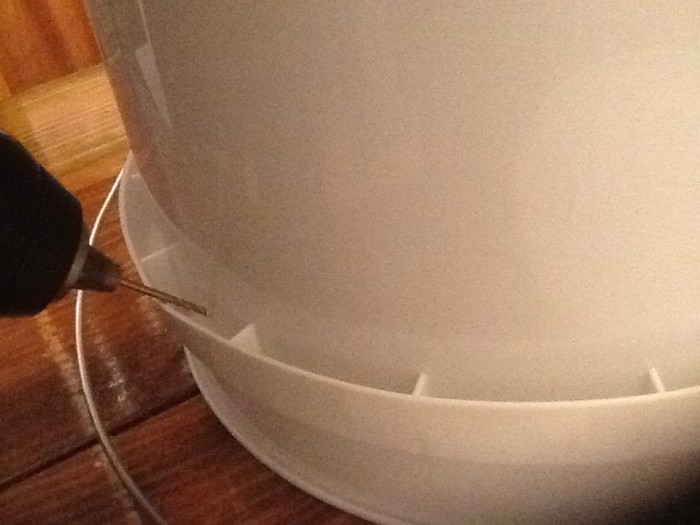
Drilling holes in each section with smallest drill bit possible.






41 Comments
The only negative I’ve ever heard about that is the possibility of sending them in a robbing frenzy, but I can’t say that I’ve experienced that. This is certainly a time saver.
I have smaller buckets that screw on (If they are to be set upside down, it is just a precaution). Also, I’m planning to have quite a few (almost one/hive). I think this may help to avoid frenzy.
It is definitely a good idea to set the feeding stations a ways from the hives.
Another advantage, which you did not mention, is that by feeding them outside of the hive, you do not introduce moisture in the hive, a consideration that is pretty important for us in Central WI.
This is not a great idea for our area (North West Alabama) as we have yellow jacket wasps galore. This will only exacerbate an already existing problem. Can’t happen here. At least not effectively.
Open feeding like this is an excellent way to spread diseases and mites. Every honey bee colony within 2 or 3 miles will find that bucket and will be rubbing shoulders with your bees and thus transfer whatever nasty things they carry. Is that what you really want?
Feeding should always be designed to limit access strictly to the hive(s) for which the feed is intended. (I use the same concept. but the bucket goes inside the hive. A 1/16″ drill bit works perfectly.)
The same access-restriction applies to cleaning up freshly-extracted combs — put those combs back on the hive(s) from whence they came. The bees in that hive will clean up the honey residue without the risk of disease/parasite transmission.
That is seriously the most informative and on the spot truth. Thank you for the comment. I about went out and did it throwing caution to the wind. Thank you for bringing me back on track. Sincerely.
‘The bees are flying’…. so is everything else flying and crawling and it won’t take long for them to find the free food. I can’t see this being a good idea.
Are they left out overnight? What about the critturs?
Good luck!
Latent, dead on! Gonna be interesting when the ants wake up, not to mention yellow jackets, and any other critter in town!
Would open feeders spread varroa mites?
Hi Mary,
any neighborhood cooties that are transferable from bee to bee would be possible in a scenario like this.
A very good idea
This time of year, in my area (east TN), I am also using remote feeding stations. I am more concerned with providing food than spreading parasites or feeding insects that aren’t a problem right now. I do not want to open my hives and potentially chill my ladies or brood. It’s a calculated risk with a large dose of common sense thrown in.
Oh, look, a MacDonald’s for bees. Sugar water is not food. It is equivalent to junk food for humans. NOT a desirable project and glad this person doesn’t live near my bees.
What do you feed your bees if not sugar water?
Curious.
This is a well meaning, well intended concept, but a disaster waiting to happen. This can not only lead to disease and mite transmission, but also to a situation similar to robbing. The other concern would be yellow jackets and skunks. Again well intended, but a seriously bad idea and not what most professional beekeepers would consider wise by any stretch of the imagination. Why would you share this unwise practice? Please take more care with what you post on your site for the sake of all beekeepers.
It’s apparent that some of the folks replying have no clue about professional beekeeping and likely have only one or two hives themselves. We, those of us who run over a hundred hives, do in fact open feed
Please stop presenting your ignorant opinions as actual fact
Open feeding is prohibited in much of the nation. No responsible large-scale beekeeper uses this practice. There was a case of a commercial beekeeper in my state who was caught open-feeding. He ended up compensating every beekeeper in flying distance for contaminating the honey of innocent beekeepers.
@blaine: You are dead on. very god comment, and I am not aware of any established bee keeper who makes this part of his program. Open feeding is what happens at bluegrass festivals while we walk around with our open Coke bottles!
This is called expressing opinion as fact and shows just how ignorant you are. Prohibited by who? Call your state Apiary Inspector and ask if this practice is prohibited, it is NOT. You are simply lying. I am currently open feeding 100 hives dry pollen sub using Mann Lakes pollen feeder. Again, a one hive operation trying tell us all how he is a beekeeper. You are simply ignorant
Spot on my friend. Open feeding works fine. Best to keep feeders 100 yards from yard.
Mites will show up in any event. Treat by fogging with mineral oil bi weekly during honey production then Oxalic Acid after honey is off.
I have been open feeding for several years and it has always worked well for me. It is best, I think , to open feed as far away from the bee yard as possible. Another good method is to punch or drill the holes into the lid itself and they will clean up every drop in the bucket. By the way, mites are bread and spread from the hive; that is the only place they can survive.
I am no expert when it comes to Verrona Mites but I would think if there were a parparasite problem in a bee yard all the hives would eventually have the problem with or without community feeding or how else would the few hives have gotten them in the first place? Certainly anything that could speed the spread of the mites should be avoided. However most beekeepers lke me only have a small number of hives. I would use this set up in the early spring or late fall. Not all ideas are good for all beekeepers everywhere so don’t be so quick to knock it.
Openions are like butt holes, some stinks and some don’t but everyone is entitled to there own. If you don’t like open feeding don’t do it. Doesn’t mean you have the right to criticize others for doing what they think is best for their bees. I was taught at a very young age that if you don’t have something good to say about someone you should keep your opinion to yourself. This person didn’t try to get anyone else to try this they just shared an idea they are trying. Im more than interested in hearing from someone who is trying something different rather than someone looking down their nose and criticizing another person’s efforts at improving things. I think it could be beneficial to hear how it works out for her rather than criticizing her.
Richard, if we limit only comments to support and applause, we have now cut off the one avenue that we are given to communicate ideas. If some of the readers of this blog have tried open feeding and it was a failure, would you not, likewise, want to know what they discovered? I for one love tor hear about the successes and failures alike so I can learn by others trials. Be as generous to others as you would want them to be to you. And by the way, if I am heading for the bridge that’s out, I would appreciate a “danger: Bridge out” sign ahead.
I totally agree with you and would like hearing about people’s experiences. I just don’t like someone putting someone else down for being different or trying to improve the system. As you well know often two people can do the same thing and get completely different results. Necessity is the mother to invention so we should never stop trying to reinvent the wheel. Our environment is changing our bees are changing and we are doing things today that a few years ago we was told was impossible so never give up. I for one like this ladies idea and believe with some slight modifications and in the right environment this idea will work and I’m planing to try it myself. So thanks for the idea and the input on feeding.
Right on Richard. Thanks for your response. I agree with you as well. I experimented with open feeding in my small Apiary, and had moderate success until mid spring. The activity made walking through the yard almost impossible for someone not in a bee suit! LOL. I never realized how many yellow jackets we had in our area until we rang the dinner bell. It was amazing.
Sorry I hate bee feeding the fungus not to mention the Birds that will station them selves near by to eat bees. Bats and skunks at night and even bears will smell the sugar water.
It always bothers me that anytime comments are written, they always tend to get away from the subject and opinion and attack the person. Why do people do this? We have a choice whether or not try another person’s idea. We also have a choice to show good manners, and if one cannot do it in writing, then no comments should be made.
Where in the world did that commenter attack anyone?? Seems like you’re doing the attacking!
Remember, if we go through life only getting applause from the crowd, we will never change our act. And if others have seen the act and the failures in it, wouldn’t we be remiss in our duties to not inform them of their errors? Open feeding works for a short period of time each season, and then becomes a disaster, and that is not just the opinion of this rank amateur, but of many who have decades of experience. No one has attacked this blogger, but only given helpful, good natured comments. Take a slow breath and say, “I love America, where opinions can be expressed with vabratto, and we can go home friends!”
Like Craig, Michael, Sharon and Richard, I hate when people comment in such a mean-hearted way. You can comment about it without tearing down the person who posted. I like new ideas and fully hope that Nancy will let us know if this doesn’t work. From what some say, this is not a new idea and has been used a lot. If so, then I would consider it after reading up on it more. Good luck Nancy.
Well said.
Hoping to try this soon as the weather is warmer.
Great idea. Thank you.
Feeding depends on so many things. What time of year? How are they set for honey stores? What are you looking to accomplish? What subspecies of apis melifera? These folks are in GA, so maybe they are getting really chilly nights and would need to bee concerned about excess moisture and chilling the bees and brood. If they are coming out of Winter right on the edge with not enough food, then feed, but I would do a non high fructose corn syrup fondant over the inner cover with some really cake-y pollen patty to absorb moisture and not get moldy. The queen needs 2 things to signal laying in the spring, a thin nectar/sugar syrup coming in and pollen/protein. Make sure you use PURE CANE SUGAR. Yes it is junk food for bees but for the short term to help them make it to first nectar flow, your are preventing starvation. Don’t cook it – it changes the molecular structure of the sugar and makes it indigestible. Put it on the hive warm, helps warm them up a bit. Put it over the inner cover and put an empty super over that, then the outer cover over that, and block the entrance from your inner cover if you have one. As far as open feeding, you reduce robbing if you put it at least 100 yards away from the apiary. Robbing in Spring is much less likely than in Fall. If you have Italians, they are more prone to robbing than any other sub species. Must be the Mafia in their genetics 🙂 – they also eat more in Winter. Varroa can move surprising fast and could theoretically transfer when bees from different hives are wing to wing at the feeder. If you have hundreds of hives, setting up individual feeders for each hive is incredibly time consuming. You can avoid the ant problem by setting it up in a moat of water, which they won’t cross.
I don’t understand how this method of feeding would put my bees more at risk for disease or parasites. My bees are well behaved but I have never been able to train them to stay within their yard. Those ornery girls really get around, flying all about the countryside, rubbing elbows with any bee that comes along. Brazen floozies!
Hi, I see in the first picture you’ve mounted the station up off the ground. What did you mount it up on? Also is it necessary to have it off of the ground?
I was looking for a practical waterer for a remote apiary. I planned to buy chicken waterers today. The problem has been difficult. I can forget the sugar part. This idea is fabulous for me. I’ll carry water in 5 gal buckets, as I do now, but simply replace the afield bucket I’ll even be able to measure consumption of provided water for the apiary. Awesome
Thank you so much for publishing the idea.
Yours,
@mikegras
Good idea, no matter what kind of comments came out of this posting. The mites? Control them as you would normally. This would allow a good healthy feeding and be able to carry on with life as the bees get the “boost” they need from the “Taco Bell”. I saw a post that it’s fast food? Everybody feels better after getting a full stomach, even if it’s from Taco Bell or Burger King. So, I will be trying this idea out with my bees the next opportunity I get (springtime). Keep up the good work and keep “thinking” about better ways of doing things!
its all about location location location. no these feeders are not a good idea in built up areas but when you are out in the country a tad and there are no other human controlled hives within 5 miles its a GREAT idea. In a one year study I found that these remote feeders removed robbing the hives as its a communal area and no robbing was seen in 14 nearby hives. they even shared with local hornets and such without issues. a 1-3 gallon chicken feeder works great however you need to block the “hole” in the feeder from the girls getting inside the feeder once its low. rocks or a screen works great.
Some may consider it junk food but for the bees if they do not want it they will ignore it..and it builds hive strength as 8 of my currently 14 hives are this years cut-outs and will be going to “bee hosts” next spring.
Great idea its not a cure all for everyone though.
Phil the
Bee Guy
Thanks for sharing. I hope you have a good Honey flow this year.
This happens to be a good idea. There are entrance feeders also. They would be better off for your bees so the whole neighborhood is not rubbing shoulders with your bees. Just ignore some of the rude remarks you received. Keep up the good work on learning about your bees. I have a patty formula soon as I find it I will posts it here for everyone.
Why do some people think that only pure cane sugar is worth feeding to bees?