
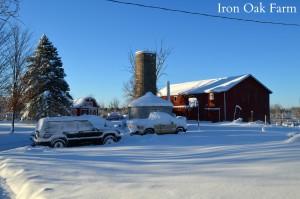
 I can’t help feeling guilty, tucked into the warm farmhouse, the wood burning furnace roaring and blasting heat up through the vents.
We bundle up, and hurry through the outdoor chores so we can get back inside and warm ourselves indoors. But my conscience always nags at me as I leave the barn and the coop in the cold and head for the house. I wish there was a way we could bring all the farm animals inside. To keep them warm and toasty in the brutal cold. But since that’s not possible, we have to do the best we can in keeping them comfortable.
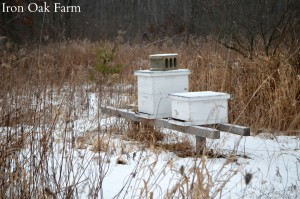
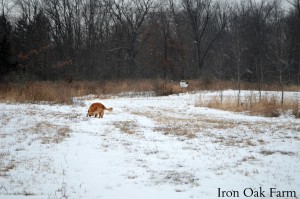 The bees seem especially vulnerable. You would think such a delicate little insect wouldn’t stand a chance in our Michigan winters. I peer across the field at the hives and wonder how everyone is doing. We of course can’t open the hives to check. This would let all the heat that the bees have stored within the hive to escape, and they would all surely freeze. So we must wait and trust in nature, and hope that in the spring, we find a healthy hive ready to forage.
Because we can’t open the hive in the cold, the bee life remains a mystery to us in the winter months. As bee keepers, we tuck in the bees in the autumn and hope for the best. But what goes on all winter?
 When the outside temperatures drop to about 55 degrees, it signals the bees to start gathering for winter warmth.
Bees are active all winter long, unlike some insects that lay eggs in the fall then die in the winter only to be succeeded by their young. They also don’t hibernate. The bee is cold blooded, so the hive must maintain a warm temperature to keep the colony alive.
They accomplish this through clustering. The bees attach themselves to each other with the queen in the center of the cluster. The movement of their bodies through shivering and wing flapping creates warmth and keeps the queen at around 90 degrees in the center of the cluster.
Outer bees trade places with inner bees to maintain a rotation of temperature and to allow honey consumption.
As the temperatures drop, the cluster cinches up, and the bees tighten the cluster to create more warmth.
All of this movement takes a great deal of energy on the part of the bees. They replenish their energy stores by consuming stored honey.
The cluster moves around the hive consuming honey as it goes.
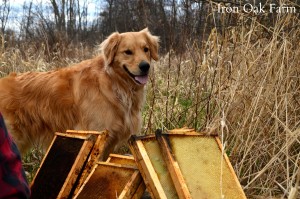 This is why it’s important to always leave more than enough honey for your bees to consume throughout the winter.
It’s also important to provide additional feed in the spring before the flowers start blooming. This is the most critical time for bees and when starvation occurs most often.
In late winter/early spring the temperatures warm, so the bees begin to forage because their honey stores are at their lowest. If there isn’t nectar for them to gather, they waste precious energy.
For more information on this, read my post The Importance of Spring Feeding.
You can give your bees a helping hand in winter by creating a barrier with straw bales to block wind and harsh weather from hitting your hive. But don’t block the entrance and leave ventilation between the hive boxes and the blockade material.
Other reading material:
http://westmtnapiary.com/winter_cluster.html
http://wonderopolis.org/wonder/what-do-bees-do-in-winter/
https://brookfieldfarmhoney.wordpress.com/2010/11/23/what-happens-to-honeybees-in-the-winter/






7 Comments
my neighbors bees thick on my grapes last summer every day 100 deep. also in my trash my 100 lbs carrots for sheep etx. ! it is dry out here & ive never seen so many bees eating grapes .. all sun up .. im thinking it was the only water / food source for them he is 6 acres away from me.. .. i need to solve this as he doesnt listen or feed his hives and i cant take another bee sting / or not use my garden/ porch … thanks ..
That was interesting to hear, I thought most of the died out over the winter. Thanks for postinf. I’m going to look at the post on building a backyard hive next.
Thank you for very detailed and helpful posts about bees.
Q. The photo shows the winter set up in your snowy yard. How do you determine that colonies would be better or you prefer by single brood or doubles?
Can I raise bee hives in Long Island, ny?
Thanks
I live in Northern Alberta. My hive is weaker than usual as hornets were giving us grief. My question is. Can bees brood, as they huddle up to keep the queen warm. Through the colder months. We had a weeks worth of -10c to -17c This week and now today starting a weeks worth of +4c to +9c. The bees are wrapped up with 1.5” insulation plus and outer tarp. Sawdust on top box. I did not take any honey also . Just more curious as to would they brood in colder months if they should.
Thanks for the information
live in ew South Wales Australia but really enjoy your articles and posts about bee keeping
I am new to bee keeping with only 2 hives but am really enjoying the journey.
regards,
Jenny