
Do you know which bee species is right for you? Here are some common bee types to help you decide.
If you’re like me, when it comes to adding livestock – or any animal for that matter – to your home, you relish the research. It’s fun to flip through literature and find the breed, species, or whatever the subspecies (also called ecotypes) may be called that jumps out at you and finds its way into your heart and onto your land.
With bees, it’s no different; there are choices. In the case of the honeybee, there are four main European ecotypes (called bee races) of the Western Honeybee that were introduced to the New World.
The important thing to consider, as always, is for what purpose do you want this creature? The most profitable use is most often contracting with agriculture producers for pollination purposes. And some honey production is usually important to the backyard beekeeper. With the different races of the Western Honeybee, you can have both. For the rural or urban apiarist, a good mix of honey production and pollination probably is the most desirable use, but you also want to find a gentle bee. If you get a hive that is “hot” or “sparky,” you’ll most likely have to remove the hive or requeen, and it will take some time to restore production.
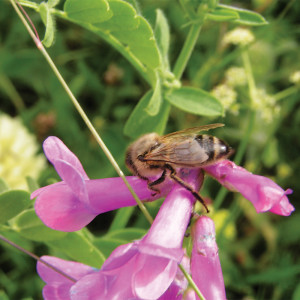
Caucasian honeybees produce more propolis.
It’s also worth noting that with bees, there is a large amount of crossbreeding between races. Simply put, it’s far more difficult to isolate and control breeding among them than it is with dogs, cattle or chickens. Crossbreeding has created more and more of a melting pot over time, and that’s not necessarily a bad thing. So, while there’s no guarantee of race-specific characteristics, research can’t hurt. One tip for finding a gentle hive is to scour websites and find reputable beekeeping operations, take note of those that tout gentle hives and keep an eye out for images of sellers working their hives with minimal equipment.
The first four races listed were brought to the New World. Finding them in pure form is virtually impossible since hybridization is rampant. Moving down the list we see more hybrids like the Russian and Buckfast, and when you buy Italian Honeybees to start your hive, you too are more than likely getting a hybrid whose seller has hopefully selected for desirable characteristics. While it is a melting pot, your bees are still descendants of the following subspecies. Understanding the races no doubt gives you a better understanding of the creatures you’re bringing to your property.
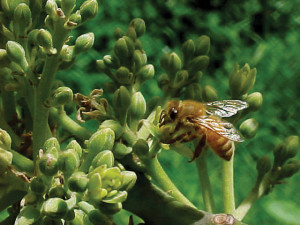
Italian honeybee pollinates avocado blossom.
Italian Honeybee (Apis mellifera ligustica) – This is the standard in the United States, the most commonly available, and the honeybee most often recommended for beginners. It was imported to the New World in 1859. The bee is adapted to a Mediterranean climate, so this is the variety best suited to the warmer climates common to much of the United States. The color of workers and drones is bright yellow, so queens are easy to identify because they are darker in color. The Italian has a moderately low tendency to swarm, and they are good producers of honey. Drawbacks are that they can be difficult to keep alive in cooler climates, and they are susceptible to the tracheal mite and the varroa mite.
Carniolan Honeybee (A. mellifera carnica) – Otherwise known as the Gray Bee, the “Carni” comes from Slovenia as well as neighboring Carinthia and countries east to Romania and Bulgaria. Its chitinous abdominal rings are dark with light gray-yellowish hairs. This honeybee is second to the Italian in terms of worldwide economic impact. It’s cold hardy and well adapted to the mountains. Some say this bee is gentler than the Italian.
German or Black Bee (A. mellifera mellifera) – This race is extremely hard to find today. It was probably one of the first to be introduced into the Americas, but lost favor due to defensiveness, and because beekeepers usually prefer lighter-colored honeybees. The short-tongued German Bee is often susceptible to disease.
Caucasian Honeybee (A. mellifera caucasica) – The Caucasian is known to be cold hardy and gentle, but produces a lot of propolis, gumming up the hive and making it a little more difficult to work. The Caucasian is similar in shape and size to the Carni. Chitin appears dark with brown spots at different times of year, and hair color is lead-gray. The Caucasian has a longer tongue than most races, so it can take advantage of more nectar sources.
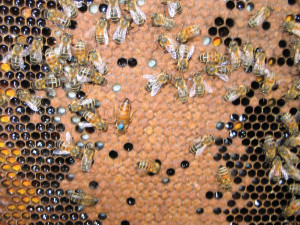
Russian honeybees are more mite-resistant.
Russian Honeybee – This honeybee is not a subspecies per say, but rather a hybrid created by the U.S. Department of Agriculture Honey Bee Research Laboratory in Baton Rouge, Louisiana, for the purpose of showing resiliency to varroa and tracheal mites. The bee comes from stock located in the Primorski region of the Sea of Japan, where it had been exposed to the mites for about 150 years. Russians are twice as resistant to varroa mites as other honeybees and highly resistant to tracheal mites, but they can be a little on the aggressive side. They are moderate honey producers and produce a fair amount of propolis.
Buckfast Honeybee – Another hybrid, this honeybee exhibits good hygienic behavior and strong resistance to tracheal mites. It was created by Brother Adam of the Buckfast Abbey, who spent a large portion of his life crossing races in hopes of creating a superior subspecies. These bees can be defensive, so make sure you find a gentle hive. It’s popular in the Northeast and does well in cool, damp temperatures.






13 Comments
I’m dissappear that carniolan honey bees are ignored in this article. They are very popular with beginners as they are gentle, productive and do well in colder climates without excessive propolis use.
They are likely the second most common breed in the US and are available in packages and nice for beginners.
Message*Tim: either you did not read the whole article or they added the info about the Carniolan after your comment. They talk about it under the Italian bee subheading.
I don’t think you have your facts straight for the history of Russian bees in this article. I would check your sources…
The Russian description could use a revision. Russians are not hybrids, though you can buy bees marketed as Russian hybrids, which usually just means they did not come from a breeders. While Russian hybrids are known for being defensive, pure Russians are extremely docile and easy to work. As a new keeper, they have tolerated my clumsiness with grace. The defensiveness of hybrids is often attributed to hybrid vigor being that the Russians have been isolated from other breeds for so long. This does mean that Russian keepers should keep an eye out for succession queens that are not purebred as they may be more prone to getting hot.
I think the article mentions of Carnelians and Russian extract bees are accurate. I’ve got both and I have seen such tendencies. I love my Carnies but am moving to requeening with more of the Russian extract bees here myself in the plain altitudes of eastern Colorado.
Love the bee cabinet. Just what I need to start with, something simple to use. I was worried about all the lifting. Where can I get the plans or hive? Thanks, Susan
Just a proofreading note. “Carniolan Honeybee (A. mellifera carnica)” should be bolded, and given its own paragraph. Thank you for the helpful information!
Hi Gene. I’ve been (temporarily, I hope) disabled from a car accident, and unable to work, so with LOTS of free time I’ve decided to build an observation beehive in my garage. I’m designing the hive now, with plans to build it over the Winter and “open business” in the Spring. My first issue is how big to make the hive. My friend–who keeps bees commercially–is of the opinion that the minimal sustainable hive is pretty big, five or six frames at least. However, the hives in trees around here (NJ) aren’t very big, so I’m thinking wild honeybees might be more manageable. So I’m thinking to use wild honeybees, which I hope I can get from a beekeeper who removes a hive from an annoyed homeowner’s yard. Do you have any thoughts on this? Thanks.
Hi David,
I haven’t had a great year. I lost a couple of hives, during the winter. One was in a log, that I was planning on, just keeping as natural. It somehow blew over. Not sure what happened there.
Anyhow, I’m fairly new to beekeeping. When I started, I was ravaging the local library, for anything bee related. I found a book on swarm traps. These don’t have to be fancy. A simple box, about the size of an 8-10 frame deep. Add frames. Several old ones, if you have some. I cut a 3/8″ X4″ slot in the bottom front. I got fancy and glued a landing strip below that. Bait the box with lemon grass oil, stick it 10-20′ in a tree, and wait. If I get activity, I let mine “cook”, for several weeks to let the queen build up some brood.
On my first catch, following the addage, ” move your hive 3′ or 3 miles”, I took mine to my cousin’s, about 4 miles away, and transfer them to a hive box. He is very happy with me dropping bees off around the time he’s putting in his garden. After several weeks, I go and bring them home. My original hive is still here, doing great.
I like free bees, that are sourced locally.
Also, put your name on a swarm call list, with the local Sheriff, fire, and extension office. Non bee people are freaked out by a big ball of bees, hanging off of their cars, trees, fences, and the like. Be prepared to go, immediately. I lost a nice swarm, by 3 minutes.
I keep an older cotton bee suit, in my truck.
Oh yeah, forgot.
When someone asks what breed they are, I just tell ’em, “Hillbilly Bees”.
I would like to know also about mason bees and othr typs that are good polinators, thank you
Hello Daniel,
Check out our Bees 101 page. https://www.keepingbackyardbees.com/bee-keeping-101/
This directory should get you to all of the information we have on several different bee varieties.
KBB Team
Hello we are just setting up for beekeeping. We are trying to learn as much as possible before we get hives. When we get our nucleus What time period should we go by before checking them ?