
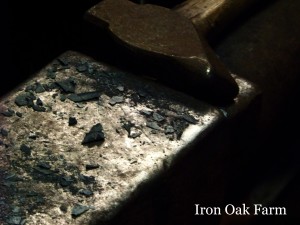
 Last week, Grit magazine shared several articles about blacksmithing, beginning blacksmithing and some project ideas on Facebook and social media.
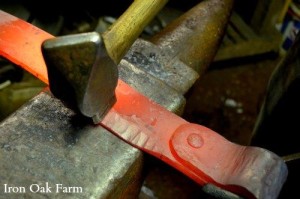
hammering the edge of the fro blade
Among the collection of articles included a post I wrote for Grit last year about how to forge a fro. Re-reading the article got me thinking about how our bees help us with my husband’s metal work.
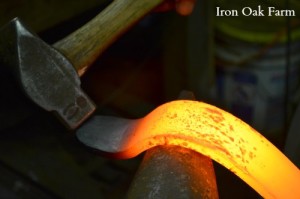
bending the blade of a soon-to-be fro
My husband Zach has been a blacksmith for over 12 years. When he first started out, blacksmithing was a lost art. It was difficult to find information of any kind. Even the internet was lacking.
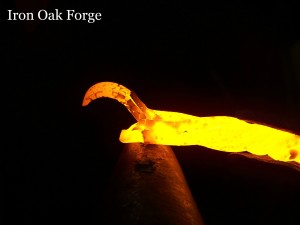
Forging a bottle opener from a recycled railroad spike.
I’ve noticed over the past few years, with the movement to return to lost artisanal crafts that blacksmithing is becoming more popular, especially among the younger generations.
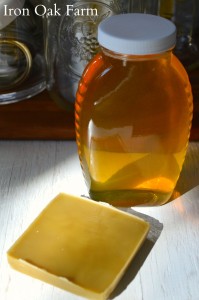
Beeswax harvest from our hives.
Zach and I decided to keep bees several years ago for several reasons. First being, the delicious honey we would be able to harvest. We also felt strongly toward supporting the declining bee population and wanted to do our part to help. But lastly, Zach uses a lot of beeswax in his metal work. We had been purchasing our wax from a local supplier, but it can be rather expensive and with good reason!
Bees produce approximately 1 pound of beeswax to every 5 pounds of honey. It also takes more energy for a bee to produce wax vs. honey. Because of this, a wax harvest is more difficult for the bees to recover from than a honey harvest alone. So while we understand and can sympathize with the costs related to purchasing pure beeswax, we were excited that when we got our first hive, we would be able to reap some of the benefits of being able to harvest our own wax used for his metal work, (Or at least a portion of it.)
Click here to visit my post on harvesting beeswax for home use. Mind Your Beeswax
How is Beeswax Used in the Forge?
Zach forges mostly with mild steel. Many people think that blacksmiths work in wrought iron, however wrought iron is really a material of the past. Steel tends to be more forgiving than wrought iron when it is forged, but is also a harder material and takes more energy to do the same amount of work.
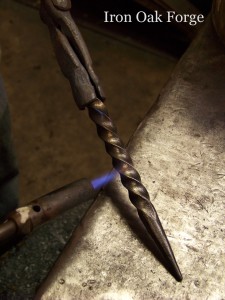
Heating a hand forged center punch tool
Steel even appearing to be dry and dry to the touch is still holding moisture within the unseen pores. To prevent rusting, we heat the metal objects to about 300 degrees over the coal forge, with a torch or often even in the oven.
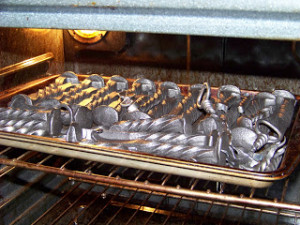
Baking a batch of steel bottle openers to dispel moisture
This dispels the moisture from the steel without getting it to hot to burn the bees wax or draw unwanted colors to the steel.
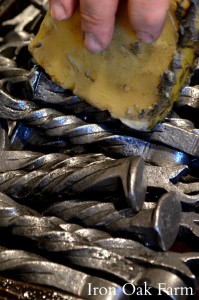
Allowing a brick of beeswax to melt over the hot bottle openers
While the metal is still hot, a layer of beeswax is applied
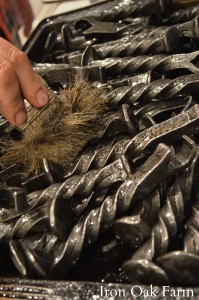
using an old natural bristle brush to get the wax in all the nooks and crannies of the metal.
and brushed over the metal.
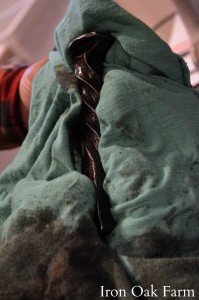 Then the excess is buffed away. The wax seeps into the pores of the metal and seals the object against rust. It also gives the metal a beautiful deep glow, highlighting the shadows and character of the metal.
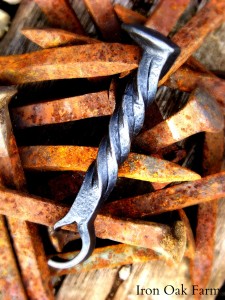
The finished product.
If you have ever “blackened” a cast iron skillet, then you know how this is done.
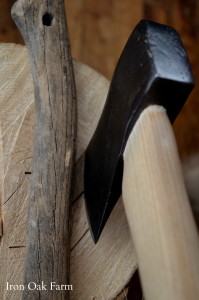
Wax Solution with Mineral Spirits and Linseed Oil
A mixture of bees wax, linseed oil and mineral spirits can be used to prevent rust on everyday steel tools. It makes an easily applied paste that can be rubbed in with a rag without the need to heat it first.
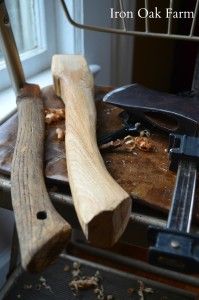 This also works great to seal wood handles on axes or shovels and has bee used as a floor polish for centuries.
 Lubricant
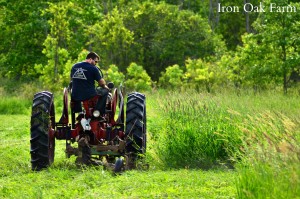
Having the ability to blacksmith has it’s benefits when you own a farm. Zach has often forged his own tractor parts, mangers for our goats, axe heads… among other things. We also use beeswax to lubricate the sickle bar blade.
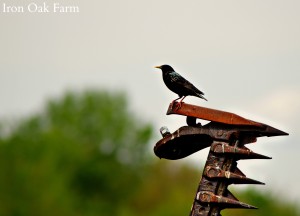 The sickle bar is used in haying. In a sense it’s like a hedge trimmer on steroids. It cuts the grass low to the ground without grinding it up the way a lawn mower might. The beeswax lubricates the triangle shaped blades as they slide back and forth. Beeswax acts as a natural lubricant that won’t harm the goats if it gets on the hay. We just sort of grate it over the blades and the friction of the back and forth motion heats the wax and distributes it.
How do you use beeswax around your house? Any non-traditional uses you’d like to share? Leave a comment below or visit the Keeping Backyard Bees Facebook Page.






8 Comments
I mix beeswax and mineral spirits to make cork grease for the joints on my clarinets and oboe.
Love the tip about cork grease! Wish you had included ratios and method for making the tool polish you mention. Thanks for sharing how you incorporate bees into your farm life!
Do they really use beeswax to have the metal work go better? I didn’t know that they did things like that. It makes sense and it would be helpful to have something to help with the ironworks.
Hi Jennifer,
As I am sure you have already been told, steel does not contain or hold moisture, it is not porous – this is impossible, the moisture seen on heating is from the heat source – ie using for instance Oxy propane, CO2 and H2O are produced in the flame itself and picks up on the steel as condensation.
This is why heating in an oven eliminates this possibility.
You can easily prove this if using a propane oxy source – heat the steel from underneath and you will see that no moisture occurs on the top surface, only where the flame comes into contact with the steel.
Hey
This was so useful to read – what ratios of beeswax to linseed oil and mineral spirit would you use though?
Thanks
I had someone suggest the bees wax idea for corrosion prevention and I keep finding the same thing. Beeswax, linseed oil and mineral spirits but no one says how much of each is needed. Id like to make a batch to have the paste available for a project I have planned.
Thanks for this – I knew beeswax was used by blacksmiths but wasn’t sure how. As a beekeeper (in England) I have plenty of beeswax! and was talking to a knifesmith (?) the other day about this and he hadn’t heard of it so its great to get the inside gen. Thank you
Can you share approximate proportions for the wax, mineral spirits and linseed oil that you use in this paste?
Thanks
Dee