
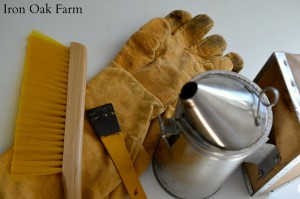
 The bee keeper’s collection of tools can range from a few simple items to a large variety of bee-specific gadgets. Much is determined by preference, how many hives you have, and how much money, time and effort you are willing to designate to complete a chore.
Here is an overview of some common bee keeping tools to help you decide what you will need for your first hive.
Hive
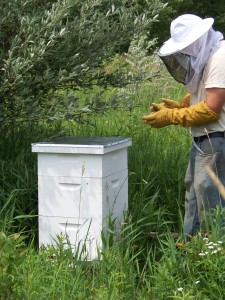 The hive itself acts as a tool in keeping the bees in a location where you can easily access them. The hive structure (the boxes and frames) organizes the hive in a way that is possible to extract honey and wax sustainably. Harvests can be carried out while doing as little damage as possible to the hive. It also keeps your bees relatively safe against predators, and provides shelter against the elements.
The hive will probably be your most expensive investment in beginning bee keeping and there are many designs to consider. The two most common designs are Langstroth and Top Bar.
Langstroth hives are what we typically think of when imagining a domestic bee hive. They consist of rectangular boxes stacked on top of each other, each box containing eight to ten frames that hang from a lip inside the box. These frames hold the foundation which the bees create comb for storing honey or rearing brood.
Top Bar hives are generally more of a homemade option. They are often a triangular trough with wooden “bars” covering the top. Each bar has a ridge that protrudes on the bottom. This ridge provides a starting point for the bees to make more of a free form comb.
Do your research. Some hives have smaller frames which are easier to carry when loaded with heavy honey. Some are better for wax production. It’s important to know exactly what you’re investing in. Read, read, read or even better, talk to an experienced bee keeper who can tell you what hive design is best for your needs.
Suit
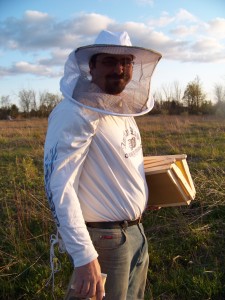 Most bee suits are made of heavy duty cotton fabric and are white in color. A bee suit does not guarantee 100% protection against stings but wearing one will GREATLY reduce the chances of being stung.
What you wear when you open the hive really depends on personal preference. A full bee suit offers the most protection when working with your bees. If you are getting children involved in bee keeping this is the best choice.
You can also wear a bee jacket. This provides protection to your upper body. Denim is fairly sting proof. A pair of jeans and a bee jacket offer a good amount of protection.
If you choose not to wear a suit, be sure to wear light colored clothing. Some say that wearing dark colors can make the bees more aggressive. We haven’t found this to be true, but better safe than sorry.
Veils and Hats
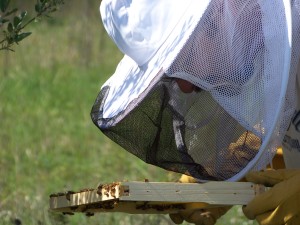 A veil and hat protect your face from being stung. The see-through netting is usually held away from your face a few inches by the brim of a hat. This prevents the bee from gaining direct contact to your skin.
The hat can be a canvas cloth upper with rim stiffened by a flexible plastic. Or there are hats similar to a hard hat with a hard plastic top.
There are different veil designs available as well. Some are designed to wear with a suit. They zip to the collar and provide a sealed seam so bees can’t crawl up your neck area into the veil. Others have a draw string which tighten around the collar. These are usually inexpensive and easy to find. The most simplistic of veils is a fold of fine mesh netting that is meant to be worn with a wide brimmed hat, like a sun hat. I particularly like this design because it doesn’t limit your peripheral vision and isn’t as hot when working on a warm day. I tend to feel claustrophobic in the more covered veils. I like to have an acute awareness as to how the bees are flying around me, and some of the more closed in veils limit that.
There are also more streamline coverings, more like a hood. These designs are less bulky and cumbersome.
Gloves
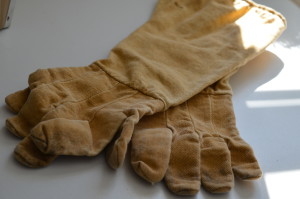 Most bee keeper’s gloves are made from a heavy canvas fabric. They are designed to protect not only the hands, but the wrists and forearm and generally go past the elbow. They usually have an elastic cinch around the arm area to prevent bees from crawling inside the glove. Some people might be comforted by the protection of gloves.
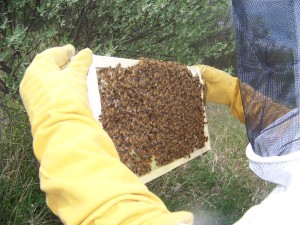 Personally, gloves make me feel clumsy and I like to see where I’m putting my hands, I need that tactile reassurance. If you are clumsy with gloves you may be more apt to accidentally kill a bee which can excite the hive and could make them temporarily aggressive. But you have to decide what you are comfortable with. My advice is to invest in a pair of gloves so you have them, wear them when working with your hive and remove them as needed.
Smoker
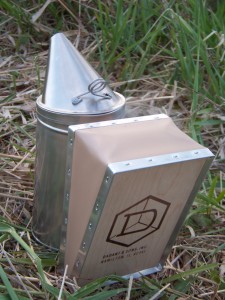 The smoker is the bee keeper’s friend. It calms the bees by playing on an instinct that there is a fire near by. The bees focus on gorging themselves with honey and nectar in case they need to evacuate the hive to find a new home. This distraction allows you to work in the hive without being stung. (For more information on using a smoker read my post Understanding Your Smoker)
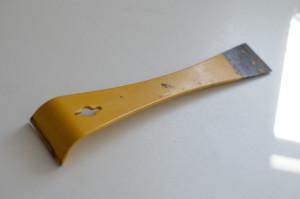 Hive Tool
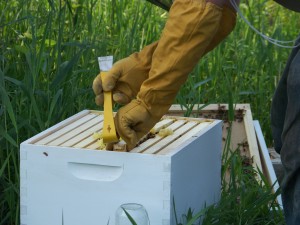
A hive tool is like a small crow bar only the metal is thinner so it can wedge between frames easily and cut through the propolis (a sticky wax that the bees produce to “glue” the frames together.)
Bee Brush
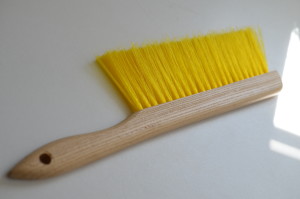 A bee brush is a wide, very soft bristled brush used to move bees gently. You may need to move the bees off a frame of honey to be brought inside, or perhaps off the rim of the box when trying to place a frame back into its place, or before putting the lid down. A bee brush is important to the safety of your bees. It’s gentle and efficient, and can save bee lives when working with the hive.
Frame Carrier/ Frame Grip
A frame carrier isn’t a necessity, but it can make removing frames easier and perhaps safer for the bees. A full frame of honey is heavy and can be difficult to pull directly out. The frame carrier clamps on to the top of a frame and provides a temporary handle.
Electric Uncapping Knife
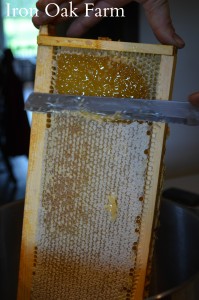 When you bring in your frames to extract the honey, the caps of each hexagonal cell is usually capped with wax. This wax must be removed to release the honey. You can do this with a long knife, a scraper tool (Needle Scraper) or a heated knife which melts the wax and slides easily down the frame. A wax knife isn’t a necessity but it’s a nice tool to have if you have many frames to extract.
Extractor
 Extractors use centrifugal force to whip the honey out of the wax cells in the frames. The honey drains down the sides and then is collected in jars from a spigot below. When purchasing an extractor you have the choice between a manual crank type, or an electric design which are more expensive. Some hold only two frames at a time, and the frames must be flipped to do both sides. Others hold many frames and don’t need to be flipped.
An extractor might be the second most expensive purchase when bee keeping. But luckily, there are ways around this cost. There are other ways of getting honey in jars.
Many bee organizations will rent extractors or have a “pass around” sign up where each person in the group is allowed to use the extractor to harvest his honey and then it’s passed to the next person on the list. Check bee clubs in your area.
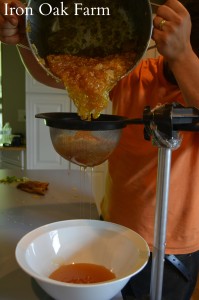
You can also extract honey using items from your kitchen and a little ingenuity. It takes more time, but it will get the job done. Read my post Extracting Honey Without and Extractor for more information.
Many bee keeping supply companies offer a collection of useful tools as a package to beginners. Most of these items were included with our first hive kit.
Did I forget anything? Share with us what you use when tending to your bees. Leave a comment below, or visit the Keeping Backyard Bees Facebook Page.






4 Comments
The starter bee hive that I purchased needs to be painted white. What type of paint should be used. Is there something that is especially suited to bee’s and non toxic to them?
You only paint the outside so most paints should be OK!
honey knife that you can control the heat range in the knife . thank you for your time. ron
Thanks, keep up the GOOD work!