
 My husband Zach and I have been raising honeybees for 3 years now. So far we have been very, very lucky with our hive. We still have the working descendants of the original colony that we purchased three years ago, and they have sustained themselves with very little effort on our part.
This past winter was an especially trying season. We live in Michigan, and our state broke all records in inches of snowfall, the Great Lakes froze more solidly than they have in years and Spring came in slow, cold and wet.
 I’ve been reading about the horrifying losses that beekeepers (and the planet for that matter) are experiencing with the increase of dying bees. A beekeeper friend of mine told me that Michigan and Ohio were at 75% loss. That was staggering to hear.
But spring has finally arrived, the snow is melted, and we were able to check our bees. You can imagine the excitement we felt when we saw our bees coming and going from the hive, returning with balls of yellow pollen from the first spring flowers. We fed them a solution of sugar water for an added boost and decided to watch the weather for the next warm day when we could open the hive and make sure things were ok on the inside.
 We had high hopes and felt that our hive was in the clear….or so we thought.
The next warm spell offered the perfect opportunity to open the hive for inspection.
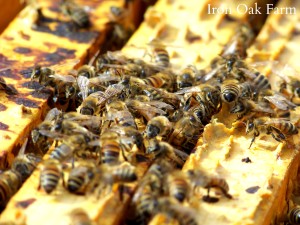
With our smoker and our veils, we opened the hive to find bees! Lots of bees! Which was encouraging. But as we delved deeper and deeper into the hive body, there were some unsettling discoveries that left us disappointed.
 What we found is that through the colony had survived the winter, the queen had not.
Deciding that our hive was queenless wasn’t as easy as simply looking for the queen. There were a few pieces of evidence that helped us form this decision.
1. We couldn’t find her.
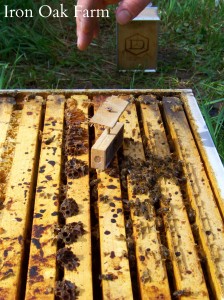
This might sound like a “duh” kind of thing, but finding the queen among thousands of bees can sometimes be difficult. Especially since the worker bees cater to her as she lays her eggs and can camouflage her in a clump of doting bees. So there was a good chance that we may have just missed her. But none-the-less we did a visual inspection. The workers, for the most part, all look the same and the queen is strikingly larger. Her thorax is about double the length of the worker bees. And while it may seem like a difficult task, we have been able to find her in the past. But this time, we searched frame by frame and couldn’t physically find her.
2. No brood or eggs
Our second clue was that there was no brood, eggs or larvae in any of the cells. Only honey. The brood cells are capped in a thicker coating of beeswax. There also wasn’t signs of workers attending the larvae or eggs.
3. They were especially docile.
We didn’t necessarily notice this first hand…our bees are pretty chill most of the time anyway, but I have read that if a colony is unusually docile that could be an indicator that the queen is gone. Without a queen, the bees lose some of that desire to protect.
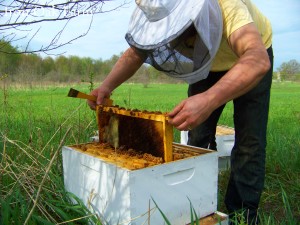 With this evidence, we were pretty confident that we had a queenless hive.
There are a few ways of acquiring a new queen. One way is to introduce a brood frame from another existing hive and hope that the queenless colony will create a new queen by feeding one of the brood Royal Jelly. Unfortunately, we only have the one hive.
So we contacted a local beekeeper that was willing to sell us a new queen.
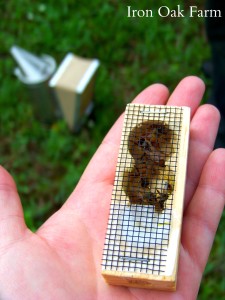
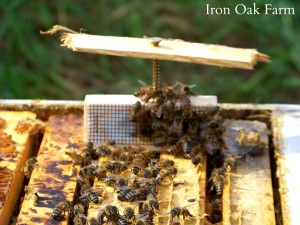
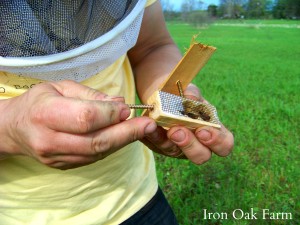
 The queen comes in a small wooden box with a screen cover. She is accompanied by a few worker attendants. One side of the box has a small opening that is sealed with a small cork. Behind the cork is a thick layer of sugar/candy. This candy should be dampened with a drop or two of water a few times a day to give the worker bees and the queen a source of water to drink and to make the sugar easier to consume while in the box. This candy serves not only as a source of food but also as a time release block. When the new queen is introduced to the hive they will need time to acclimate to her and decide if they want to accept her. If they do, they will eat the sugar candy blocking the box entrance and release her. The time it takes for them to eat the sugar gives the queen protection against an immediate attack. The queen can stay alive in this container for 2 weeks or more.
To introduce our queen we first did a preliminary introduction. We opened the hive and placed her box near a large cluster of bees. This was the final test to see if our hive was in fact queenless. If our bees became agitated with this new queen, that would be a sign that they had loyalties somewhere else.
 But they didn’t. They greeted the queen calmly and the whole cluster slowly started moving (in a line almost) toward the new queen. Each bee taking a turn to investigate and before long, the queen box was covered with worker bees.
This successful introduction was a great indicator that the new queen would be accepted, so it was time to place her in the hive with her new colony.
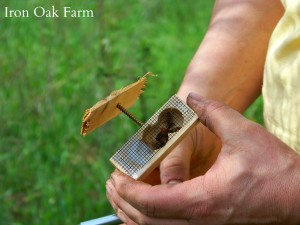
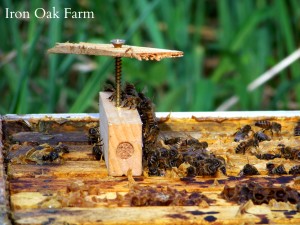
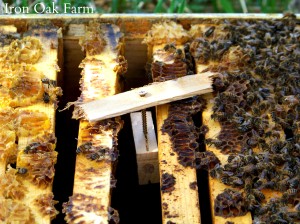
We removed a frame to make room for the queen box. Then we attached a thin piece of wood to the top of the box using a screw. This would suspend her between the two frames.
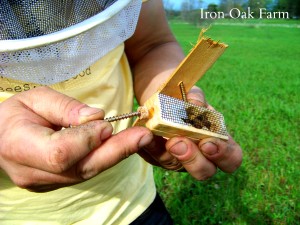
Then we used another screw to remove the cork. Again, she won’t be released immediately because the candy is in the way of her exit.
So we sealed up the hive and now we wait. We will give it a few days to let the workers eat the sugar and see if the queen is accepted. If she becomes the new queen, she will start laying eggs and our hive will continue.






13 Comments
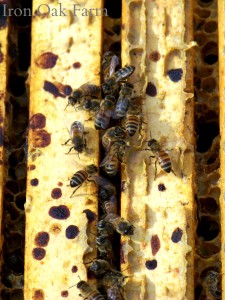
You seem to have a lot of “spotting” on the top bars and that is NOT a good thing, there is a problem there, they couldn’t break cluster to go out and have a cleansing flight. You might want to get a sample of bees tested for Nosema.
Where did you get your queen. We have 12 hives and are always interested in finding a source for queens, just in case.
Do by no means ever enter your App Store or Play Retailer
username and password in these program and websites!
Remarkable! Its really amazing paragraph, I have got much clea idea concerning from this post.
Хэя я первый раз здесь. Я наткнулся на нашли эту
доску, и я в поиске действительно полезно & это помогло мне много.
Я надеюсь, представить назад и ПОМОЩЬ
помощь таких, как Вы помогли автоматизированного меня.
excellent information. I really enjoy reading your information. 1st year beekeeper.
I am enjoying all the messages you produce. I am a newbe and find your articles a valuable source of instruction. Thank you very much. John
How long do you need to wait to see new eggs? We installed a new queen a week ago, checked on it today and didn’t see eggs. The queen box is empty, but we didn’t spot the queen. Do we wait another week? What is it supposed to look like after a week?
This item is very informative, but I feel you made one error. “When the new queen is introduced to the hive they will need time to acclimate to her and decide if they want to accept her. If they do, they will eat the sugar candy blocking the box entrance and release her.”
The bees will eat the candy anyway and if there is no other queens present she will be accepted, as she smells like them and belongs in the hive if she does. Releasing her pheremones also transfers her scent to the hive. Remember smell is the only way they recognise their own kind. Even bees who enter the hive which dont belong, if theyre not immeadiately killed and roughed up initially, will impart the smell of the “guard bees and will be accepted. Any lost disorientated bee bringing food, like a welcome guest, is allowed in.
Tks for the info. I just installed a nuc and can’t find the queen.
Thank you so much for all the information you give new people who kbow very little about bees
I am very interested to know what happened with this hive. Was it infected with Nosema? Did it survive?
Great piece of information! My daughter has just received her first shipment of bees, and we discussed what to do if the Queen was dead/missing. I am going to make sure she can read this. Thank you!