
 The phrase stealing honey from the bees could not be more accurate.
In addition to bees, at Iron Oak Farm we also raise chickens for eggs, and goats for dairy and fiber. With the other animals on our farm, I feel as though the relationship is a bit more balanced.
We provide food, shelter and comfort to our chickens and goats, in return for the things that they provide to us. But with the bees, the scales are terrible tilted in our favor.
Realistically we do very little to help our bees. We check them every two to three weeks, during the summer months. There’s no daily up-keep. We feed them in the spring and harvest in the fall. And the only reason we really have to check the bees, is to make sure that they are conforming to our standards to which we’ve placed the colony. I mean sure, we’ve “given” them a home to make their hive, but they could just as easily make their hive in a nearby tree without the disruption of hive checks.
 As I scoop grain into the goat and chicken pails, and haul bails of hay and buckets of water out to the barn in the winter, I realize how incredibly low maintenance the hives really are. For most of the year, we don’t feed our bees, they are entirely self sufficient. In fact, the process of them eating also benefits us by means of pollination which helps our pumpkins apples and garden to fruit.
It’s an amazing one sided relationship.
This is our first year with this new hive. We have two active hives now, as we split this flourishing hive in the middle of summer. (Split Hive Success!)
If this is your first year bee keeping, or you’re thinking of getting into it in the spring, here is an overview of what we collected with one hive.
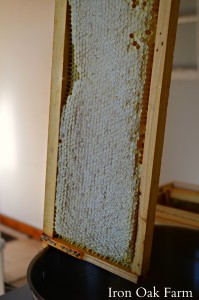
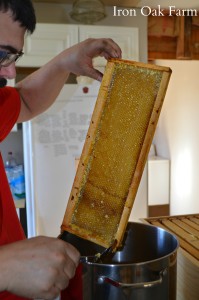 Throughout late summer, the bees were capping honey frames in the harvest box. When we did inspections, we sometimes removed these frames for honey because our stores inside the house were running low. Our hive failed us last year and we lost our bees.
When we harvested these 2 or three frames at a time we gathered around a quart to a quart and a half.
We did this three times.
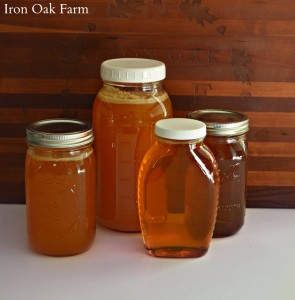
With this last large harvest we gathered a half gallon plus a quart and a half. So total collection was around 1 gallon ¾ to 2 gallons. My brain works in gallons because when I see honey I think in recipe terms, but honey is usually measured in pounds.
 1 gallon of honey is around 12 pounds so we collected 21 to 24 pounds of honey.
We probably would have collected more honey had we not split our hive this summer.
But next year this new hive will hopefully produce around 2 gallons as well. So it was a smart investment.
Part of the last harvest is the beginning of our winterization of the bees. Once the honey is harvested, we remove the harvest box for the winter. The bees won’t have time to fill these boxes again before the flowers die. We remove the box so that the bees will not have to keep this area of hive warm throughout the winter.
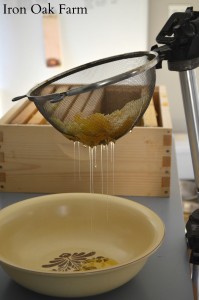
We separate the wax from the honey using a simple filtration method. (Extracting Honey Without an Extractor)
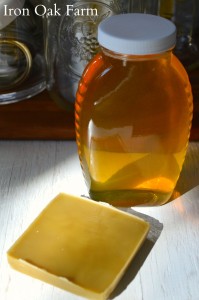 And clean the wax for use around our home. (Mind Your Beeswax)
Honey can be stored in any clean glass jar. There is no need to can it or process it in a water bath due to the sugar content and antibacterial properties.
We have enough honey this season to last us until next harvest and to give some gifts away throughout the holidays.
A jar of honey makes a great hostess gift for Thanksgiving dinner!






2 Comments
How much honey do you leave the bees?
I lost my hive last winter but was fortunate in that a swarm moved in during spring. I have a regular deep with two nukes and hope that’s enough for an expected mild el nino Oklahoma winter.
We live in Michigan with pretty harsh winters. We leave two deep boxes. 🙂