
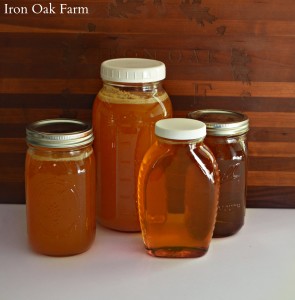
 Honey is a unique food in that it never spoils. Properly saturated honey should stay safe to eat forever.
In fact, one study found “stored honey from Ancient Egypt to be over 3000 years old and still completely edible”. http://www.compoundchem.com/2014/08/21/chemistryofhoney/
So Why Doesn’t Honey Spoil?
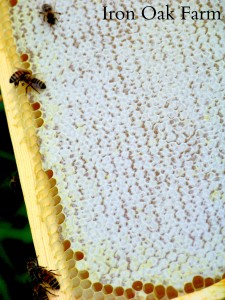 Honey safely stores for long periods of time for many of the same reasons why canned goods store for so long without refrigeration. Each capped cell in the honeycomb is very similar to a Mason jar in your pantry filled with food stores.
Honey is made from nectar that bees collect from flowers. They bring the nectar back to the hive and it is stored in the wax cells of the comb. The bees fan the nectar with their wings evaporating the water from the honey. When the honey is saturated enough, the bees cap it for safe storage.
Finished honey has about a 17% water content, which is interesting because when we boil maple syrup, we reduce it to a 17% concentration before we can it. Maple syrup also stores safely for long periods of time.
Honey is a high concentration of Fructose and Glucose. So high, that it is almost a solid. This is why honey often crystallizes…but more about that later. The saturation is so high that there isn’t enough water in the honey to support the growth of bacteria and mold spores. The bacteria actually suffocate or dehydrate.
Similarly, if you’ve ever canned jellies or jams, you know that a LOT of sugar is usually required in the recipe. This isn’t just to make the jam extra sweet, all that sugar is functional in keeping the jam safe while stored. Bacteria doesn’t thrive in super saturated amounts of sugar.
The second reason that honey is resistant to spoilage is that it is an acidic food. Bacteria doesn’t like acidic conditions. We can use the canning example again here. If you’ve ever canned tomatoes, you might be aware that a simple 10-15 minute water bath is perfectly acceptable in preserving tomatoes in jars. As opposed to green beans for example, a less acidic vegetable that requires a pressure canner to can safely. Tomatoes are high in acidity. Because of this, they don’t require the high temperatures and long exposure in boiling water to make them safe.
Honey can be stored in jars without any heating or canning process. The natural antibacterial properties keep it safe.
Crystallized Honey
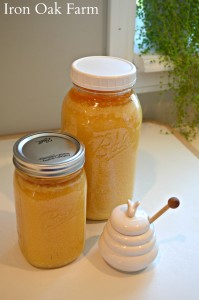 Often stored honey will become crystallized. The color will lighten and it will become opaque and textured similar to sticky wet sand.
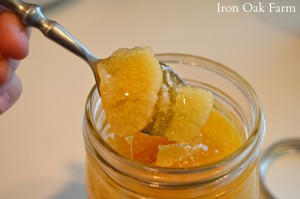 If this happens to your honey it does not mean that it is spoiled. In fact, quite the opposite. Like I mentioned before, honey is so concentrated that it is almost a solid. The sugar is just a few water drops away from being a sugar crystal. If water does evaporate, the glucose will crystallize. This crystallization begins a chain reaction and will spread rapidly though the jar. The honey is still perfectly safe to eat in its crystallized form.
The concentration of crystallized honey ensures that the bees were able to evaporate the nectar to 17% before you harvested. Sometimes honey frames will contain uncapped honey cells. If you harvest this along with the capped cells, you are mixing more water into the finished honey. This opens up the possibility of spoilage.
What to do with Crystallized Honey
Usually I just leave it be. I find that it spreads easier on toast. The heat from the toast melts the crystals and turns the honey clear again.
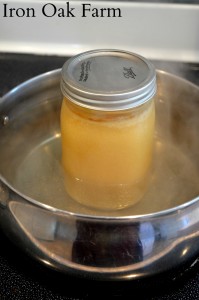 But if you want your honey back to its golden, clear hue, boil a pan of water, turn off the heat and let the jar soak until the honey is clear again.
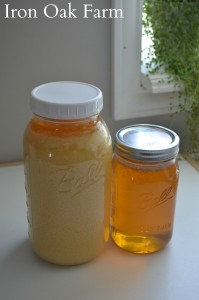
The jar on the right was heated and the crystals went away leaving smooth golden honey.
Honey can contain small amounts of botulism which is harmless to adults and older children, but younger children especially under the age of 1 should not consume honey.






14 Comments
I robbed a bee hive and about a month later it was sour and blew the lid off
Only the “CAPPED” cells in a comb of honey are ready for storage. If you took comb of uncapped honey it likely still had too much moisture in it. The bees cap the cells when the moisture content is exactly right!
We are first year bee keepers. We were able to get 1 gallon of honey from our hives this year.
If I sterilize the glass jars and lids, do I have to put wax over the honey before I seal the jar?
Also, we have 1/2 of another gallon that is partially water and honey. Can we or should we use that
also??
Thank you !!
Jarring honey is not like canning fruit or veggies. You just wash your jars and tops with soap and water and fill the jar and put the cap on. Done. I suggest you pick up a book on beekeeping and take a class through a beekeeping club near you. They can be so helpful with guidance and information. Good luck.
No, you do not need to add wax.
You can use the other 1/2 gallon, but because it has water in it you need to use it before it goes bad, or feed it back to your bees and extract it later. Only the “capped” comb is ready for removal and storage.
if its not caped when it taking and put up it will spoil.
I am also having a hobby of bee keeping but most often sometimes my few jars get freezed ,while as others remain quite clear,can u help me how to handle it plz
Great article. I did not know about the water content or that you could eat the crystals.
Incorrect statement from your text above: “Maple syrup also stores safely for long periods of time.”
Maple is about 33% water when canned which is why it must be refrigerated once its container is opened. Unlike honey, maple syrup will not keep at room temp after its container is opened; it will mold and spoil rapidly.
info great on crystalized honey. big mistake though to say tomatoes are safely canned after 10-15 minutes in water bath. tomatoes need 85 minutes according to Master Food Preservers info. I hope you checked the rest of your article better. tomato info is dangerous!
I put my crystal honey in the microwave.Take the lid off set your jar in the centre and cook for two minutes, job done, and the jar is still cool enough to pick and take out.
Maurice
Great information. Thank you.
Thanks for this info. Very helpfull.
I soaked cranberries and orange slices in honey….it did not ferment. Should I ‘can’ the honey? I’m concerned that the properties that keep honey good have been interrupted with the addition of the fruit and will spoil.