
I used to depend on two beehives to provide me with about 100 pounds of fresh honey each year, but upon inspecting my tiny apiary after a recent, unusually severe Ohio winter, I discovered that the cold weather had entirely wiped out one of my colonies! I knew once spring came I could restock my empty hive with a mail-ordered bees-and-queen package, but I decided, instead, to use the remaining hive community to establish a new colony by making queen bees!
My procedure wasn’t terribly complicated either. It should be well within the abilities of any backyard beekeeper, and the “queen making” skill can be an important one for any apiarist to master.
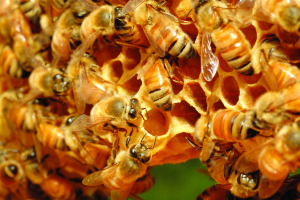
Honeybees feeding a queen larva in an uncapped queen cell.
Before I could use the “trick,” however, I wanted to make sure my remaining colony was at its peak strength. So I waited until May when the bee population had “blossomed” along with the spring flowers. I then opened the hive, examined the insects’ brood box and located the queen. I let her crawl between my thumb and forefinger, then gently grasped her thorax, or midsection – being careful not to clasp the abdomen, or tail section, where she makes her eggs – and clipped off a piece of one of her wings using cuticle scissors. (I knew I didn’t need to worry about stings during this operation, because queen bees almost never attack.)
I then gently transferred the “grounded” insect to my empty hive, along with two frames containing ready-to-hatch brood cells, one frame laden with honey, and another containing pollen. The four racks provided food stores and, most importantly, a source of soon-to-emerge young workers (known as nurse bees) that would tend to all the queen’s needs.
Once the colony-starting elements were in place, I closed up my “reborn” hive and blocked off most of its entryway so the temporarily shorthanded residents could defend their supplies from any invading “robber” bees. (I removed the entrance reducer two weeks later.)
So far, so good. But how, you may wonder, did the strong hive find itself a new queen? The answer is simple: The bees made themselves one.
Worker bees and queen bees come from the same type of eggs. A worker is a sexually undeveloped female, while the prolific queen – an insect that can lay up to 2,000 eggs a day during the height of the summer season – is a fully matured reproducer. The “secret ingredient” that makes one female egg develop into a lowly laborer and another into the hive’s highness is a bee-made food called royal jelly.
Scientists don’t understand how this magic substance works, or even exactly what all it contains –
oh, the unsolved marvels of apiculture! – but they do know that queen bees are raised entirely on royal jelly, while workers-to-be are fed the mysterious food for only the first three days of their lives.
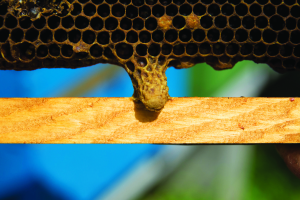
Queen cells have an appearance similar to a peanut.
I had already spotted the tiny white, uncurled “specks” of one- to three-day-old larvae in the original hive, so I knew the colony contained some royal-jelly-fed youngsters that had the potential to become queens. To provide a further stimulus, I created an artificial honey flow by filling three-quart jars with a 1⁄4-to-3⁄4 sugar-and-water mix, poking small holes in the containers’ lids, and inverting these feeders in the space left by the hive’s four missing frames. I then reassembled the hive.
Within 10 days, the bees had created eight queen cells. I took out a frame containing one of the peanut-shaped holders, and another with two queen cells, and used these – along with some brood – to start two more small colonies.
That left me with five queen cells in the original hive. The first insect to hatch out would destroy her unborn sisters. If more than one emerged simultaneously, the throne seekers would fight until only the strongest bee survived to become the new queen.
The addition of a frame containing 1- to 3-day-old larvae can help renew a hive that for any reason has lost its queen. In my case, using this technique to increase my apiary meant that I once again had two strong colonies, in addition to a pair of up-and-coming new hives. Best of all, that summer I was able to, once more, harvest a 100-pound honey crop!
– Merrill Schulz






10 Comments
Last spring I did the same thing, except I put the queen into the nuc without any brood, and shook nurse bees in with her. Then I dusted with powdered sugar. This way there were no mites brought in with brood, and hopefully few with the adults. It is now a three story nuc (5 medium frames per box), and we shall see how it does during this winter!
I really enjoyed these articles eminsly. These are excellent questions people ask all the time. When I talk to school students, they are fascinated. Thank you!
Hello, I really enjoy your articles. They are very informative. As a new beekeeper, rearing new queens is something I will need to learn. Wondering about how you would mate a queen after the splits? Does she fly out and come back to the same hive?
read this over
Bom video obrigado:
My first year with 2 bee hives. Enjoy your articles. I have been feeding my hives 1/2 and 1/2 sugar water since the flowers died in the summer. I have a tub of the yellow pollen, should I start making those patties for them to eat. Do I keep feeding the sugar water?
I am brand new at bee keeping and need all the advice I can get. I have a flow hive and don’t know how to set it up the right way.
I really have appreciated your videos and your on your post learn much from them thank you! I’m just a new beekeeper so all the help I can get I do appreciate!!
Hi,
I have a couple of hives, hobbyist only, and have had them since October. Although I live in New Zealand, I’ve found the information given by beekeepers on Backyard Bees. really useful- especially that about making Queen Bees.
It’s also amazing to learn of the conditions bees in other parts of the world have to endure and survive – I’m thinking of the extremely cold winters you have. Where we are, in the North, we never get snow , don’t even get frosts, and to get a couple of degrees below centigrade here is newsworthy!
A big thanks to the knowledgeable contributors; it’s all very helpful information for a novice.
Once the colony-starting elements were in place, I closed up my “reborn” hive – is this the new hive or the old one? Thanks, Therese R