
 by Jennifer Sartell of Iron Oak Farm
If you’re looking to increase the number of bees you keep, a swarm box is an inexpensive way to collect additional colonies. All you need is some scrap plywood, 4 to 5 frames and some essential oil.
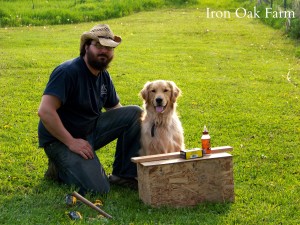 What is a swarm used box for?
A swarm box is an inviting home which is attractive to wild swarms looking for a place to live.
Why are these wild bees homeless?
Wild bee swarms can be looking for a potential home for a variety of reasons. Hive damage is one reason, but a more common reason is that the original colony grew too big for the hive. In this case, the colony will make a new queen and split the colony in two.
The swarm will take off and find a temporary home often on the side of a barn, in a tree branch or other less convenient places like under a picnic table. The swarm gathers as a giant ball of bees clinging to each other with the queen safely in the middle, being tended by her workers. From here, the swarm will send out scout bees to look for a new home. A swarm box is a perfect location for searching scouts.
What you will need:
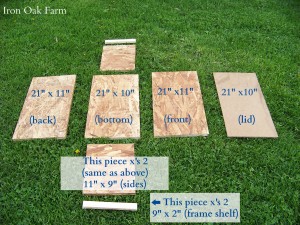 1/2 inch ply wood cut into the measurements shown in the photo
an additional piece of wood cut 3 inches by 24 inches for the hanger
wood glue
screws or nails
1/2 inch wire mesh
wire snips
roofing nails or screws with washers
lemon grass essential oil
several hive frames (It’s better if they are from an active hive with honey and comb on at least one)
paint
How to:
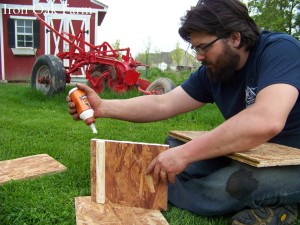 Begin by cutting the lid, sides and bottom piece as shown in the photo.
Run a bead of wood glue against each adjoining side screw together the bottom and sides.
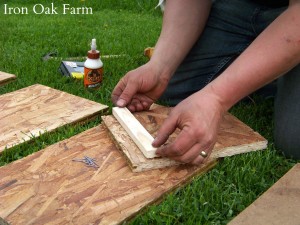 The frame hanger pieces can be glues and screwed about 1 inch from the top of the box. The frame ledge will rest on this shelf.
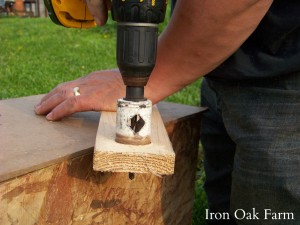 Cut an additional piece 3 inches by 24 inches for the hanger. Drill a 1 inch hole using a hole saw near the end of the board. This hole will be used as the hanger. The large circumference makes it quick and easy to remove the swarm box once it’s full of bees.
Attach this to the center of the back board.
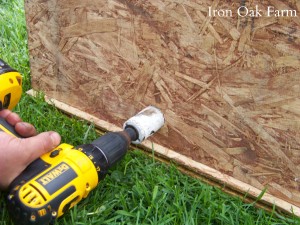 Drill a 1 inch hole using the hole saw, in the center of the front of the box about an inch from the bottom. This is the entrance hole.
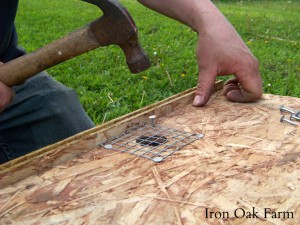 Cut a piece of wire mesh large enough to cover the entrance hole. Using roofing nails or screws with washers attach the wire over the hole. The nails with the large head help keep the mesh in place. The mesh allows the bees to enter the box but stops birds and rodents from making the swarm box their home.
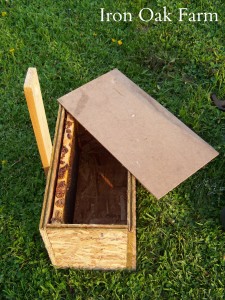 The lid can be attached by screwing a screw with a washer in one of the back corners. This allows the lid to pivot open.
We decided to paint our box camouflage to disguise it along the wood-line along the back of our property. You can paint it any color you like. The paint will offer the wood some additional protection against the elements.
To install:
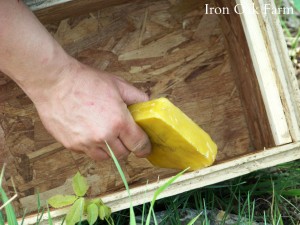 We rubbed our swarm box with beeswax as an added attractant.
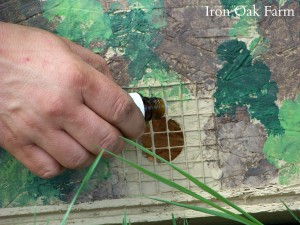 Put a few drops of lemon grass oil at the entrance of the hive. Bees love lemon grass and this will attract scout bees.
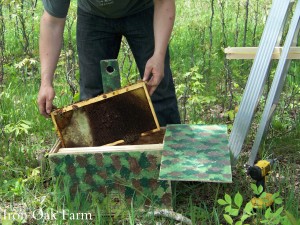 Then we added our frames. The frame system makes it easy to transfer the swarm to your hive box.
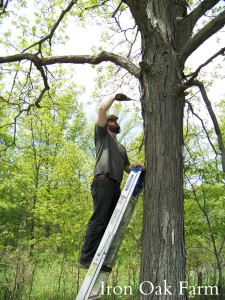 Hang the box by drilling a long screw into the tree or pole half way.
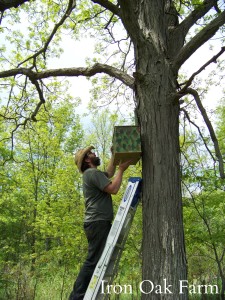 Simply loop the hole of the hanger over the screw.
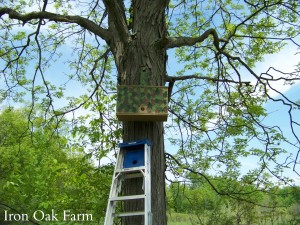 Ideally, your best chance of catching a swarm is at 30 feet high, with a south facing entrance, along a wood clearing. But these conditions are not necessary. Hang the swarm box in a tree or pole as high as you can. Swarm boxes have a usual success rate of about 1 in 3. It should be checked at least twice a week.






44 Comments
I have not started keeping bees yet but I have just begun reading up on it. Your post here addresses a question I had, which was, “can anything be done to prepare for a swarm so you can start a new hive?” Thanks for the post!
Check out Superior Hives on Facebook before buying a bee hive box. They have addressed most if not all the problematic areas of rearing bees. You can also begin by planting bee friendly plants. These are plants high in pollen for the bees to eat. Make your yard and surrounding areas full of these plants and your bees won’t have to leave the area to make honey. They will fly shorter distances, and make comb, pollen, honey, ect much faster and it won’t be full of GMO pollen.
That is what this article addresses. A swarm box is you preparation for a swarm. It is set up to entice the swarm to establish in it so you can then move them to a permanent hive. Just understand that a swarm box/trap is no guarantee that a swarm will use it.
Love your swarm box, but what do you do with them when they come in and fill up the swarm box? Some pictures and explanation of what to do at that point would be really helpful. Thanks. – Sidney
You’ll need to have ann empty hive ready to go. Then you transfer the newly caught swarm into the hive you have waiting and there you have a new colony started.
What bee will do when they enter in the box and how we collect the honey inner detail not clear. Thanks
Already submitted
When do you put up a swarm box? In the spring? My uncle is giving me some bee boxes. Should I clean the boxes, they look old?
Yes, Clean your bee boxes, pressure wash, or run a torch over everything to burn any mites or beetles, or moths. I would suggest getting a proper hive box from Superior Hives on Facebook. They are the only ones I know of building such a hive box. Then use the boxes your uncle is giving you as temporary bee boxes in transferring or starting new colonies.
Do you want to copy posts from other sources
rewrite them in seconds and post on your site or use for contextual backlinks?
You can save a lot of writing work, just search in gogle:
rheumale’s rewriter
Which way should I face my hive? Should the hive have any daytime shade? Would it not be a good move to put a solid wood fence around 3 sides of the hive?
Any help with these questions is much appriciated.
For the healthiest hive, try to resemble nature as Almighty God, the Creator intended it. Bees in the wild live in well insulated trees in the forest near the edge of the woods most of the time. So putting your bee box in the shade prevents summer stress, thus more honey for you. Having an insulated hive prevents winter stress and kill off, meaning more honey for you. Bees try to counter these challenges with a lot of effort resulting in them consuming a lot more honey which leaves less for you. Check out the proper plan on Facebook – Superior Hives.
Message* love this page I have start my own colony and its going well
You might mention putting frames in with foundation wax installed. Also, putting in one older frame of black comb is a big attractant. Instead of wire mesh (hardware cloth) over the entrance hole, I just nail two nails across the entrance making a cross. That has kept the critters out. Check out McCartney Taylor’s book “Swarm Traps and Bait Hives” for some great ideas. He also has some utube clips on bait hives. Catching a swarm in these boxes is always a treat!…………..
If you are using 1/2 inch plywood your dimensions are off just a little bit. Instead of 21 inch lengths the wood should be cut to 20 inches. Otherwise a 19 inch top bar frame won’t span the gap. I made my first box following your dimensions without thinking it through. Finished constructing my first box before trying to hang a frame. Solution was easy, nail in another 1/2 inch strip of plywood on each end of the box. Just need to set my saw back up and cut an inch off of each of my 21 inch lengths of wood.
I agree… Fortunately I caught the difference before I assembled.
My 19″ frame would not have fit either.
Still… I love this tutorial!!!
Great piece! Only question I have is about the gluing of the framerests for the bait hive. Will it hold or should it be secured by additional screws?
Printing this one out! Thanks again!
[…] your friends yards and in random places and you might just capture a swarm or two. You can buy or make swarm boxes. Natural beekeeper Michael Bush has estimated that bees show up in around 10% of the […]
I place my swarm boxes in the tree stands where I deer hunt. I use ladder type stands that are from 15 to 18 feet high. Of course by the time deer hunting comes the swarm boxes are already removed for the winter.
Nice simple plans. It would be my opinion though to increase the size to 2 cubic Feet or bigger. We have lost some swarms due to the box being too small and it was bigger than the one displayed here. The bees seem to prefer the plywood over other materials that we have used to date. I don’t know if we have it posted on our Facebook page under Superior Hives but if you take a 2×4 and mount it to the hive vertically with the end cut at at 45 sloping into the box. Take another 2×4 and mount it to the tree with the same 45 degree angle cut on the end with the slope facing the tree. Now your trap should hook onto the tree with ease. This makes it a lot easier for taking on and off. There are some other slight modifications that we make to increase the stability but that is the main hook up that we use for the tree.
Lost my bees for the second time in a row. Had plenty of honey left don’t know what to do!
Thanks for the tutorial; built two- one for my neighbor and one for me. Appreciate the post.
I have a hive in tree just above my head.
I need to know how to catch them so I can hopefully keep them. In my front yard
Thanks for the tips ,I have had a similar experience, and your swarm box idea has renewed my enthusiasm.
I live in Western Australia and some of your ideas don’t transfer well because of our seasonal differences,however I can adapt the processes. Keep up the good work.
Rgds Tom
Hello,honey bees are at a tree at my home they have been there for years how can I get them to move into a hive
Just curious where you get the facts that they are 1:3 successful and that 30 ft high is best. Unless you have real data maybe it would be better to say they are your preferences or what you find in your work, but I doubt either of these are absolutes. Ask three beekeepers the same question and you’ll get three answers.
to FireFox how about letting up on the Superior. I get it you make money on ’em but they don’t even offer a swarm box on their website.
In Laura Ingall’s books, she talks about her Pa finding a bee tree. To get the honey, he chopped the tree down. He told Laura the bees would take the rest of the honey and move it to another place. So I would guess, set up your hive and then chop the tree down.
You state on your site that swarm boxes are made from plywood yet in the illustration you are using OSB…….wondering why??? I jave built my swarm box from OSB like yours and now after 2 weeks and after having bees going in and out I find my bees are dead and the box has ants in it…what do you think caused this? I did use the lemongrass oil as an attractant
Hi, newby here. We are on six acres in The Woods. Recently a swarm of bees made their home in a hollow place in a half-dead oak near the house. The hole is about 30 feet up and faces south.
Thank you for the simple instruction and plans!
I built this swarm trap today with much satisfaction of its results!
I plan on using these plans for future traps as well. I really like the simplicity of moving the frames directly into hive boxes after a swarm is caught.
I hadnt thought of rubbing the inner walls with old comb… But after doing so the inside smelled so good I myself wanted to live in there!
Let’s hope a swarm feels the same.
I’m up in the north and swarming season is just started due to a very wet spring.
Best wishes to you All!
All the information I read about bee keeping I find informative but I wish the information was more through like the swarm box. It claim to use ply wood but you can tell it is really wafer board with no thickness stated. Then it talks about the construction but I cannot build this with the information given. I just need more details. Always things are assumed? Then out of the blue you mention frames are added. Nothing about size of frames how many frames? I am frustrated to even try
Just look for any info you need ref. box ,frame or types of bee boxes best type for your area or age all on the www. Cheers.
We built this out of scrap wood, so there’s no exact measurements that you need to adhere by. Really, you simply need to make a box similar to the one here that will fit your frames.
Good job, I find most of my swarms at head high or less. Enjoyed this
Thank you so very much! 🙂
How far away from your own bees? What prevents your own bees from going in there?
How do you ascertain that bees that do go in there are not your own bees?
Only a swarm of bees will move into the empty box. If a swarm leaves one of your hives and you catch it that is a good thing! Usually you want to split your hive when it starts getting crowded in the spring to prevent losing some of you bees due to a swarm leaving.
Good job!
How do you actually do the transfer of bees? Open the top of the hive? Dump the bees in? 🙂
Hi Lisa,
That is the gist of it. If you have a feeder or honey that you can install that will entice them to stay. If you can find the queen in the swarm and put her in a cage, even better.
Here is a podcast on catching swarms.
https://www.motherearthnews.com/www.motherearthnews.com/podcast/catch-a-swarm-zepz1804zcbru
Here is an article on installing a “package” of bees. A package is an artificial swarm.
https://www.keepingbackyardbees.com/3784-2/
We hope this helps!
KBB Team
Great article. easy to build. Now let’s see if I can catch the 2 swarms in my yard. Thank you for the great pictures.
I just built some of these and while they are nice there are definitely things I would change. First do away with the 1/4” plywood. It doesn’t give you enough support for a hanging strip. Also the box is to wide. With 6 frames in it a 7th will almost fit. I would cut the 9 1/2” measurement down a good bit. More like 8 1/2. You don’t want those frames with enough room to get spaced out of all crazy so that neds to tighten up some.
This tells you to ‘print’ but it only prints the first page off – whats wrong?
I have looked over your plans, design and page. I cant see clearly, whether or not the sides overlap the bottom or but directly into the bottom.