
 Guest post by Dawn Combs
Learn about the healing history of honey as medicine, how it can improve your health and how to know you’re buying sustainable products.
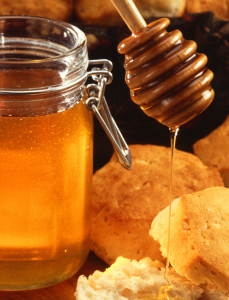
I’m still surprised when someone comes up to our farmers market booth and asks if there is any truth in the idea that honey is a health food. For me, a beekeeper and honey enthusiast for 10 years, it’s difficult to imagine that people in the U.S. still think of honey as just a sweetener. Honey’s many medicinal benefits have been employed throughout recorded history, and today we know more than ever about its scientifically backed healing properties.
History of Honey
In North America, the honeybee we know today was an import, brought with European settlers in the 17th century. Before that, this continent had native bees that did not collect as much honey. American Indians probably collected honey from wild hives, though we don’t have much in the way of historical evidence.
The settlers who brought the bee here clearly understood her value. Yet at some point American culture came to doubt the medicinal quality of honey. Most likely this occurred when Western medicine came to the forefront and cast aspersions on folk healing. We are only now beginning to accept the value of honey as a medicine again with the help of modern medical studies that are returning honey to the hospital for the treatment of diabetic sores and burns, and into medicated bandages for everyday cuts.
Despite our forgetfulness here in the West, the worldwide use of honey as medicine has continued uninterrupted since ancient times. In Egypt, honey figured prominently in the maintenance of life and preparations for death. In ancient Greece, Hippocrates used it as a base for most of his formulations, a practice continued in the works of the medical greats such as Galen and Dioscorides. We have more than 4,000 years of recorded use of honey as medicine from the ancient world to the present. It has even been successfully used as battlefield medicine from the time of The Iliad to as recently as World War I.
Types of Honey
Perhaps some of the reason people doubt the truth of honey’s healing powers lies in its variability. We still believe honey is honey. We know that it is antibacterial, but when someone in one part of the world touts honey as a cure-all for chest congestion, we doubt this lofty assertion rather than observing that their honey is collected in a grove of eucalyptus trees.
Lab tests show that various types of honey differ in their amounts of vitamins and minerals because every honey sample is made up of a different compilation of nectars. Depending which plants bees are visiting, honey can take on “supercharged” levels of certain nutrients and beneficial phytochemicals.
In the past several years, manuka honey has become popular. While this honey is every bit as fabulous as the marketing would have us believe, it’s not unique in its medicinal fortitude. We demonstrate our lack of understanding of the honeybee when we fail to see the complexity of the honeys she creates. To the bee, nectar isn’t mere sugar. Each flower has a varied vitamin and mineral content, so she is really filling her larder with a balanced diet just as we do with our grains, beans, vegetables and dairy. Our shopping lists may also include items to soothe a headache, protect against infection or relieve a cold. Each plant a bee visits has a different phytochemical profile, which allows her to mix her own medicine as well.
In the case of manuka honey, scientists have analyzed the honey that is collected from a specific tree (the manuka tree or Leptospermum scoparium) and found that it has an especially high mineral content and antibacterial activity. Interestingly, the manuka is in the same family as the Melaleuca group, which gives us the well-known antibacterial, tea tree oil.
While manuka is indisputably medicinal, it is important to understand that every culture around the world has had its highly medicinal honeys. In Greece, there is an abundance of thyme honey, while sage, rosemary or lavender honey may be found in other regions of the world. They all contain the benefits of the original plant from which the nectar was collected and can contain phytochemicals that are nourishing and relaxing to the nervous system, protect against fungal overgrowth and much more.
Here in the U.S., one of our most medicinal honeys, buckwheat honey, is very dark and contains high levels of minerals and antibacterial activity, just like manuka honey. It has a rich, molasseslike taste that can be difficult for some people to get used to. Knowing that all well-raised, chemical-free, raw honey has medicinal benefits can free you up to be choosy and splurge on an imported honey, or simply convince you to buy from your local beekeeper instead.
 Bees’ Needs
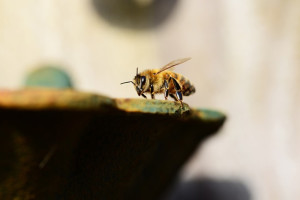
Understanding the complex nature of honey helps us better understand the bee and her needs. Scientists are studying the current disappearance of our bees, yet they often fail to consider bees’ basic needs before entering the lab.
Bees that are trucked from one major monocrop field to another—the common practice in commercial farming—are weakened. Almonds are quite healthy, but if you ate only almonds day in and day out, you would be very sick. Only recently are we seeing growers in these large monoculture systems begin to allow native weeds and medicinal plants to grow in windrows to provide alternative forage for pollinators. As an interesting note, in an article recently published in The New York Times, biologist Mark Winston says, thanks to increases in crop yields, farmers who plant their entire field would earn $27,000 in profit from the farm; those who left a third unplanted for bees to nest and forage would earn $65,000 on a farm of similar size.
We know bodies not fed a balanced diet need more medical care. When the bee is denied the means to remain healthy, she is prey to disease, pests and fungus and is too tired and sick to avoid crops that are sprayed or unacceptably modified. Taking care of the health of the bee is job one—and a vital one for all of us, considering bees pollinate at least 30 percent of the world’s crops and 90 percent of our wild plants. We can’t possibly obtain optimal health benefits from products made by unhealthy bees. Indeed, we may find it much more difficult to survive without healthy bees in our world.
—
Author DAWN COMBS is the owner of Mockingbird Meadows Herbal Health Farm in central Ohio and the director of its Eclectic Herbal Institute (mockingbirdmeadows.com). Mockingbird Meadows is nationally known for its line of herbal honey spreads. Dawn is the author of Conceiving Healthy Babies: An Herbal Guide to Support Preconception, Pregnancy and Lactation.






4 Comments
I am confused. Can you explain this comment. ” As an interesting note, in an article recently published in The New York Times, biologist Mark Winston says, thanks to increases in crop yields, farmers who plant their entire field would earn $27,000 in profit from the farm; those who left a third unplanted for bees to nest and forage would earn $65,000 on a farm of similar size.” How does decreasing your production acres by one third almost triple your income? If you can prove this with science I will truly be impressed – if not, I will have doubt with everything else you publish. Please take the time to prove this comment for I am truly interested. Thank you, Mark.
I am not the researcher, but if you had bees on your farm (you left a portion of your field to raising bees, instead of planting crops) they would increase your pollention, hence increasing your crop yield.
If you read the NYT article, it states in the paragraph before the the statement you reference……Recently, my laboratory at Simon Fraser University conducted a study on farms that produce canola oil that illustrated the profound value of wild bees. We discovered that crop yields, and thus profits, are maximized if considerable acreages of cropland are left uncultivated to support wild pollinators.
You would have to dig into their study to get the hard statistical facts. Its one of those “Less is More” things
[…] “The History of Honey as Medicine”; Keeping Backyard Bees; October 2014; http://backyardbees.wpengine.com/history-honey-medicine/ […]
I love to hear about bees. I do not have what it takes to keep some. Can someone out there bill me out. I want to think Kenya is a futile ground fo bee keeping. Who out there is willing to partner with me?