
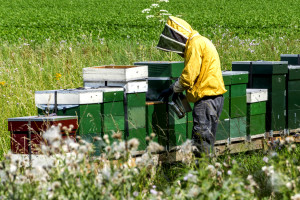
Photo by Paul van de Velde
I just attended a bee conference in Nashville, Tenn. for advanced Bee Keepers. I had questioned whether or not to go but I figured, “It’s mid-January … not much going on … why not?” I attended 6-8 schools last year promoting a rotatable beehive that I have been working on that is designed to take out the lifting of supers in order to check on the queen or do routine inspections.
So, I made reservations and planned for the trip. Our local bee club is in charge of planning for a bee school this year, and I’ve had several meetings to organize that bee school with club members and an extension personnel. I mentioned at one of the meetings that I was going to attend the conference and was asked by a non-bee keeper if he could accompany me to see the flow of the bee school. We met on a frosty morning and headed to Nashville.
I had only met him a few weeks earlier so we started off by making small talk, kind of like that song by Joe Diffie, “Ships that Don’t Come In.” He mentioned wanting to get into beekeeping this year. I did not want to push the issue, so I thought instead I would let him rub shoulders with the beekeeping community of Nashville. Everything went great and I was really impressed with the speakers and from the response of curious beekeepers about my displayed hive.
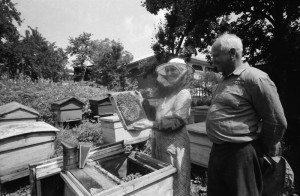
Photo by Ion Chibzii
My travel companion was excited and thought he might win a door prize, which usually values more than the registration fee, but no such luck. As the conference ended, we loaded up and headed back home as we talked about beekeeping, the up front cost of beginner kits offered by supply companies in the price of bees, and even getting in by buying used equipment as an option.
We made a safe and uneventful trip back home. As we parted, I wondered if I had given him all the right answers, wanting him to understand and experience the benefits of being a beekeeper. As a beekeeper, you usually talk to a dozen or so beekeepers every year, and sometimes it’s the same ones year after year.
Honey bees are an amazing insect that man began hiving more than 3,000 years ago. Bees collect nectar and pollen for food, and in the process, pollinate many trees and wildflowers. These products are brought back into the hive and stored in cells that are remarkably designed for strength and space. They are made out of the nectar that is converted to wax by glands on the body of the bee. A third of the food we consume is thanks to the honey bee. Pollination alone is reason enough to keep bees. It’s one of greenest things you can do!
A colony is always preparing for winter by storing nectar and pollen which will result in excess that can be harvested.
Let’s look at the image of the beekeeper: First, you have the commercial beekeepers, always on the move to one location or another. Transporting bees that are confined for a day or more then set out to pollination sites for a few weeks at most, then loaded up and moved again. But this is simply not what bees are built for. But population grows, so grows demand for commercial pollination, so there is often no alternative. Thousands of colonies are needed to perform these tasks, resulting in big demands for beekeeping supplies that are being mass-produced, which results in cheaper prices for all beekeepers.
Thus, the hive that is widely used by hobby beekeepers, is the same hive that is used in commercial beekeeping. It was designed to be able to be transported. Indeed, the frame design is one of the biggest innovations in beekeeping history. The boxes are made of cheapest wood available, and manufactured to precise details using the least amount of material as possible. That means the colony inside the box is being protected from the elements of nature by barriers 3/4 of an inch thick. Not at all like the protection the colony would have in an natural tree cavity.
This material will begin to decay in a few short years. Ultimately, new beekeepers are looking at initial investments in hives that are not durable even if they’re visually appealing. A flaw of humanity is how we invest in the visually appealing, even when the desired object has no real value (such as cars with fancy paint jobs). We don’t do this with our own homes. We take great care to build them out of the best material available and spare no expense with added exterior design just for curb appeal. Then it’s heated and cooled and whatever else is needed to control the environment of the interior. And then again, we spare no expense to furnish for our convenience and personal taste. On top of that, we pay monthly costs for what we call entertainment that has little or no life enhancement value.
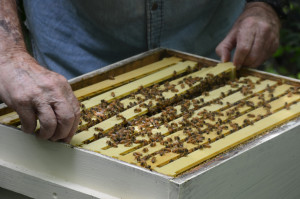
Photo by KOMUnews
But, by becoming a beekeeper you benefit from having available high quality health enhancing products that can be shared with family or turned into revenue. Plus, the pollination benefits our food sources as well as trees and wildflowers, helping to compensate for our so-called carbon foot print. As a beekeeper, you have a greater appreciation of the eco-system by watching and learning from the ecology of a colony of social insects.
Honey was once a treat for “high society,” but with imported blending and mass-production, prices for commercial honey are nearly on par with artificial sweeteners (which have none of honey’s benefits). That results in a negative perception of the local honey producers who price their products by the average consumer.
So: Let’s take a look at beekeeping. Come to think of it, “beekeeping” isn’t even the right word. After all, the bees come and go as they please. Sometimes the whole colony will leave by swarming with you not understanding why. So, maybe we need to come up with a better title. Other professions have changed their titles, shouldn’t we. The guy we knew as a mechanic is now an “auto-technician.” The garbage man is a now a “waste manager.” Perhaps a beekeeper should then be called “A Life Enhancer”?
In the future we should look at an alternative hive that benefits the bees not just our budget and get future beekeepers to look in the box and not at the box!






4 Comments
I like the name bee whisperer, having the instinct of our bees helps us better understand their needs.
By all means, change your title, but must at least keep the word “bee” in it! The title you chose is much too broad, and although it’s true, it’s not descriptive enough and loses that beautiful word. Back to the drawing board, in my opinion. Bee Assistant. Bee Harvester. Bee Something.
I wondered why the bees own design of their hive in the wild was ignored by beekeepers. Now, I see. Big business. Of course.
Thank you for your articles! I’m looking for more. 🙂
http://www.honeyflow.com/
Maybe just a bee landlord.
I don’t worry too much about my outer shell. I build mine out of 3/4″ pine (cheap). Screwed and glued, and painted. But, come winter, I cover mine with foam insulation. Along with a vented insulated inner cover.
First, the insulation blocks the wind. This has to help with keeping the internal temperatures a bit more stable. I know I’m going to get comments about moisture, but I do have an upper entrance, albeit small, that allows a small air flow.
Second, by insulating, it has to cut down on honey depletion (think of how your heating bill would go up, with no insulation), and allow your colony to have enough to make it through until spring.