
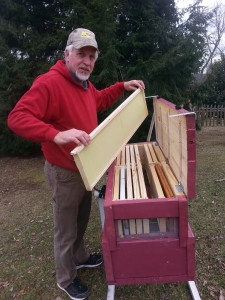
 Several years ago, after being blessed with grandchildren in my later years and wanting to share some of my childhood experiences and memories with all the environmental issues brought to light in the last few decades, I did a little research and decided to take up beekeeping. Buying the most common and up-to-date equipment available and joining a local bee club, I made a leap into my first and adventurous year of beekeeping. Trying to keep up with the grandkids and staying as active as possible and with no major issues, I’d say the first year was a successful one.
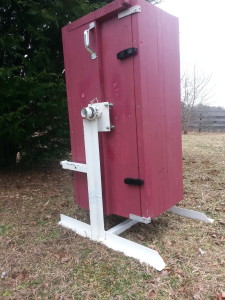 I entered the second season of beekeeping with a strong and healthy colony and a little more knowledge. With mother nature cooperating and a little bit of luck, the colony began to expand and produce surplus honey (as they are genetically programmed to do).
But beekeeping requires routine inspections and management techniques to maintain hive health, and part of that process includes removing honey supers that can weigh thirty pounds or more just to gain access to the brood. With flare-ups from back surgery a few years earlier, I found it very difficult to carry out these tasks.
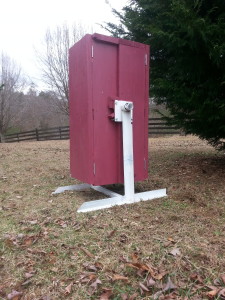 After a bit of research, I found out that current beekeeping hives were designed more than 150 years ago (and with the commercial beekeeper in mind). There have been few recent improvements for the backyard beekeeper and hobbyist. Wanting to make the brood area more accessible without the heavy lifting and a dismantled hive, I designed and built my first rotatable beehive using standard frames that are readily available on the market.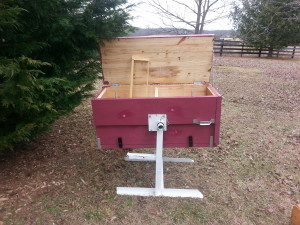
The colony survived through the first winter, and indeed, I even observed colony growth. I implemented some new management techniques and began to improve on the original design. With success and encouragement from fellow beekeepers, I was determined to patent and to continue improvements on my rotatable beehives.
Now, with nearly four years of thought and operation (and feedback) from fellow beekeepers, I have a marketable design. This design eliminates issues faced by many older or physically challenged beekeepers with a more natural design for a colony.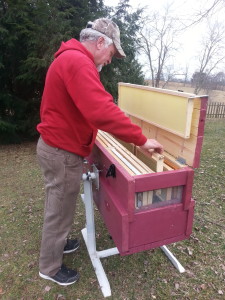
The design consists of a sturdy metal stand that supports the hive. It allows ventilation around the entire hive, thus increasing the life of the hive itself. It holds standard, deep, and medium frames in vertical position while bees are carrying out daily activities.
With the simple pull of a pin, the hive can be manually rotated 90 degrees in one direction for brood accessibility or rotated 90 degrees in other direction to access honey chambers with minimum effort. The hive is rotated at a workable height that requires only minimum bending.
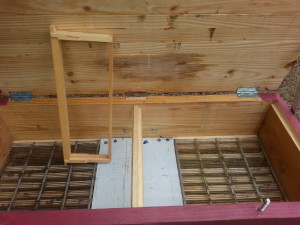
Much of my design was inspired by a book published by Dadant about the history of methods and frame designs used in nearly two centuries of beekeeping.
The rotatable hive has proven trial-runs yielding more honey production and overall colony health, in part because it uses a larger brood frame. This frame allows the queen to lay more eggs without having to stop laying and relocate to the next available frame. The design of Dadant’s jumbo frame was better than original frames, but a brood box weighing more than 100 pounds was just not marketable.
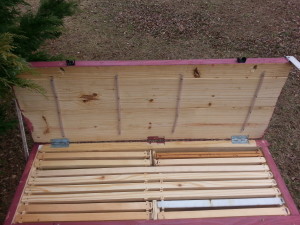
With that thought in mind as well as thinking through the way a natural comb develops in a tree cavity, I altered the design of the standard four brood frames to nearly 38 inches in length for the center brood area of the hive. When the rotatable hive is standing in vertical position, it mimics the natural cavity of a tree, and gives the queen more area to lay without relocating.
Then, all you have to do is rotate the hive 90 degrees to access the brood frames, each which weigh only about twelve pounds each, and can easily be removed for inspections with minimum disturbance to the bee colony. This is my Appalachian Rotatable Beehive!






27 Comments
[…] The Rotatable Beehive. […]
How do I order the plans to build this hive.
Where do we buy them?
What an eye opener….may I ask…how may we obtain a copy of your design plans for this kind of hive? How does this kind of hive stand up to the attentions of bears? Thank you
So what would you use to spin out the honey? Looks like such a great idea. Thanks
Also interested in purchasing info. What a Godsend this would be to all of us disabled people who don’t want to give up our bees. Thank You!
Would love to buy one. Not really wanting to make it myself.
I would like more info on your hive.Were to buy ,how much, do you have plans? Thanks LeeRoy
I would also like to know how do I order the plans to build this hive.
As a 60+ BK myself, I find your design appealing. However, if the hive (and therefore the frames) are normally vertical, do you find nectar runs/leak out of uncapped cells when the hive is horizontal for inspection/servicing since the bees build cells slanting “upward” to hold the nectar in.
Love the thought of less lifting, my back would appreciate it. I started my hives with my 5 year old granddaughter. Do you have a site with more info? A link to a u-tube video showing it in action would be great. Thanks!!!
How do I go about getting the plans to build one of these? I’m sure I could figure it out on my own, but I’d have to go through trial and error which you’ve probably already done! 🙂
Looks intriguing. I like the thought of the larger frames but wouldn’t they weigh a lot? Another idea for physically challenged beekeepers is a horizontal langstroth which you could build long frames for. There are some horizontal lang plans here http://goo.gl/DZRhlH
Also would like purchase details please.
Like everyone else it is a very intriguing concept and, since I used to build cabinets, it doesn’t seem to be overly difficult, I would love to have a set of plans or rough drawings (with measurements please) so that I can try building one(or more) myself. You sure hit the nail on the head about not being able to lift heavy stuff anymore. It sure is tough to get old.
Would like to have this
I can not see any reason for this silly Yankee nonsense. His aim could be better achieved
with a national hive using the Michael Vesty invention called The Draw Hive, look it up it
is very good I have been using it for a no of years.
I don’t get why people think bees prefer building hives vertically more than horizontally. Or vice versa.
I do A LOT of removals. I have come to the conclusion that bees simply DO NOT CARE about the shape of their hive. It can be round or it can be square. It can be horizontal or it can be vertical. To the bees, it DOES NOT MATTER.
What they do care about is the VOLUME of the space.
Why rotate upright? Keep it horizontal like a long-hive. Bees love floor joists hives and that is horizontal. Use langstroth frames, three boxes long, solid separator board you move as the hive grows horizontally. Use three migratory covers on top. No heavy lifting of boxes. Want more room just remove a migratory cover and put a langstroth box on top and start going up.
Very good comment. Long hive uses standard very available equipment that may be interchanged with fellow beeks if absolutely necessary. Your transition from Langstroff is easy and reduces expense.
I just wanted to give you kudos for helping to keep the bee’s happy and safe. With all the pesticides out there killing our little pollinators, it’s nice to see that they are being taken care of and thriving. Thank you!
I am interested in starting bee keeping. Would this be a good way to start? If so how can I get more information on buying or building this type of hive
I’m surprised you don’t do a top bar hive where the frames are so much easier to handle and lift and not disturb the rest of the colony.
Being an over 50yr old beekeeper, I would like to try one of these hives! Are there plans available for sale, or better yet free?????
Like the long langstroth. How long are the long frames? What do the bees think of having a longer brood chamber? Wanting to build a similar long langstroth but not be rotatable, just fixed with and entrance at the end and the frames running the long way down the box. Would put my honey supers on one end with a queen excluder, that would be a normal sized lanstroth box.
Am very interested in your hive I am a new beekeeper
Carl Jackson, How do I order a set of plans to build this verticle hive?