
If you read my previous post Overcoming my Fear of Bees, then you know that I used to be petrified of anything that went buzz. But after learning and working with bees, my fears subsided and curiosity and intrigue soon replaced any apprehension I had.
I love our bees! They are amazing little creatures which I find fascinating. But just because I love them, doesn’t mean I love it when we occasionally get stung.
It happens. No matter how careful you are, if you keep bees, eventually you will get stung. And it’s a bummer, and it hurts like the Dickens. But I understand why a bee might want to sting me when I’m tearing open it’s home and stealing its food.
Why do bees sting?
Bees rarely sting willy-nilly. They are gentle creatures for the most part and don’t want to sting you because sadly, a sting results in death for the bee. Bees only sting when they feel threatened.
A bee’s job is to protect the hive and the queen. Which means they are most likely to sting when they feel that there is a direct threat to their home, or their mother. (It’s kinda sentimental when you think about it.)
Bees are very focused. They tend to concentrate on the work in front of them, rather than attacking. When a bee is out foraging, it is concentrating on gathering pollen and nectar and less interested in what us humans are up to.
A bee is also less likely to sting when it is in a package or a swarm because it doesn’t have a home to defend at this point.
How does a bee sting you? What happens to the bee?
Honey bees are brave little soldiers. Giving her life to protect the good of the hive.
The stinger on a honey bee is barbed. When it inserts the stinger into your skin, its body isn’t strong enough to pull the stinger out against the grain of the barbs. Instead, part of its abdomen and digestive track pull away, thus killing the bee.
How to Prevent Stings
1. The Smoker (for more information on using a smoker visit my post Understanding your Smoker)
 The bee keeper’s number one defense against stings is the smoker. The bees pick up on the smoke signal and start preparing for a hive fire. They begin to consume honey as fast as they can so they will have nutrition to take with them as they prepare to move the colony away from the “burning” hive. The excess honey puts the bees in a type of food coma, where they become lethargic and less aggressive.
Whenever you are working with your bees it’s important to use a smoker. This not only protects you, but the hive as well.
2. Bee suit, veil and gloves
The second means of protection is through protective clothing via the bee suit, veil and gloves.
 There are many different suit designs on the market, with different amount of coverage. Some are half suits protecting the torso and arms, some are complete suits that cover the entire body. Bee suits are not 100% effective. A bee can still sting through the material in the right conditions, but it lessens the chance greatly.
 A veil protects the face and head from stings. The veil usually has some sort of brim, or stiff construction keeping the veil fabric away from the face and head, this prevents stings from coming in contact with the skin. There is usually a mesh front so the keeper can see and breath.
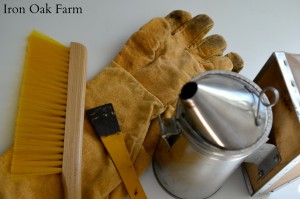 Bee keeping gloves are make of heavy cotton and are long, meant to go up the arm toward the elbow.
All of these clothing items help prevent stings, but do not guarantee complete protection. Usually when a sting happens, it is when a bee climbs up one of the garments and gets trapped or nearly squished. So take precaution.
My advice is to wear what makes you feel comfortable. I prefer not to wear a suit. It makes me claustrophobic, and I’d rather see what the bees are doing around me.
3. Wear light colors
There’s a reason bee suits are usually white. Bees are less threatened by light colors than dark colors.
4. Don’t stand in the way of the entrance.
Bees usually establish a flight pattern that guides them into the entrance of the hive. If you block this entrance with your body, returning bees will get agitated. They might buzz close to you angrily, or start thwaping into you with their bodies. These are warnings to move out of the way before someone stings you.
5. Slow movements
Don’t swat! Bees see fast movement as threatening. Try to be calm and move slowly and deliberately.
6. Fragrances
Bees won’t sting you just because you smell good, but they will be attracted to you. And that increases your chance of direct contact with bees.
7. Pay attention to the buzzing
The humming level and the activity of the bees is a general indication of whether or not the colony is happy with you. Louder buzzing, increased movement, circling of bees around you or thwapping is a good indication that they might need another puff of smoke, or maybe you need to move away from the hive for a moment.
8. If you are stung, move away from the hive.
When a bee stings, it emits a pheromone to the rest of the colony that says “danger, we’re under attack!” The rest of the colony will often move in to chase off the aggressor.
9. Use sugar water with a new package
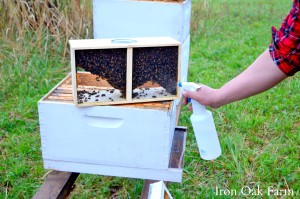 When installing a new package of bees, you don’t want to use the smoker to calm the bees because they might interpret this as a sign that their new home is dangerous and fire prone. Instead, lightly mist the package with sugar water. The bees will concentrate on cleaning themselves and less likely to sting.
10. Get the Honey and Go.
When removing honey, do so quickly and make sure all bees have been removed from the frames. If a bee is still attached to the frames you are bringing inside, they can send out a pheromone to the rest of the colony that says “hey guys, I now where they’re taking the honey.” This can result in a swarm of angry bees following you to the house.
With a little common sense, and a bit of precaution, working with bees can be an enjoyable, pain free experience.
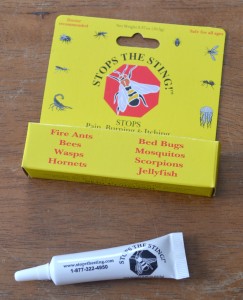 Be sure to enter the giveaway for a tube of Stops the Sting in my last post Overcoming My Fear of Bees






13 Comments
ASPIVENIN A VACUUM TOOL FOR THE STING RELIEF FROM THORNE PAGE 35 £24 00 worth the money .
Thanks for this great post; our listeners loved your post so much we chatted about it on this month’s Beekeeping Podcast.
Some good tips here, but we don’t have package bees here in New Zealand. So never used the sugar water on a new colony idea.
Gary and Margaret
[…] 10 Ways to Prevent Bee Stings […]
Have you ever heard of honey bees stinging someone because they are wearing hearing aids?
Very well written article and exceptionally informative.
Thank you
Great information, thank you. I have anaphylactic reactions to all stinging insects but want to keep a hive or two for their pollination activities. My wife and I have discussed it and since we have some wild colonies in our woods we are going to put a few hives out for the swarms to find. We already have a friend we get our raw honey from so these bees will get to keep all the fruits of their work for themselves. Our farm is organic and it just seems like the best thing to do for us and the bees.
Dear sir,
We at our house have these bee guests after 10 years.
We really don’t want to get rid of them.
But unfortunately they are at dangerously close distance near our house entrance.
We are in a fix as to what to do.
Kindly advise.
Could you send us some images of what you are dealing with?
Good info for me as I am first time bee keeper
[…] and go. A very easy way to dodge the bees is to not pay attention to them and not make and noise orhttps://www.keepingbackyardbees.com/2466-2/ […]
Breath = you mean breathe
Now = know
Sorry but it looks unprofessional. Thought you should now = I mean know..
i would let the bees ting me .then they come out and said that is good for some thing
we have a lot of homing bees and les than 2 weeks ago i was in my garden sitting on chair then there was a swarm so i left but do youwalk or run then on tuesday there were swarming again sounding verry angre and were loud left again thank you p Stephens