
Winter is coming.
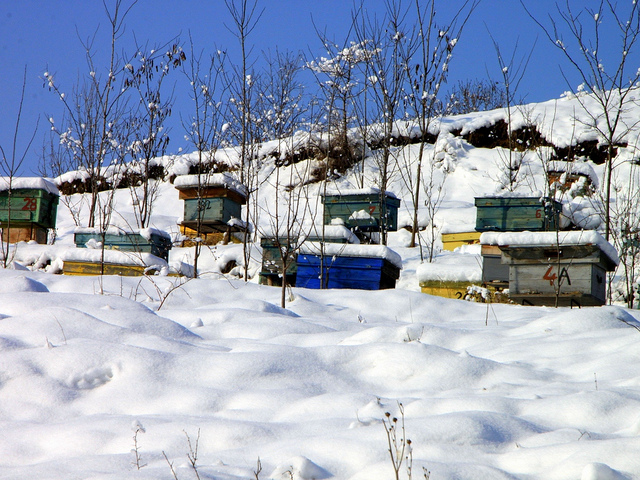
Snow covered hives on a sunny day. Photo Credit.
Now is the time to begin preparing your beehives for a successful overwintering. During winter, instead of foraging for and storing food, the focus of the hive is to overwinter the queen. Successfully overwintering the queen ensures the hive’s survival for next spring. Honeybees during this time will cluster around the queen only to break the cluster during warmer days (mid-40’s) for cleansing flights and to move the cluster closer to food stores. So why do hives die anyway during winter?
Starvation: Honeybees will perish if they do not have plenty of food reserves stored in the hive. A poor man’s way to check for food stores is to gently lift your upper deep. Is it heavy or light? During this time of year it should take some effort to lift and be quite heavy with stores. If it is not, feed the bees a 2:1 sugar syrup until about a month prior to your first frost. After that, plan to use a back-up winter feeding method. There are few including the use of fondant, mountain camp method, and candy boards.
Excess Moisture: Bees create moisture in the hive during winter. Too much moisture and humidity in the hive can cause condensation in the hive, which in turn can drip cold water on your bees and cause them to die. To combat this, some people add a bit of newspaper in the hive, make quilting boxes, or ventilate the top lid ever so slightly. Candy boards are also helpful with this too.
Temperature Fluctuations: Severe swings in temperature can prevent the bees that broke the cluster to return to the cluster in time to protect one another from freezing temperatures. To help with this, some folks wrap their hives with roofing tar paper, use quilting boxes, or even make the switch earlier in the season to Styrofoam hives. Beekeepers who use a screened bottom board will also put the IPM board in the screened bottom board for the winter.
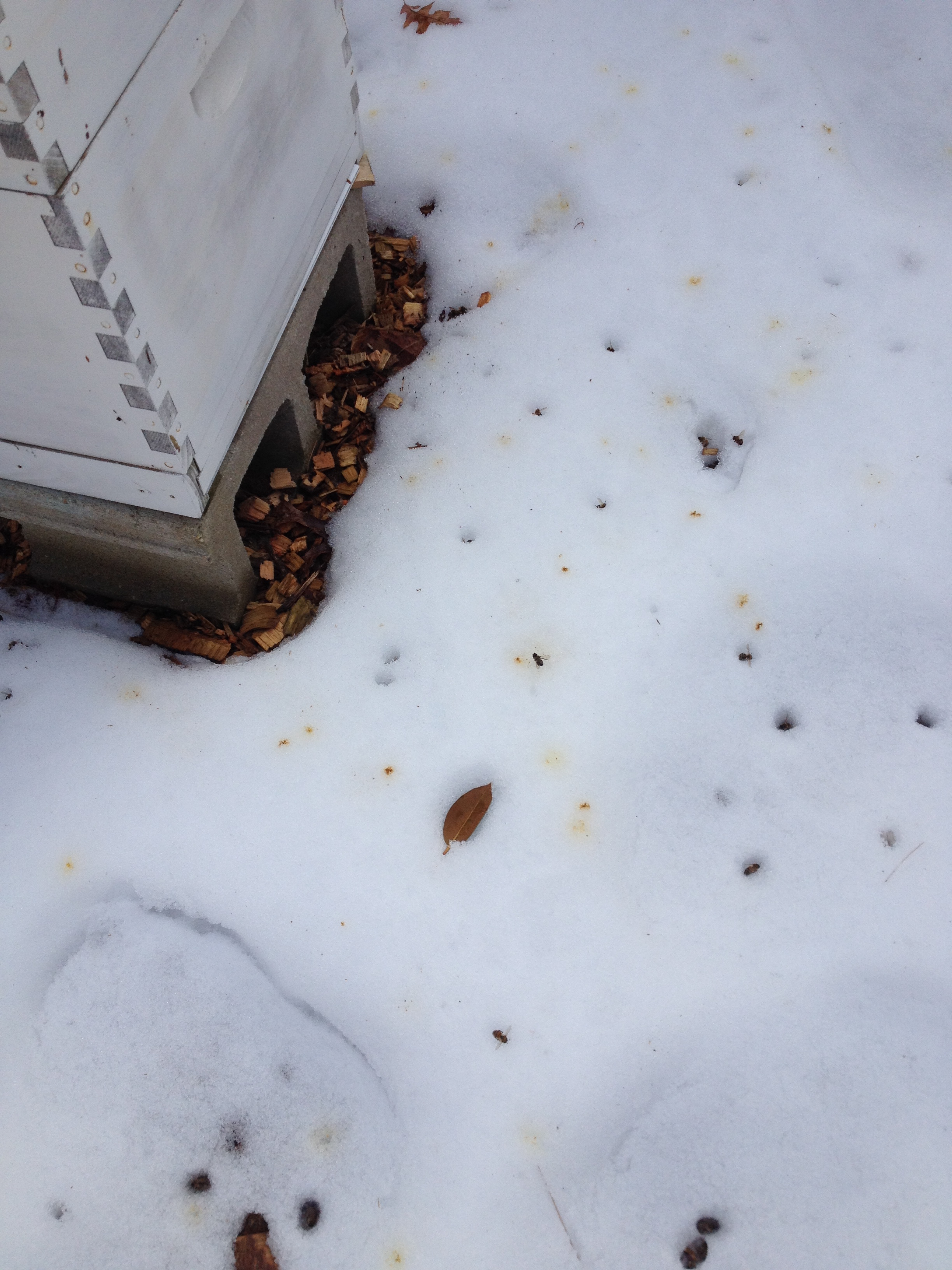
Evidence of winter cleansing flights around the hive. Photo Credit: MCaughey/Tilly’s Nest
Weak Hive Going into Winter: If you have a weak hive going into winter, it will probably not survive. Consider combining that hive with another hive. Two weak hives can merge to create a strong one. You can also add a weak hive to a strong hive. Please research techniques on how to do this. It is not difficult but must be done properly to prevent the two hives from killing one another.
Strong Winds: There should be a wind barrier near your hives to help prevent temperature fluctuation. Evergreens provide a good wind break as well as a burlap fence around the hives.
Ill or Infested Hives: Hives with large counts of varroa mites, small hive beetle, or wax moths are already weak and stressed. The best thing you can do is stay on top of IPM during the year.
Replace the Comb: Frames with comb older than 2 years, should be replaced, a couple at a time, during the active seasons of spring and summer. Old comb contains pesticides, herbicides, and fungicides that the bees are exposed to during foraging. Replacing the comb, reduces their exposure, the brood’s exposure, and the risk of causing stress to your bees.
Failure to Clear off Entrances: Bees need to be able to exit the hive even during winter. So be sure to clear off the entrances after every snow storm or provide an exit/entry at the top of the hive for cleansing flights.
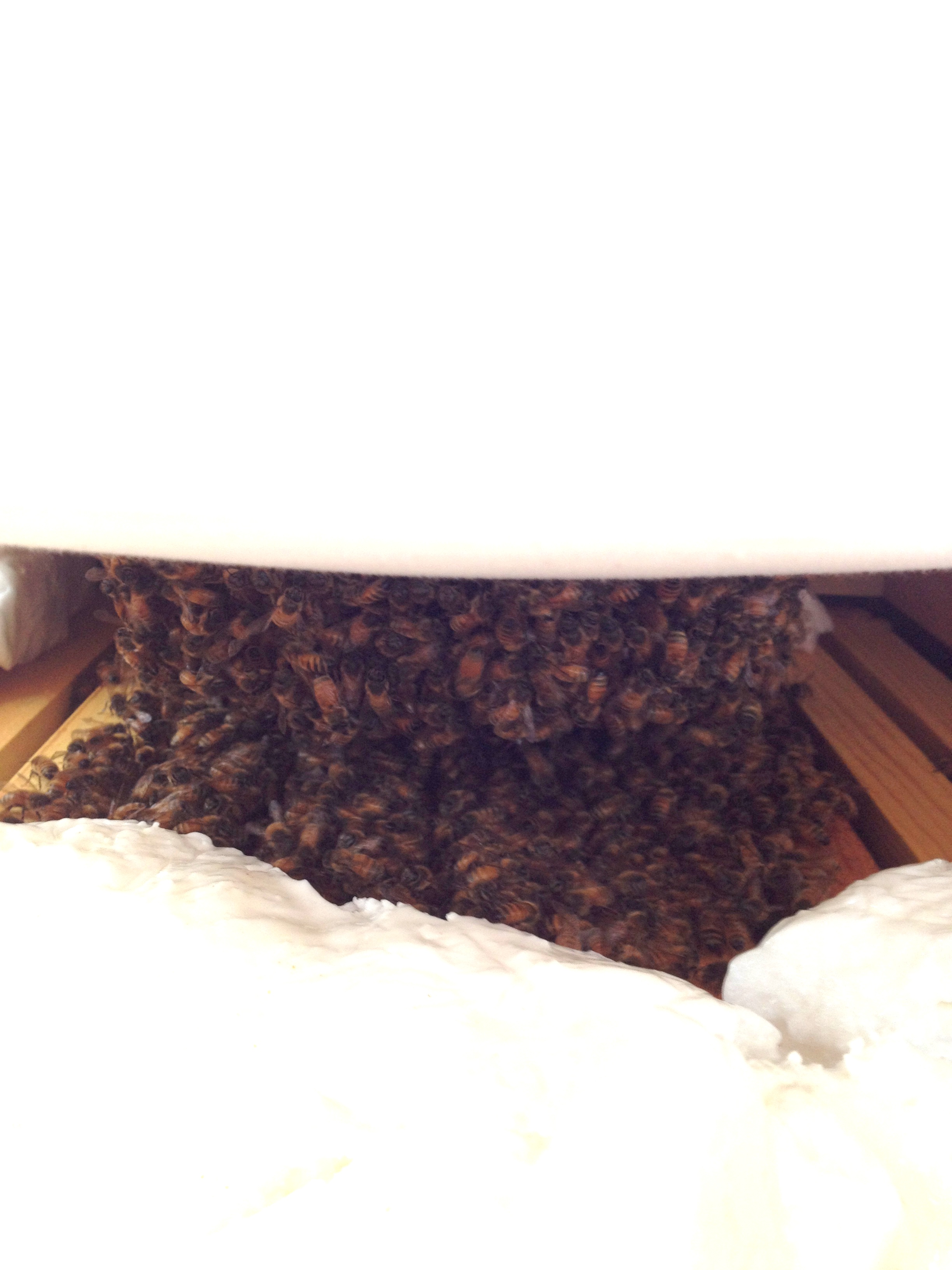
Lifting the lid reveals what is left of the candy board as well as the cluster in late January. Photo Credit: M. Caughey/ Tilly’s Nest
Failure to Install Mouse Guards: Mice will move into your hives. So keep the mouse guards on to prevent unwanted tenants. You can make your own mouse guard with hardware cloth folded over and tucked into the hive entrance on the bottom board.
Failure to Check Your Bees in the Winter: It is important to lift the lids on your hives during the winter at least every few weeks. On warmer days (40’s degrees F), quickly lift the lid to check on food stores. Replenish as necessary. Peek at the inner cover for moisture/mold when you lift the lid. Increase ventilation at the top if present. This can be done with a small shim. Also, periodically knock on the side of the hive to see if you hear your bees buzzing back to you.
For honeybee feeding recipes throughout all the seasons, click here.
One photo used under Creative Commons Licensing agreement.






19 Comments
There needs to be a mention of tainted honey stores by pesticides. Winter pesticide kills are quite common now. Its characterized by a colony seemingly healthy in late winter and then weeks later turn up completely dead with stores and masses of dead inside hive.
I have a hive of bees in a wall in my barn.
I would like to move them to a super.
When is the best time and how ?
Thanks Melissa for writing this article, some great ideas in there.
Our readers like it so much it was voted up and we talked about on our last beekeeping podcast 🙂
http://kiwimana.co.nz/the-temperature-is-rising-km082/
One more tip for overwintering bees, is always remove any Queen Excluder you don’t want the cluster moving up and leaving the Queen by her self.
Thanks again
Gary Fawcett
kiwimana Buzz Beekeeping podcast
[…] if not, then you need to keep reading. There are many reasons bees die each winter. You may not be able to prevent all of them, but you could potentially prevent a few of […]
Why would a colony leave a hive in winter? I opened it and several frames of honey were still intact, but not one bee.
The frames in the bottom/brood area had wax that was very dark, but no sign of any pests or disease. Why would it even be dark?
[…] will come and some colonies will not survive. (More info on winter hives) But, we beekeepers will do our best for the bees. And bees will continue to do what they have been […]
We have lost our hives in the first of March for the last 3 years. Any suggestions?
I am so happy to come across this article. We live in the north woods of WI and never had luck with our colonies, but this year we used the styrafoam boards, mouse guards, and insulation vents. Checked on them new years day and all hives are doing great, feeding pollen patties and sugar bricks.
Very good article, thank you for sharing.
Thank’s
Very good
Message*i have bee colony living in large trash can that I use to keep kindling for my fireplace. I don’t want the bees to die and don’t about the wood. How do I protect them?
Thank you for sharing this amazing article. It contains very informative ideas which can be very helpful.
Thanks for sharing these amazing benefits. It can be very helpful to many of us.
The way you have presented this article is amazing. Thank you for sharing this article.
Thank you for such an amazing article. I really like your way of presenting things in the article.
Thank you for sharing this amazing article. I really liked your way of presenting the article.
Nice! It can be very helpful information to many of us. Thank you for sharing this amazing information.
Thank you for this amazing article, I really liked your way of presenting the article.
I have honey bees in my loft that we see swarming around the chimney, it’s an old house and they have been here for years, for the past few weeks they have been appearing in a bedroom in excess of 50 at a time, I try to get them out the window, but most of them are dying. Is there anything we can do.