
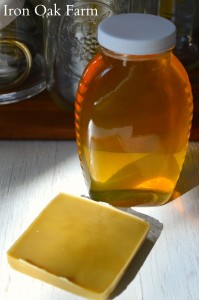
 When people talk about keeping bees it’s all about the honey. And sure, the sweet stuff is delicious, but it’s not the only useful thing that bees create.
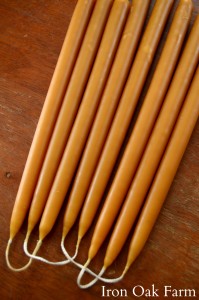 Beeswax is an amazing product. It lends substance to homemade beauty products like deodorant, lotions and lip balm, it provides a protective layer against chapped skin, can restore and protect wood and makes amazing, long, even burning candles.
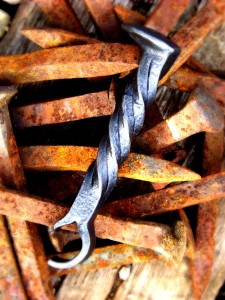 My husband Zach is a blacksmith and uses beeswax to protect his steel items from rust, like this bottle opener. The metal is baked to draw out any moisture and then sealed while hot with pure beeswax and the excess is buffed away with a cotton cloth.
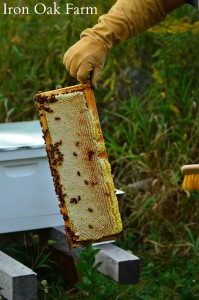 Before we had our own bees, we used to purchase wax from a local supplier to seal Zach’s work. Beeswax can be expensive and rightfully so. For every five pounds of honey harvested a bee keeper can only harvest approximately 1 pound of wax.
 Large wax harvests are better suited for hives kept in the south where the northern winters don’t make it difficult for the bees to regenerate the wax comb. We try to strike a balance leaving some of the wax in our harvest boxes for the bees. The more comb left, the faster your honey will be capped.
But when we do harvest wax, it can be a sticky situation to separate the honey from the wax comb and turn the wax into a usable product.
In 5 simple steps and some equipment from the thrift store, you can easily separate and clean your wax for use in many homemade products. *Caution* Always be careful when working with hot wax!
You will need:
Items designated for wax collection:
a glass baking dish preferably clear
a pot that can melt wax and double as a double boiler
cheesecloth or clean cotton rags
Other items:
A spoon
2 large bowls
Metal sieve
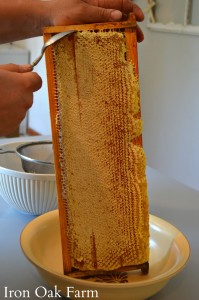
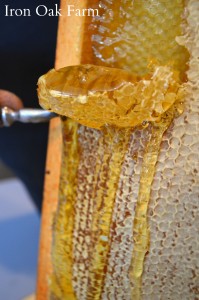 Step 1. Remove the honey and wax from the frame. We don’t have an extractor so we remove the honey and wax with a spoon into a large bowl.
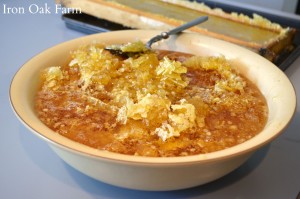
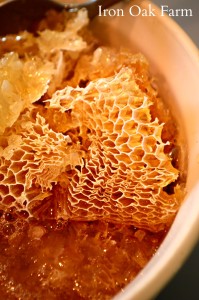
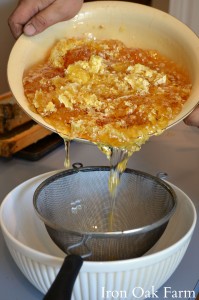 Step 2. Once they frame is fairly clean we use a mesh sieve suspended above a second bowl to drain the honey from the wax. We duct tape the sieve to a tripod and just leave it be for an hour or so. You can mix it up every so often to get more honey off.
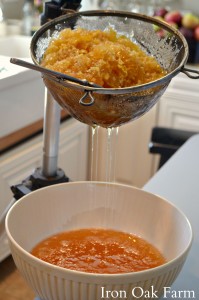
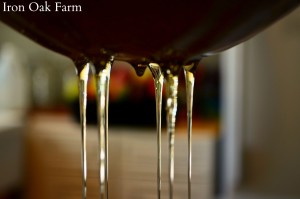
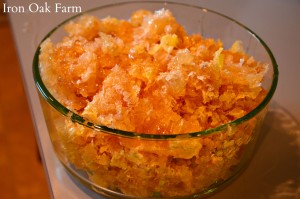 Step 3. Transfer the wax particles to an oven safe baking dish that you can designate to wax collection. Thrift stores sell things very inexpensively. I prefer glass because I can see the wax/honey separation easily (Which will come in the next step.)
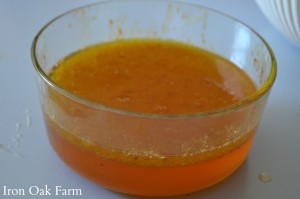 Step 4. Bake the wax until it melts on a low oven, 300 degrees until the wax melts. Remove the dish and let it cool. The wax will harden at the top of the dish and the honey will settle at the bottom.
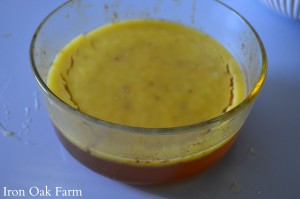
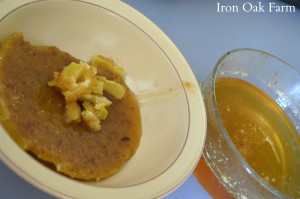 Step 5. At this point the wax will be melted in some points and granulated in others, similar to wet sand. To clean the wax of the sticky honey, scrape the wax off the top of the honey and place it in a pot (designated to honey collection).
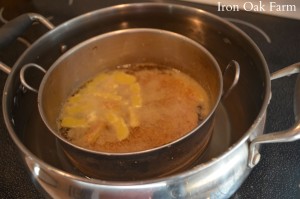 Add an equal (approximately) amount of water to the pot and set in a double boiler system. As the water heats, the wax will melt.
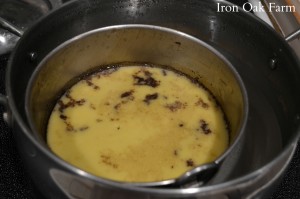 Once the wax is melted, remove from heat and let it cool.
The honey-free wax should form on the top of the water and can be removed in a disk.
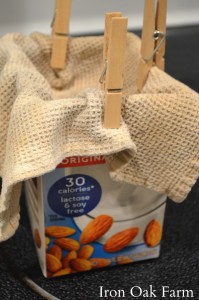 If the wax contains particles of debris, it can be melted again in a double boiler system and drained through several layers of cheese cloth or an old cotton rag.
Notes: For the final pouring, be sure to use a container that has straight sides so the wax can slip out once hardened.
If the wax is being stubborn, place in the freezer for a few minutes. The cold will force the wax to shrink away from the sides.
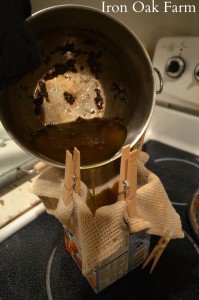 A half gallon milk carton works great for forming your wax blocks.
Once the wax cools, the cardboard can be peeled away, releasing the brick. This is the wax from two frames of honey.





4 Comments
Extractors are cheap, and even easy to make, you save so much wax by using a mechanical extractor, as you mentioned in your article. In the South where we live it is estimated at 15 lbs of honey per pound of wax. We get enough wax from the cappings of the honeycomb to make lip balm, and use for lubrication and preserving handles on our mini farm.
Where can I get more info on marketing beeswax and honey? Thank you.
Extractors are cheap, and even easy to make, you save so much wax by using a mechanical extractor, as you mentioned in your article.
I just extracted 33 lbs of honey and wanted to keep the wax for projects. Your information was detailed and easy to follow.