
 As I write this our golden retriever is barking at a car turning around in the driveway. He’s letting me know that someone is here. I tell him “Good boy,… okay, that’s enough.” and pat his head. Still flustered and huffy, he obeys begrudgingly. He quiets down and lays in his bed, ears pricked and alert, he is still listening for further activity in his yard.
I look at our golden retriever. A 95 pound animal that we’ve welcomed into our home, who sleeps in our bed, and who lives with us as if he was human. I talk to him as if he was one of my kids, and what’s interesting is that my 10 month old has only just begun to understand and respond to our spoken word. In many ways, our dog up until this point, understood more English than our daughter.
Language in the animal world, is fascinating. I think we often view ourselves as the “great communicators” but I wonder if this is only because we are not fluent in the messages that other species are sending? Animals often speak in ways that are too subtle for human recognition. Take the honeybee for example; they speak in pheromones, body language and maybe the most interesting of all…dance.
In dance, bees are able to relay incredible messages. They can communicate, distance, food availability, and direction among other things.
In this post I’d like to talk about the three fascinating dances of the honey bee. The Waggle Dance, the Tremble Dance and the Round Dance.
Waggle Dance
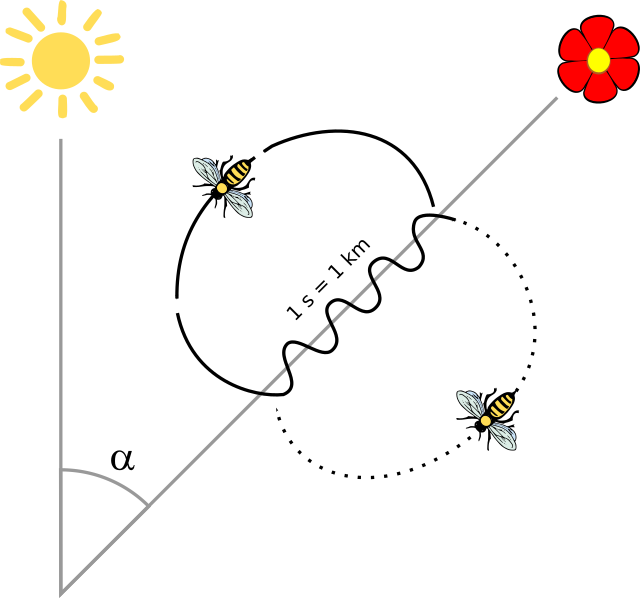 The waggle dance is perhaps the most well known among beekeepers. The dance is done in a figure

By Own work [CC BY-SA 2.5 (http://creativecommons.org/licenses/by-sa/2.5)], via Wikimedia Commons
By using tiny tracking equipment, scientists have been able to study this dance and have learned that the Waggle communicates to other hive mates where there is a good place to find food. It’s believed that the dance communicates what direction the food is, and how far from the hive.
Scientists have discovered that an angle can be calculated using the direction of the figure 8 in relation to the sun. This angle points to the food source.
In addition, it’s said that the amount of vibrations and circles completed tell how far the food is.

By (Figure design: J. Tautz and M. Kleinhenz, Beegroup Würzburg.) [CC BY 2.5 (http://creativecommons.org/licenses/by/2.5)], via Wikimedia Commons
Round Dance
Similar to the Waggle Dance, the Round Dance is a circular dance used by forager bees to let other bees know where food is within closer distances to the hive, under 40 yards.
The Round Dace is circular, but does not display the figure 8 pattern. Instead it is made of tiny loops that change direction periodically. It’s not thought that this dance shows direction.
A foraging bee will return with food, distribute food to it’s hive mates and perform this dance as if to say, “Here’s dinner, and this is where I got it.”
Tremble Dance
This dance can take up to 30 minutes to perform. The bee shakes as she moves in a line across the hive, turning her body 45 degrees every minute or so.
 The tremble dance is used to communicate that more help is needed in receiving returning forager bees. Forager bees collect pollen and nectar and when they return to the hive, they pass on their “groceries” to receiver bees at the entrance of the hive. If more bees are needed to collect at the entrance, the Tremble Dance is performed and new bees will stop what they’re doing and help out.






4 Comments
Want news letter
Signed up for your newsletter. Makes it a little more difficult when the signup section is a white background with white text. But maybe that is a test????
Ray,
Thanks for signing up for our newsletter! We’re sorry that it was difficult. We will look into the colors that are displaying on the page.
Thanks for letting us know!
Keeping Backyard Bees Team
I enjoy the information about bees . I thought that chickens eat bees? If you have them close would they not eat most of the bees they can reach? I am curious about this . Thanks for any information you can give on this .