
It’s like something out of a science fiction movie.
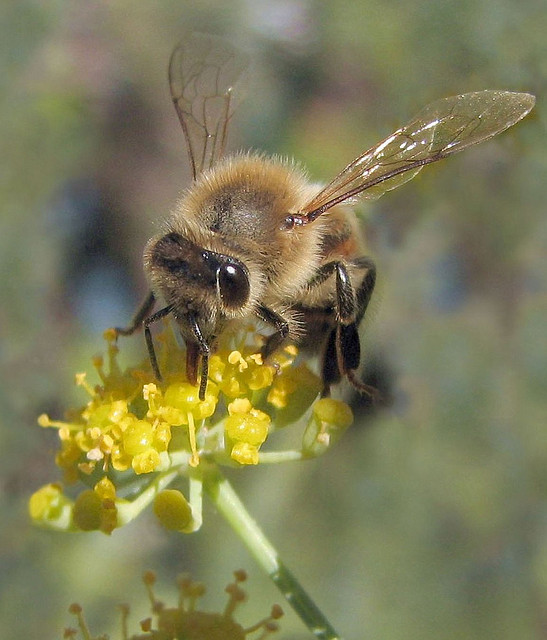
A real bee harvesting nectar. Photo Credit
Robotic bees will save the earth once the honeybees and fellow pollinators become too low in numbers to effectively pollinate crops or become extinct entirely. They could be programmed to crop specifics and fly as swarms to facilitate pollination. They could also be used for spyware, traffic assessment, weather monitoring, hazardous environment exploration, and search and rescue efforts.

Miles of almond crop fields in California rely on honeybees for pollination each year. Photo Credit
This is indeed happening and RoboBees are definitely in our future. In partnerships with Harvard University, Northeastern University, Centeye (a microelectronics company), and the National Science Foundation these RoboBees are pretty amazing and in current development. The goal is to have a small flying robot that can perform the functions of a honeybee while issues like colony collapse disorder, pests, and diseases that threaten the honeybee population are solved.
I met a RoboBee up close and personal this past week at the Museum of Science in Boston, Massachusetts.
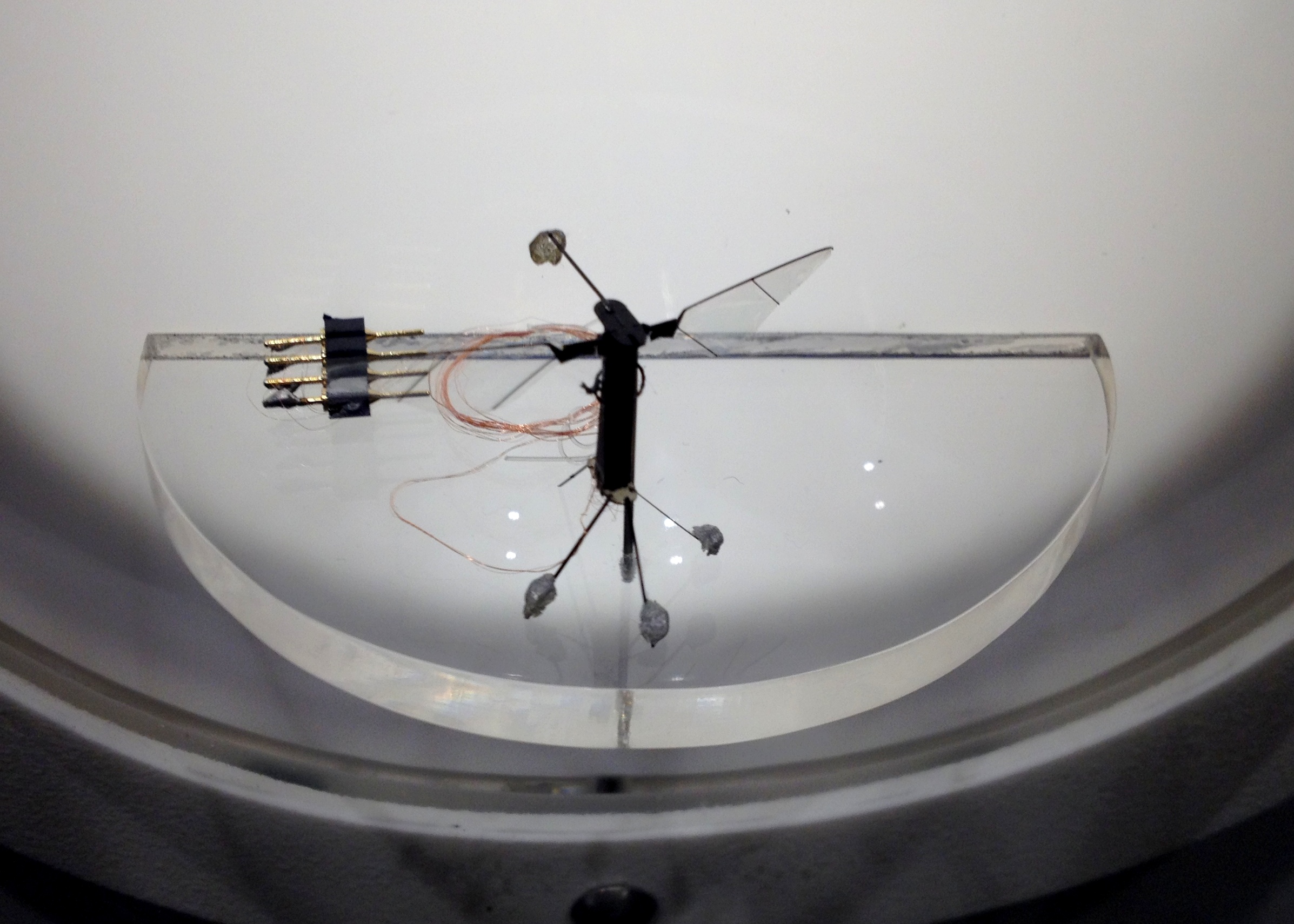
This robotic bees is no larger than the size of a quarter. Photo Credit: Melissa Caughey
It was no larger than the size of a quarter. It had sensors, wings, tripod-like feet and a strange appendage that looked like a long nose. It looked nothing like a honeybee.
Right now, researchers are working on having this bee fly on its own without the tethered electricity cord. Batteries make it too heavy to lift off the ground. As of now it is about ten to fifteen years away from being put into use. It certainly is an interesting idea for honeybee issues that face our planet today.
What do you think of robotic bees?
You can check read more about Melissa’s beekeeping here.
Melissa Caughey is a backyard chicken keeper, beekeeper, gardener, and cook who pens the award winning blog, Tilly’s Nest. She lives on Cape Cod, Massachusetts with her family of four and her Miniature Schnauzer. She regularly writes for HGTV Gardens, Community Chickens, Grit magazine, and contributes to Country Living Magazine. Her blog was recently named one of Better Homes and Gardens Top 10 Gardening Blogs. Melissa’s first book, A Kid’s Guide to Keeping Chickens, will be available spring 2015.






12 Comments
Oh Great! Canned honey, canned propolis, canned royal jelly, and ready made wax candles in the near future.
This is another gigantic waste of funds where the means does not justify the end; all for the basic reason of only resolving symptoms of the basic problem and not the problem itself.
What honey? What propolis? What royal jelly? What beeswax candles? Say goodbye to all of it because none of these will be made without the honeybee. Beeswax is produced by a honeybee’s body. Nectar must be consumed and regurgitated to form honey and bees formulate royal jelly. The only thing that the robotic bees will do is pollinate. The only PERFECT food will cease to exist, man may be able to duplicate the flavor and odor, but he cannot replicate real raw honey!
I can’t think of anything more lunatic that believing it’s ok to kill our natural bees with pesticides because they can be replaced with robotic bees that can pollinate the plants…..oh yeah…..and SPY on you at the same time!! What a deal!!
I wonder what robotic bee honey tastes like??
How do I feel about robotic bees? They are machines, eventually these machines will do their job. But, I cannot relate to them like I would relate to a living insect. I love watching bees pollinate. If you want to help bees, search for the Xerces Society, Pollinator Program. Basically, Xerces is asking people and other organizations to plant more pollinator friendly plants into the landscape. And, to refrain from using pesticides and herbicides.
None of that will matter if we don’t do something to get rid of GMO plants. The insecticide genes that are put in any flowering plant will be found in every part of the plant, including the pollen and nectar. Bees do not know that these plants contain insect poison and carry it back to the hive which helps to wipe out the entire hive!
I hope to God we never have to use RoboBees.
If we don’t have the bee problem resolved in 10 years, these are not going to save us. Consider how long our tech is in use before it actually functions without restarts. Every electromagnetic field produced by power poles with interfere with this delicate construction, even if they can manage to power it by the sun.
Absolutely maddening! It does nothing to address the problems we are creating, and we (and bees) are facing.
I suspect the purpose of the robotic bee is to solely pollinate. I can’t imagine it would be able to collect, consolidate and process nectar into honey.
And expect a beeswax shortage.
The power issue could be handled by solar cells. It could be programmed to park itself at a certain diminishing light output, and reactivate the following day.
As for spying, I’ll bet a badminton racket might get its attention.
Robotic bees, what’s the next thing we replace in nature. Instead of taking care of our environment, we are spending millions of dollars finding ways to survive after we destroy in. We need a healthier world not a robotic world. Shame on those that worked on this project, you are just pretreating our demise. Our planet and the beings that live on it are not disposable.
Just reviewed the article about ROBOTIC-Bees… Scary! Bad enough that the GMO crops/Spraying are the reason we HAVE the decline issue with the bees….. at least we KNOW when there is a concern with LIVE BEES as they tell us by DYING when there is a problem with our FOOD SOURCE……. can you say MONSANTO??!! Don’t believe me? Google it and what FRANCE did when they were faced with the SAME issues with BAYER and the Pesticide/GMO problems… Over TEN years ago… Sorry thing is our CONGRESS is funded by MONSANTO and the FDA is full of Ex-Monsanto staff….. follow the money people…sad! Share if you Care!!!
I couldn’t agree more…with the other comments that is! What a ludicrous project to spend ridiculous amounts of money to replace (not to mention that impossibility) the honey bee and not realize that their demise will herald the imminent danger of humans following them! I am forever stunned by the arrogance of mankind and this article is about yet another classic example. As a Christian, I have to wonder what will happen when they are asked for an accounting of their contribution to humanity when they reach their reward.