
Thirty or so years ago, beekeepers could be relied upon to inspect their hives for problems, make a diagnosis and take action. Today, it’s a little more complicated with so many new diseases and problems. Many of these conditions exist due to improper management of the hive by the beekeeper, so do your epidemiology homework and build your understanding of common bee diseases and treatments.
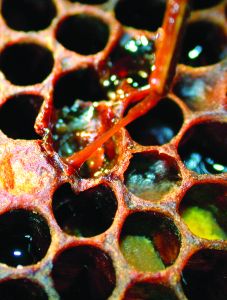
Honeybee larvae infected with American Foulbrood becomes a putrid mess. Courtesy Agricultural Research service/Virginia Williams
American Foulbrood. One of the most significant diseases, caused by a spore-forming bacterium, AFB attacks older larvae and pupae. Signs include perforated brood cappings and pupal cells that “rope out” and adhere to a stick when poked. Treatment involves burning infected hives and antibiotics.
European Foulbrood. Caused by a different bacterium than AFB, this disease usually occurs due to stressful conditions in the hive: queenlessness, attacks by pests, and bad management by the beekeeper. Diagnosis can only be performed under a microscope, but perforated cappings are not present. Treatment includes requeening and antibiotics.
Chalkbrood. Caused by a fungus and related to stress, chalkbrood occurs in spring, but is sporadic and usually found in low levels in colonies. Symptoms include larvae appearing as pieces of chalk – white to green “mummies” that are found near the entrance. While there is no known treatment for chalkbrood, proper ventilation of hives to avoid moisture is a good preventive measure; requeening and comb replacement also are known to help.
Nosema. Caused by a spore-forming microsporidian parasite of the adult’s digestive system, nosema results in the affected bee being unable to absorb nutrients. The parasite also may activate viruses. (See “Teaming Up …” on the previous page.) Symptoms are not readily apparent but include K-wings (wings that protrude out from the body, unable to fold correctly) and dysentery. Treatment includes the antibiotic fumagillin, though this has risks and may be hard on the bees.
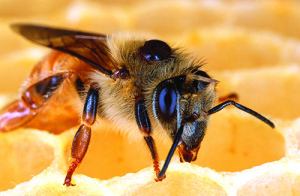
A deadly parasite, the varroa mite attaches itself between the wings of a honey bee. Courtesy Agricultural Research Service/Scott Bauer
Tracheal Mites. The Ascarapis woodi takes up residence in the honey bee’s breathing apparatus. The mites are not visible to the naked eye, and therefore diagnosis can be made only upon dissection. Symptoms include K-wings, bees unable to fly, and bees crawling around the hive entrance. Treatment includes menthol and grease patties in late summer and early fall.
Varroa Mites. Varroa are permanent residents of the hive and are responsible for large-scale colony loss since 1987. Understanding the varroa problem is not an easy one, and much can be learned from books and websites. However, the most important thing to note is that the levels of varroa must be monitored closely and treated if numbers pass acceptable thresholds. Luckily, varroa can be seen with the naked eye, so there are several methods of monitoring their numbers. Treatments include hard pesticides, essential oils, and formic and oxalic acids.
— Karen Keb






4 Comments
I have small hive beetles. I live in MN and have lost both my hives. I know they are not native to MN and assume they came either from my bees I ordered from Georgia or from a bee apiary that winters in Texas that is not to far from me. How do I clean/prepare for next year? Do I need to be concerned about them lasting the winter her in my oats or other grain by chance?
There are some great information in this article but wish you would have more pictures so that I can do some comparing and hives
I have medium sized ants going around and inside the very bottom of the hive. They are hauling out the bodies of the dead bees to eat. Do I need to worry about this or should I try to keep them out of the hive all together?
I love reading all of your articles that you post. I am new to bee Keeping and I am trying to learn all that I can. I especially liked the one about what you can learn from just watching them. I have an auto flow hive so I am more of a bee “haver” than a “keeper”. I like the idea of being less invasive is better for the hive, I just worry that something bad is happening that I could have prevented if I was more hands on with my “having”. I would appreciate any help that you can give me. Thanks, Tom G.
I suppose ants eat debris and bees could be part of the ecosystem of rotting stuff. I have not experienced this. If the bees aren’t trying to sting them, they are probably doing no harm. I’d want to open up the hive and see if the ants have built some kind of nest inside. We usually see ants between the inner and telescoping cover but occasionally on the bottom board. But they are only tiny ants.
If they had built a nest, I would scrape it out.
-Ol’ Bee Gal